Compromises by the Big Three at Versailles
Terms of the Treaty of Versailles
Terms of the Treaty of Versailles
The Military Terms of the Treaty of Versailles
Article Number | Description of Term | Impact on Germany |
|---|---|---|
42 | The Rhineland (an area in Western Germany that bordered France) became demilitarised. Allied troops were stationed there until 1930 | Germany was not allowed to have soldiers in the Rhineland. This made them vulnerable to an invasion from France |
160 | Germany’s army was restricted to 100,000 men | Many ex-soldiers became unemployed |
181 | Germany’s navy was restricted to six battleships and could not have submarines | Germany became weaker. They could not develop the military technology that other countries had |
198 | Germany was not allowed to have an air force |
The Territorial Terms of the Treaty of Versailles
Article Number | Description of Term | Impact on Germany |
|---|---|---|
45 | France was given the area of the Saar, with its coalfields, for 15 years | Germany lost 15% of their coal resources. This affected their economy |
51 | Alsace-Lorraine became a part of France again | Germany did not have a buffer between themselves and France any more |
80 | Anschluss (the union between Germany and Austria) was forbidden | Austria was a part of Germany’s cultural identity. Many Austrians considered themselves to be German |
87 | Germany lost Posen and West Prussia, which allowed the Allies to create a ‘Polish Corridor’. This gave Poland access to the sea | The ‘Polish Corridor’ divided Germany into two. Roughly one million Germans came under Polish rule |
119 | France and Britain ruled all 11 of Germany’s colonies in Africa and the Far East as mandates | Germany’s reputation as a global power was destroyed. They had fewer items to trade with other countries |
The Political and Economic Terms of the Treaty of Versailles
Article Number | Description of Term | Impact on Germany |
|---|---|---|
1-26 | The League of Nations was created, but Germany was not allowed to join | Germany felt excluded from world politics. They were more likely to resort to violence to resolve disputes |
231 | The ‘War Guilt’ Clause. Germany had to agree that they started the First World War. The clause made Germany accept responsibility for the deaths and destruction during wartime | This clause created the most anger among the German population. They felt it was unfair to take all of the blame for the atrocities caused by the First World War |
232 | Germany would have to pay the Allies reparations as a condition of their surrender. The amount was set at 132 billion gold marks (£6.6 billion). Germany had until 1980 to pay the debt | This amount would be enough to bankrupt Germany, especially as the territorial terms reduced their ability to trade |
The Compromises Made by the Big Three
The Compromises Made by the Big Three
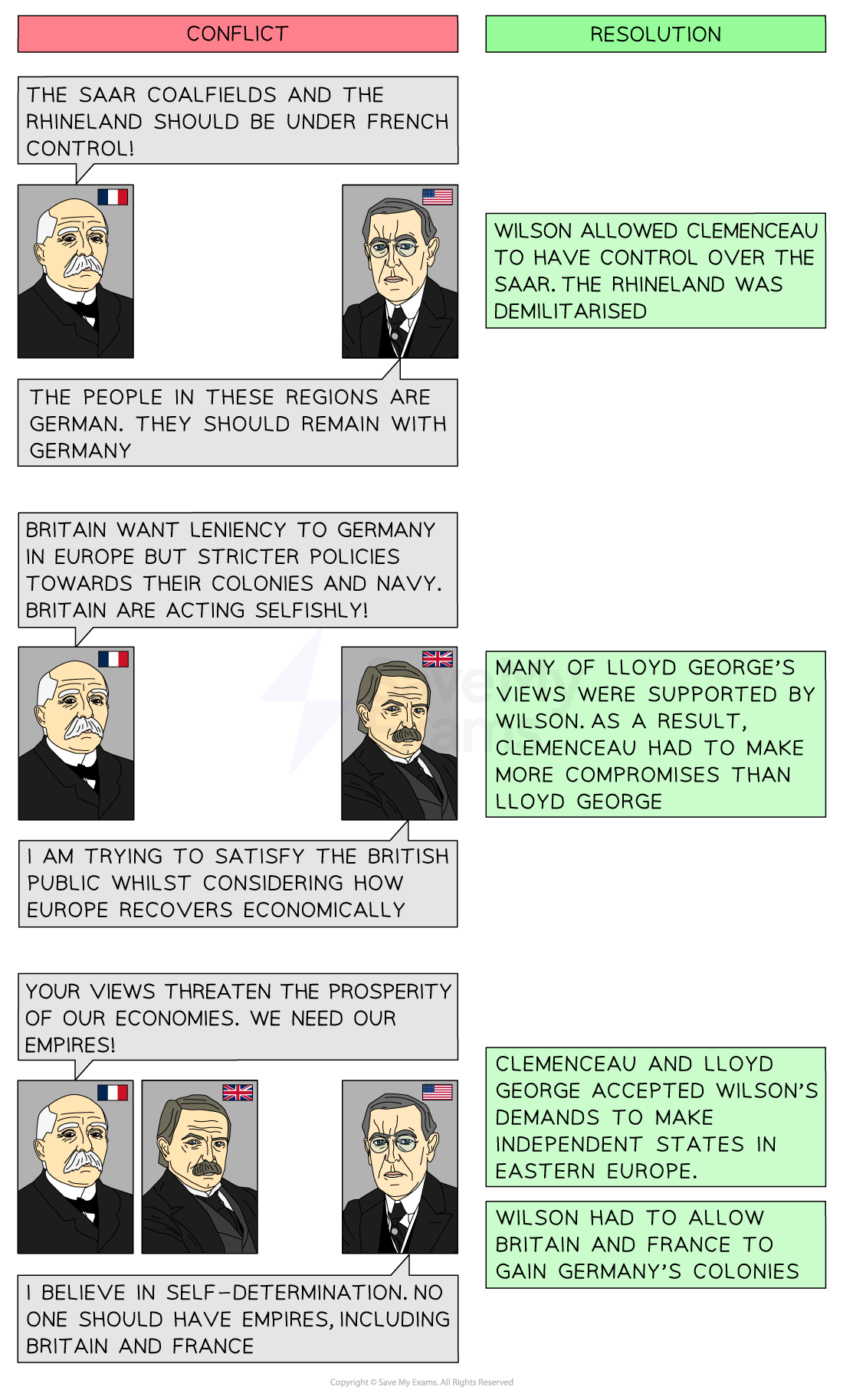
Areas of Compromise Between the Big Three
Clemenceau | Wilson | Lloyd George | |
|---|---|---|---|
Military compromises | Did not believe that the treaty restricted Germany’s army enough | Britain’s naval supremacy meant that Wilson abandoned the idea of free navigation of the seas | |
Territorial compromises | The Rhineland was not given to France. The Allies demilitarised the area | Forced to allow Britain and France to increase their empires | Reluctantly agreed to the independence of Eastern European nations like Latvia and Bulgaria |
Political and economic compromises | Wanted to set the reparation payments higher | Germany was not allowed to join the League of Nations | Worried about the reactions of Germans under the control of France and Poland |
Why did the Big Three Have to Compromise?
Why Did the Big Three Have to Compromise?
No leader could achieve everything they wanted from the Treaty of Versailles because:
Each leader of the Big Three had different aims and motives
Each leader had different public pressure
Britain and France suffered a large amount of casualties during the First World War
Lloyd George had won the 1918 election on the campaign to ‘make Germany pay’
Over two-thirds of the French Army died or were wounded in the First World War. The French wanted to impose severe punishment on Germany
The USA did not want revenge on Germany because they had not suffered as much in the First World War
They joined the war in 1917, much later than the other Allied countries
No fighting occurred on US soil
The USA suffered less in terms of casualties
Before entering the First World War, the USA gave loans to Allied countries
At the end of the conflict, the USA began to recall its loans
The repayments made the US economy boom