StudyDeck

Justification for the Treaty of Versailles

Exam code: 2147
Written by: Ashika|Reviewed by: Caroline Carroll|Updated 2 July 2026

The Post-War Treaties

The Post-War Treaties

  • Four other treaties created the Versailles Settlement. These are:

    • The Treaty of St Germain

    • The Treaty of Neuilly

    • The Treaty of Trianon

    • The Treaty of Sevres

  • Representatives of each country were forced to sign the treaty

The Treaty of St Germain

Date

Format

Terms

Impacts

September 1919

The Allies' dictated peace treaty with Austria

  • Ending of the Austro-Hungarian empire

  • Loss of land to Hungary, Czechoslovakia and Yugoslavia

  • Anschluss with Germany forbidden

  • Austria limited to 30,000 troops

  • Reparations 

  • Accept blame for starting the First World War

  • Recognition of the League of Nations

  • Land given to Czechoslovakia housed most of Austria’s industry

  • Austria experienced a financial crisis in 1921

  • Never paid reparations

  • The small states created from the old  Austro-Hungarian empire caused conflict and instability in Eastern and Central Europe

The Treaty of Neuilly

Date

Format

Terms

Impacts

November 1919

The Allies' dictated peace treaty with Bulgaria

  • Loss of land to Yugoslavia, Greece and Romania

  • Recognise the existence of the Kingdom of Serbs, Croats and Slovenes

  • Bulgaria limited to 20,000 troops

  • Reparations set at £100 million

  • Accept blame for starting the First World War

  • Recognition of the League of Nations

  • Loss of access to the Aegean Sea

  • The Allies cancelled 75% of Bulgaria’s reparation bill

  • Bulgaria continued to claim their right to Macedonia

  • Continued unrest in the Balkans

The Treaty of Trianon

Date

Format

Terms

Impacts

June 1920

The Allies' dictated peace treaty with Hungary

  • Ending of the Austro-Hungarian empire

  • Loss of two-thirds of its land and a third of its population

  • Hungary limited to 35,000 troops

  • Reparations

  • Accept blame for starting the First World War

  • Recognition of the League of Nations

  • The collapse of its economy, which resulted in not paying reparations

  • The treaty forced many ethnic Hungarians, called Magyars, out of Hungary

  • Conflict within Hungary during the 1920s

The Treaty of Sevres

Date

Format

Terms

Impacts

August 1920

The Allies' dictated peace treaty with Ottoman Türkiye (Turkey)

  • Ending of the Ottoman Empire

  • Britain and France to take control of land in the Middle East

  • Loss of control of the Dardanelles Strait, an important waterway

  • Türkiye limited to 50,000 troops

  • Allied control of Türkiye’s tax system and budget

  • Reparations

  • Accept blame for starting the First World War

  • Recognition of the League of Nations

  • The people of Türkiye threatened to overthrow the government

  • The Allies negotiated a new treaty with Türkiye in 1923 called the Treaty of Lausanne

  • The new treaty gave Türkiye 

    • Land back in Europe

    • Control of the Dardanelles Strait

    • No reparations or restrictions of the army

Impact of the peace treaties of 1919-1920

Key Opinions on the Treaty of Versailles

Key Opinions on the Treaty of Versailles
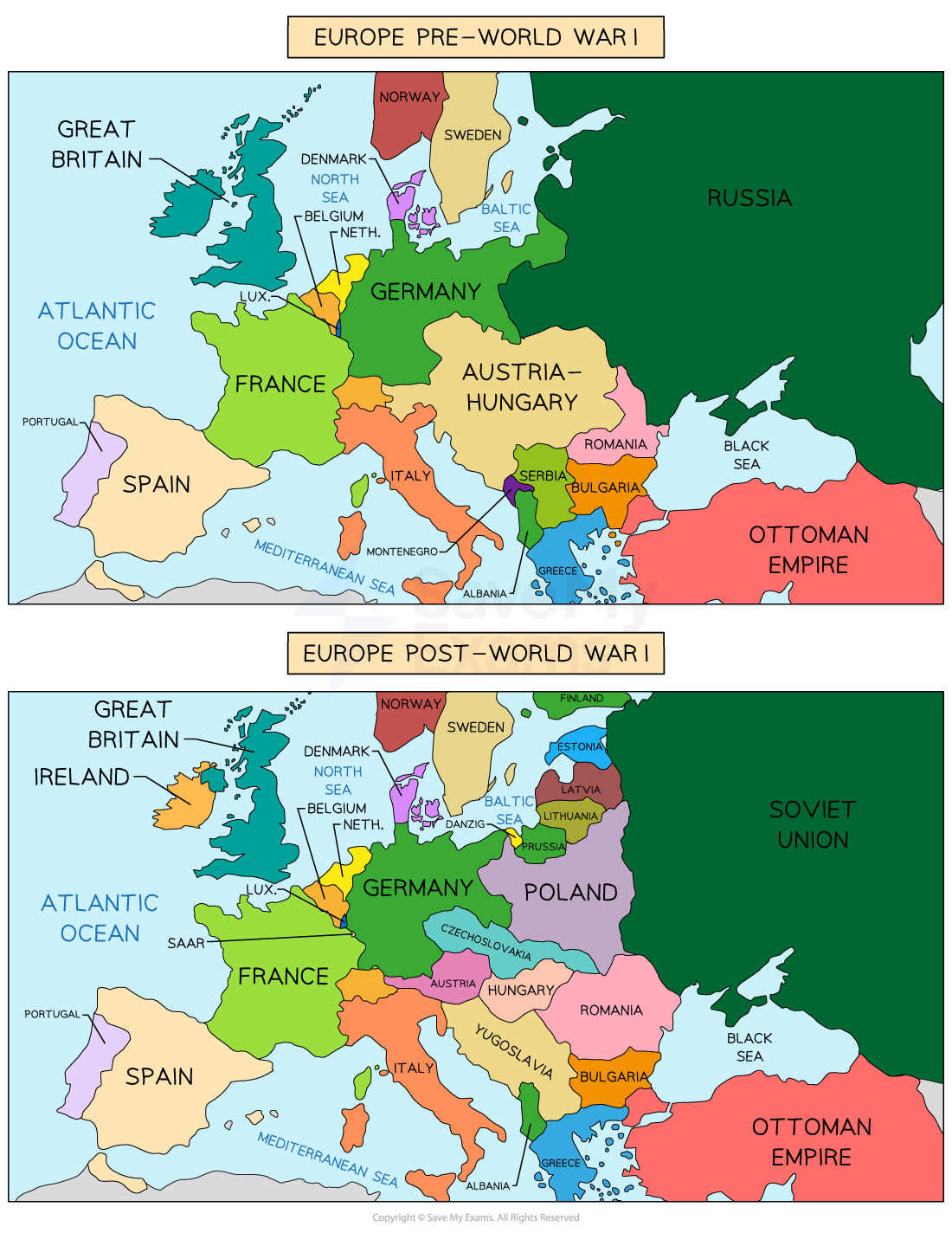
A pair of coloured maps titled "Europe Pre–World War I" (top) and "Europe Post–World War I" (bottom), showing changes in national borders.

In the top map (Pre-WWI), large countries like Germany, Austria-Hungary, Russia, and the Ottoman Empire dominate central and eastern Europe. Ireland is part of Great Britain, and Poland, Czechoslovakia, and Yugoslavia do not yet exist.

In the bottom map (Post-WWI), Europe is divided into more countries. Austria-Hungary is split into Austria, Hungary, Czechoslovakia, and Yugoslavia. Poland, Estonia, Latvia, and Lithuania appear as new independent countries. Russia becomes the Soviet Union, and Ireland is shown as separate from Great Britain. The Saar region is separated from Germany.
A map showing how the postwar treaties affected Europe

The Treaty of Versailles can be justified

The Treaty of Versailles cannot be justified

Some journalists in Britain insisted that Germany could afford the reparations

Due to economic crashes, Austria’s and Hungary’s reparations were cancelled. When Germany’s economy collapsed, the Allies reduced but did not stop reparations

The French claimed that Germany’s diktat on Russia in 1917, the Treaty of Brest-Litovsk, was much harsher than the Treaty of Versailles

The Treaty of Lausanne undermined the Treaty of Versailles. It indicated that the Allied politicians knew the Versailles Settlement was unfair

Marshal Foch, the French commander of the Allied forces, stated that the treaty did not protect France from invasion

Some British politicians and journalists believed that the treaty’s terms would cause Germany to start another world war

Some politicians in the USA believed the treaty was the best solution, given the political context in 1919

The Allies had different motives and aims. They were more interested in achieving their own aims rather than creating a fair treaty

Some people in Britain and France thought that the treaty was too lenient. As long as Germany existed as a country, they were still a threat to world peace

Forcing Germans to live under foreign rule and its exclusion from the League of Nations isolated Germany. This increased support for extremist groups in Germany

Contemporary Opinions of the Treaty of Versailles
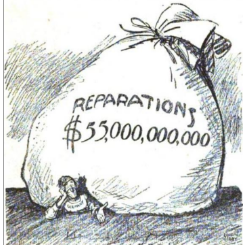
A person is crushed under a massive bag labelled "REPARATIONS $55,000,000,000," symbolising the burden of large financial reparations.
A cartoon published in a US newspaper, 1921. Germany is saying, ‘Let’s see you collect it.’
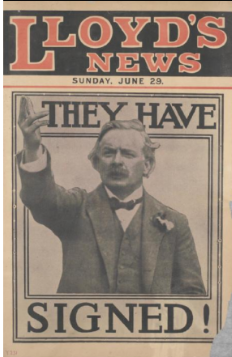
Vintage newspaper front page of "Lloyd's News" with a headline "THEY HAVE SIGNED!" featuring a man gesturing, dated Sunday, June 29.
Placard for Lloyd's News on 29th June 1919. It is announcing the signing of the Treaty of Versailles

“If we aim at the impoverishment of Central Europe, vengeance, I dare say, will not limp. Nothing can then delay for very long the forces of Reaction and the despairing convulsions of Revolution, before which the horrors of the later German war will fade into nothing, and which will destroy, whoever is victor, the civilisation and the progress of our generation.”

A quote from the British economist John Maynard Keynes in The Economic Consequences of the Peace (1919)