StudyDeck

Consequences of the Berlin Blockade

Exam code: 2147
Written by: Ashika|Reviewed by: Caroline Carroll|Updated 2 July 2026

Why did the USSR Begin the Berlin Blockade?

Why Did the USSR Begin the Berlin Blockade?

  • The Potsdam Conference agreed to split Berlin into two parts:

    • The USA, Britain and France occupied the western zone

    • The USSR occupied the eastern zone

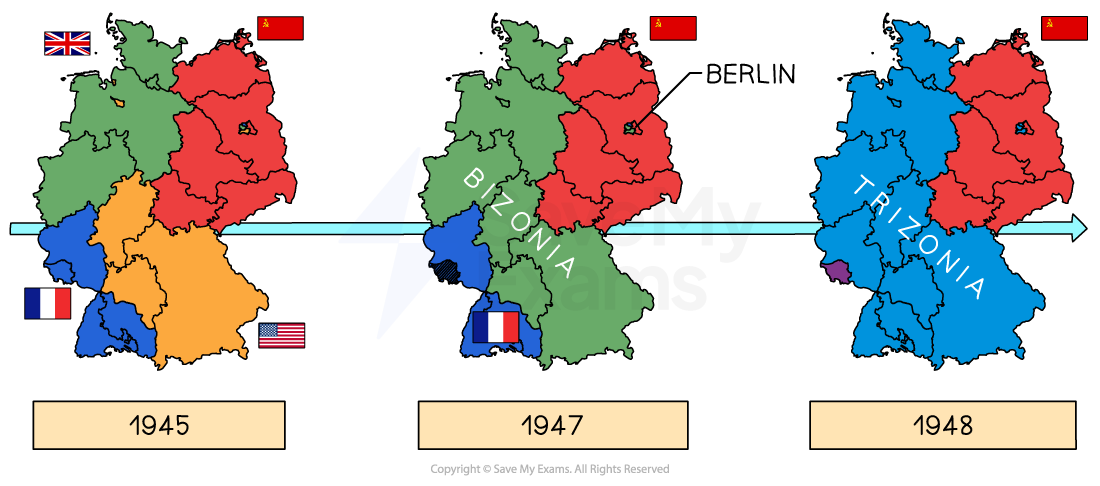
Three maps showing the division of Germany after World War II:

1945: Germany is split into four occupation zones — British (green), Soviet (red), American (orange), and French (blue).

1947: British and American zones merge to form Bizonia (green), while the Soviet zone remains separate.

1948: French zone joins Bizonia to form Trizonia (blue), showing clear division between Western and Soviet-controlled areas, with the Soviet zone unchanged in red.
How was Berlin divided from 1945 to 1948?
  • Trizonia introduced the Deutschmark in June 1948

    • This was the breaking point for Stalin
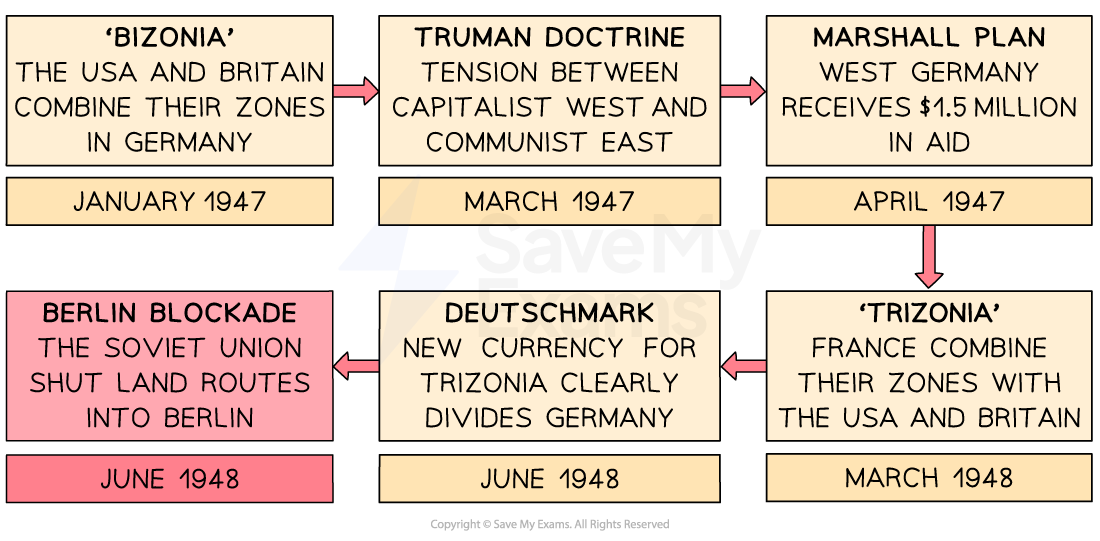
A chronological diagram showing key steps that increased East–West tension:

January 1947: ‘Bizonia’ formed – the USA and Britain merge their German zones.

March 1947: Truman Doctrine announced – formalises opposition to communism.

April 1947: Marshall Plan – $1.5 million in aid pledged to West Germany.

March 1948: ‘Trizonia’ – France joins Bizonia, uniting Western zones.

June 1948: Deutschmark introduced in Trizonia, deepening the East–West divide.

June 1948: Berlin Blockade – USSR shuts land routes into Berlin in protest.
Causes of the Berlin Blockade
  • The USSR believed that the Western powers had no right to Berlin

    • Berlin fell within East Germany

    • Trizonia threatened the power of the USSR in Germany

      • The Deutschmark split Berlin into two different economic zones

        • Capitalist Trizonia had a better economy

        • This would make the USSR look weak

  • By 1948, Stalin decided that blockading Berlin would force the West out of Berlin
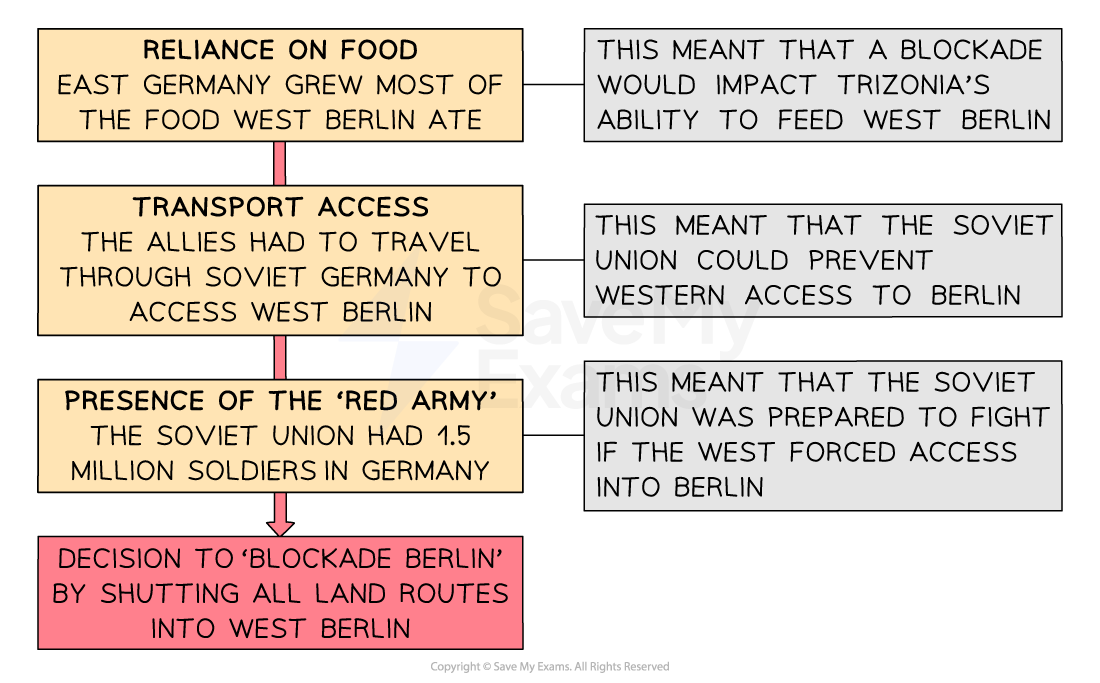
A cause-and-consequence flowchart explaining why the USSR blockaded West Berlin:

Reliance on Food: West Berlin depended on East Germany for food.
→ A blockade would threaten Trizonia’s ability to supply food.

Transport Access: Western Allies had to cross Soviet-controlled Germany to reach West Berlin.
→ USSR could cut off Western access.

Red Army Presence: 1.5 million Soviet troops were stationed in Germany.
→ USSR was militarily positioned to resist Western pressure.
Why did the USSR decide to blockade Berlin?

How did the USSR Blockade Berlin

How Did the USSR Blockade Berlin?

  • The USSR could control access to Berlin

    • It was deep inside the Soviet-occupied zone

    • Trizonia only had two agreed land routes and two air routes to West Berlin

  • In June 1948, the USSR closed road, rail and canal links across Soviet-controlled Germany 

  • Without the support of the USA, Britain and France, West Berlin

    • Only had enough food for 36 days

    • Lacked important resources like fuel and medicine

  • Stalin wanted to control the whole of Berlin

    • It was the capital city of Germany

    • The USSR could spread Communist ideas

    • Stalin would gain a propaganda victory

      • He could present the capture of Berlin as a triumph of Communism over capitalism

How did the West React to the Blockade?

 How Did the West React to the Blockade?

  • The USA, Britain and France were in a challenging position after the announcement of the blockade in June 1948

    • The West risked war if they attempted to break the blockade

    • Doing nothing would give Berlin to the USSR

    • Without the support of the West, West Berlin would quickly run out of food, fuel and medical supplies

  • They had three options to respond to the blockade:
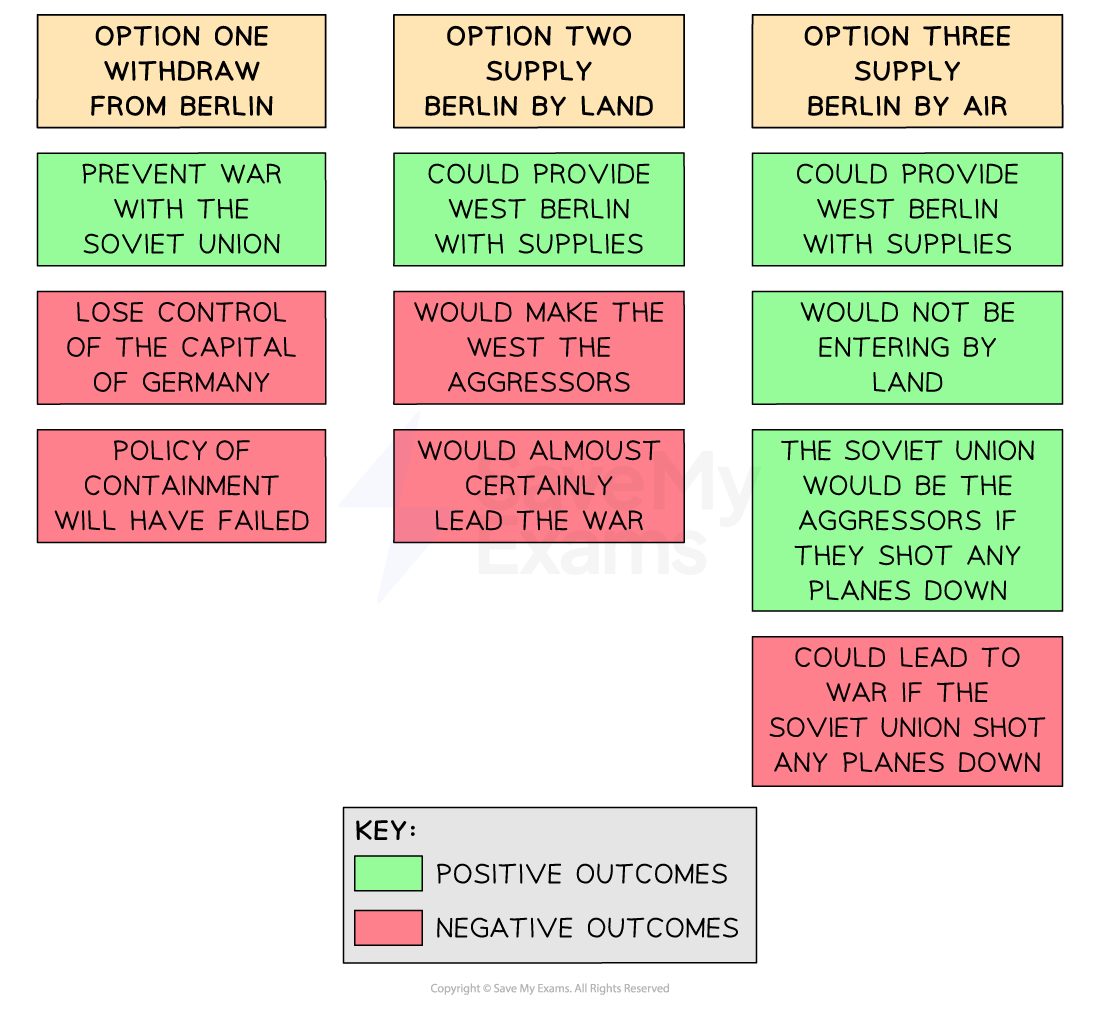
A decision matrix with three response options considered by the West:

Option One: Withdraw from Berlin

Prevents war with USSR
− Loses control of Germany’s capital
− Signals failure of containment

Option Two: Supply Berlin by Land

Could provide supplies
− Makes West the aggressors
− Likely to lead to war

Option Three: Supply Berlin by Air

Could provide supplies

Avoids entering by land

USSR would appear aggressive if they shot planes down
− Still risked war if USSR attacked planes

Key at bottom: green = positive outcomes, red = negative outcomes.
How could the West respond to the Berlin Blockade?

What was the Berlin Airlift?

What was the Berlin Airlift?

  • In June 1948, the West decided to fly supplies into Berlin. This was a clever tactic because

    • It was not an aggressive action

    • The USSR would start a war if they shot any planes down

  • From June 1948 to May 1949, the Berlin Airlift (codename Operation Vittles) flew vital supplies to West Berlin
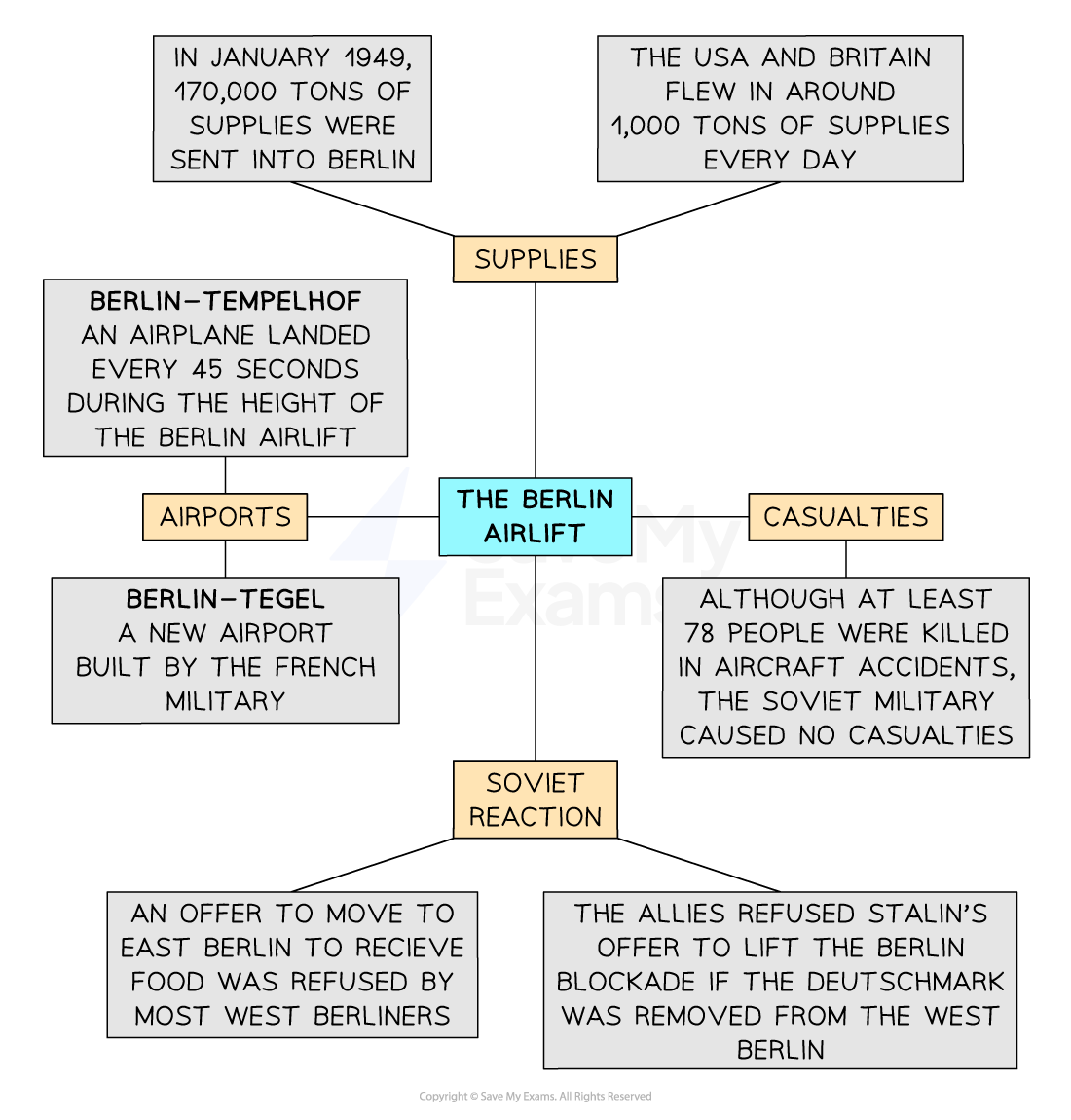
Central label: The Berlin Airlift with four surrounding categories:

Supplies
– In January 1949, 170,000 tons of supplies were sent into Berlin
– USA and Britain flew in about 1,000 tons per day

Airports
– Berlin–Tempelhof: a plane landed every 45 seconds at the peak
– Berlin–Tegel: a new airport built by the French military

Casualties
– At least 78 people were killed in air accidents, but the Soviet military caused no casualties

Soviet Reaction
– Offer to West Berliners to move east for food was mostly refused
– Stalin offered to lift blockade if Deutschmark was withdrawn, but Allies refused
What happened during the Berlin Airlift?

The Impact of the Berlin Crisis

The Impact of the Berlin Crisis

  • The Berlin Airlift had negative impacts on Stalin

    • He could not stop the airlift

      • Shooting down planes carrying supplies would lead to war

    • It humiliated the USSR

      • By doing nothing, the USSR looked weak

  • On 12th May 1949, the USSR lifted the Berlin Blockade

    • The Western Allies continued to fly in supplies until 30th September 1949

  • The Berlin Airlift was a massive victory for the West over the East

    • This worsened tension between the two ‘superpowers’

  • Several key events happened partly as a result of the Berlin Crisis:
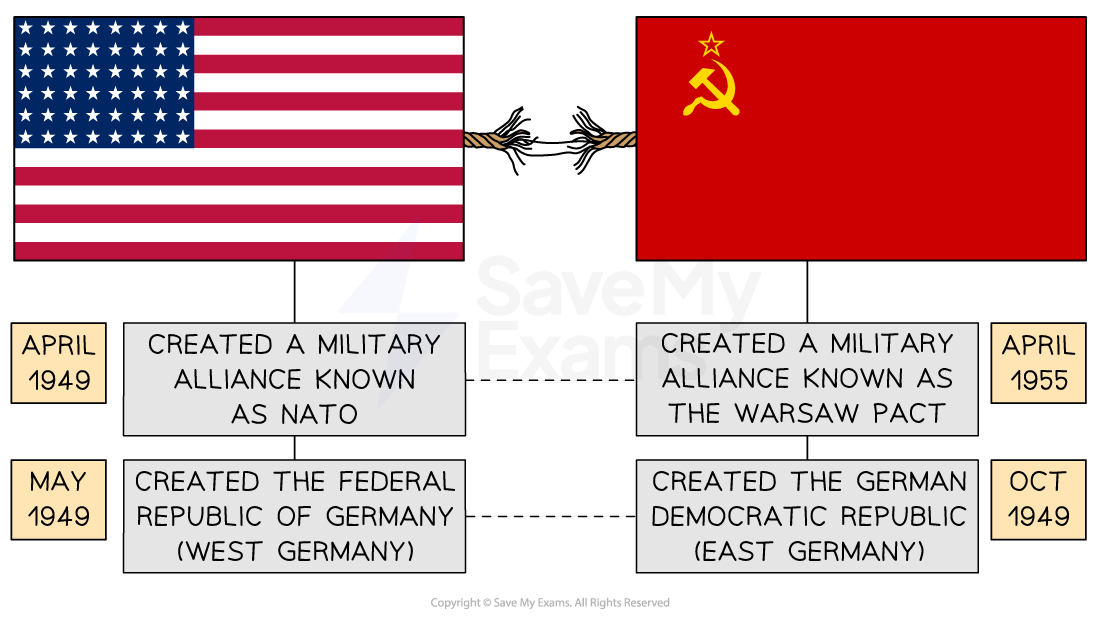
The image shows a divided diagram with the USA on the left and the Soviet Union on the right, linked by a fraying rope to represent increasing Cold War tensions.

USA side:

April 1949: Created NATO (a military alliance)

May 1949: Formed the Federal Republic of Germany (West Germany)

Soviet Union side:

October 1949: Formed the German Democratic Republic (East Germany)

April 1955: Created the Warsaw Pact (a military alliance)
What was the impact of the Berlin Crisis?