Motives & Aims of the Big Three at Versailles
Who were the Big Three?
Who were the Big Three?
The armistice only ensured temporary peace
There needed to be an official peace document where the Allies agreed on the terms of the Central Powers of Germany, Austria-Hungary, Türkiye and Bulgaria’s defeat
Discussions began in January 1919 at the Palace of Versailles, Paris
The meeting is called the Paris Peace Conference
The meeting aimed to create five peace treaties called the Versailles Settlement. The biggest treaty was the Treaty of Versailles, which dealt with Germany
The ‘Big Three’ negotiated the terms of the treaty. These were:
Georges Clemenceau (Prime Minister of France)
Woodrow Wilson (President of the USA)
David Lloyd George (Prime Minister of Great Britain)
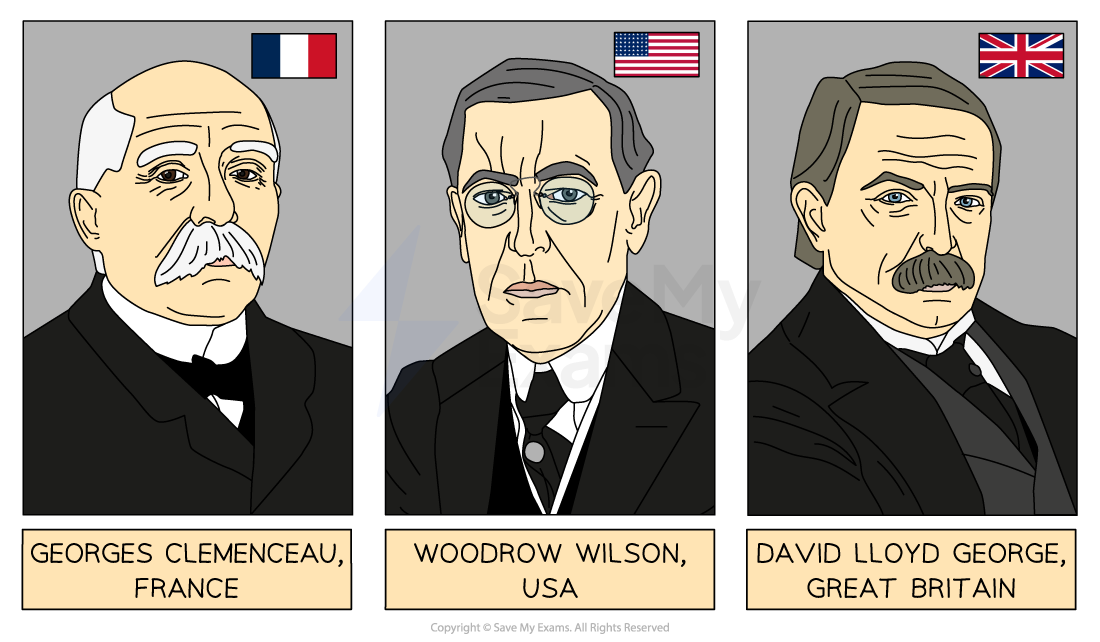
Motives of the Big Three
Motives of the Big Three
Georges Clemenceau’s Motives
Clemenceau saw the Paris Peace Conference as an opportunity to gain territory back
France and Germany had fought twice during the 19th century
Germany had taken key areas from France including the region of Alsace-Lorraine
France feared future invasion from Germany
Germany and France shared a border
Clemenceau wanted to limit Germany’s military strength
Clemenceau was angry and uncompromising
The majority of the Western Front was in France
The fighting had destroyed many roads, hospitals and factories
Clemenceau wanted Germany to pay to repair these damages and take responsibility for starting the war
Woodrow Wilson’s Motives
Wilson was an idealist. He wanted to create a lasting peace after the First World War
The Versailles Settlement should embody what he called the ‘14 Points’. Some of his 14 Points were that:
All national groups should have their own country. This is called self-determination
All countries should follow a policy of disarmament to avoid war in the future
All countries should discuss their issues openly and not sign secret treaties
All countries should remove trade tariffs and cooperate economically
Wilson pictured a new organisation called the League of Nations
This League encouraged countries to communicate their problems rather than use violence and war
Wilson wanted all countries to join the League of Nations
It would support the implementation of Wilson’s 14 Points
Wilson wanted to trade with Germany
Large reparations would make Germany weak and could lead to its collapse as a country
A strong, economically secure Germany would help rebuild Europe after the First World War
David Lloyd George’s Motives
Lloyd George was realistic and agreed with aspects of France’s and the USA’s motives
Britain had experienced high casualties like France
The British public hated Germany and wanted revenge
Lloyd George understood some of Clemenceau’s personal anger towards Germany
Before the start of the First World War, Germany had challenged Britain’s naval power
From 1884 onwards, Germany had expanded its empire. Britain wanted to have the strongest and biggest empire in the world
Britain also supported Wilson’s point that a strong Germany was better for European economies
A prosperous Germany would want to trade with Britain and buy its imperial goods
Aims for the Treaty of Versailles
Aims for the Treaty of Versailles
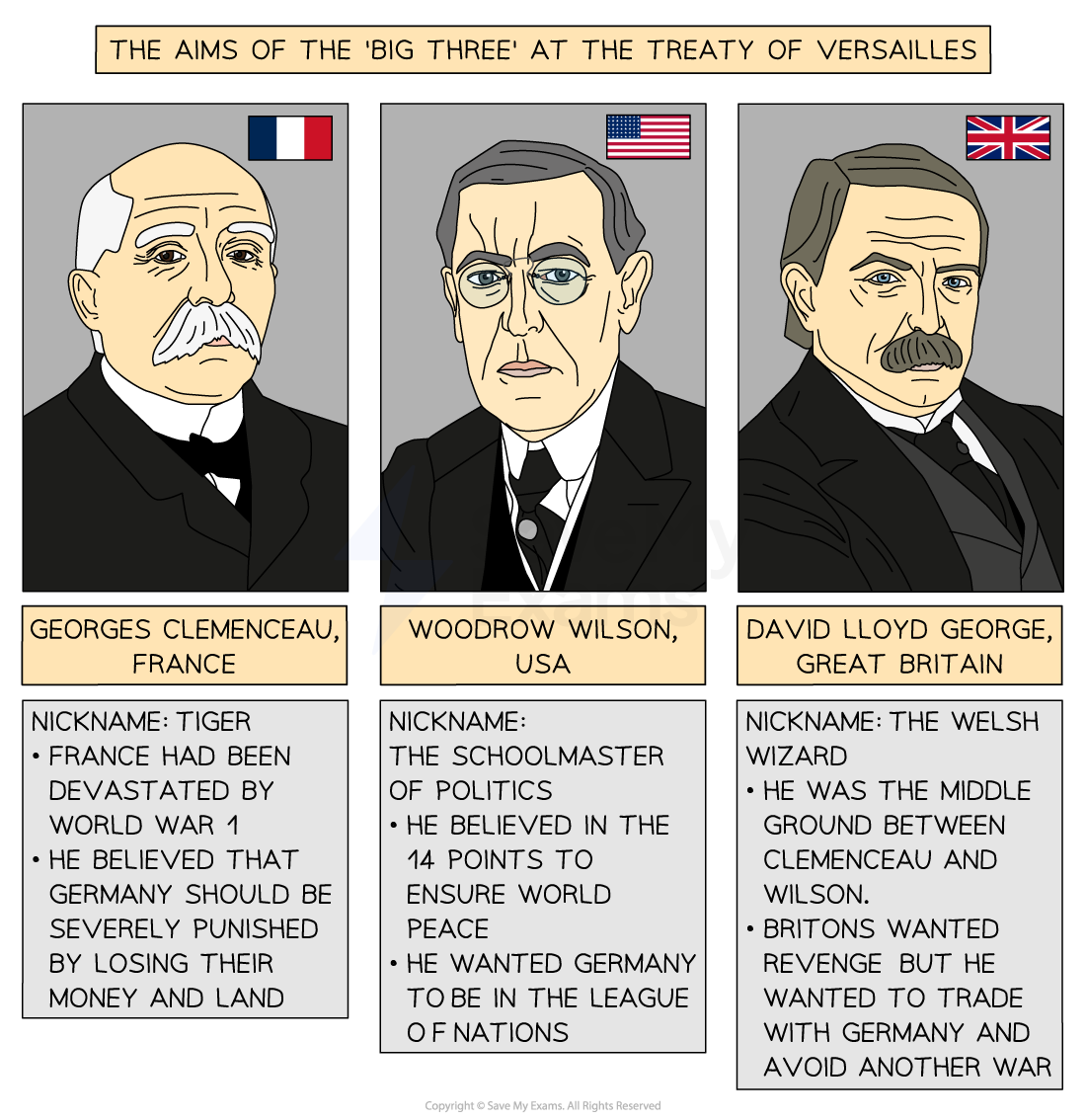
Due to their different motives, the Big Three all had different aims for the Treaty of Versailles:
Georges Clemenceau wanted a harsh treaty that included:
High reparations
The protection of France’s borders
The splitting of Germany into states
Germany disbanding its armed forces to prevent another invasion
The return of Alsace-Lorraine to France
Giving France the rich industrial area in Germany known as the Saar Basin to rebuild its economy
Germany giving its overseas colonies to France
Woodrow Wilson wanted a soft treaty that included:
The creation of independent states like Poland that had access to the sea
The return of Alsace-Lorraine to France
The end of Germany’s empire and the weakening of all empires
Avoiding blaming Germany for the start of the First World War. This included not making Germany pay high reparations
The inclusion of all nations, including Germany, in the League of Nations
Freedom of the seas. Wilson believed that trading ships should have access to any waters without fear of attack
David Lloyd George wanted a fair treaty, somewhere between Wilson's and Clemenceau’s vision. His treaty would include:
Retaining a strong trading relationship with Germany
Taking Germany’s overseas colonies
Harsh enough terms to satisfy the British desire for revenge. Lloyd George had just won an election on the promise that he would ‘make Germany pay’
Germany keeping its military strength to prevent communism from Russia spreading into Europe
A reduction in Germany’s navy to reinforce Britain’s naval supremacy
How different were the aims of the Big Three for the Treaty of Versailles?
Clemenceau | Wilson | Lloyd George | |
|---|---|---|---|
Military aims | Harsh | Soft | Moderate |
Territorial aims | Harsh | Moderate | Moderate |
Political and economic aims | Harsh | Soft | Moderate |