Finding Gradients of Tangents
Finding Gradients of Tangents
Finding gradients of tangents
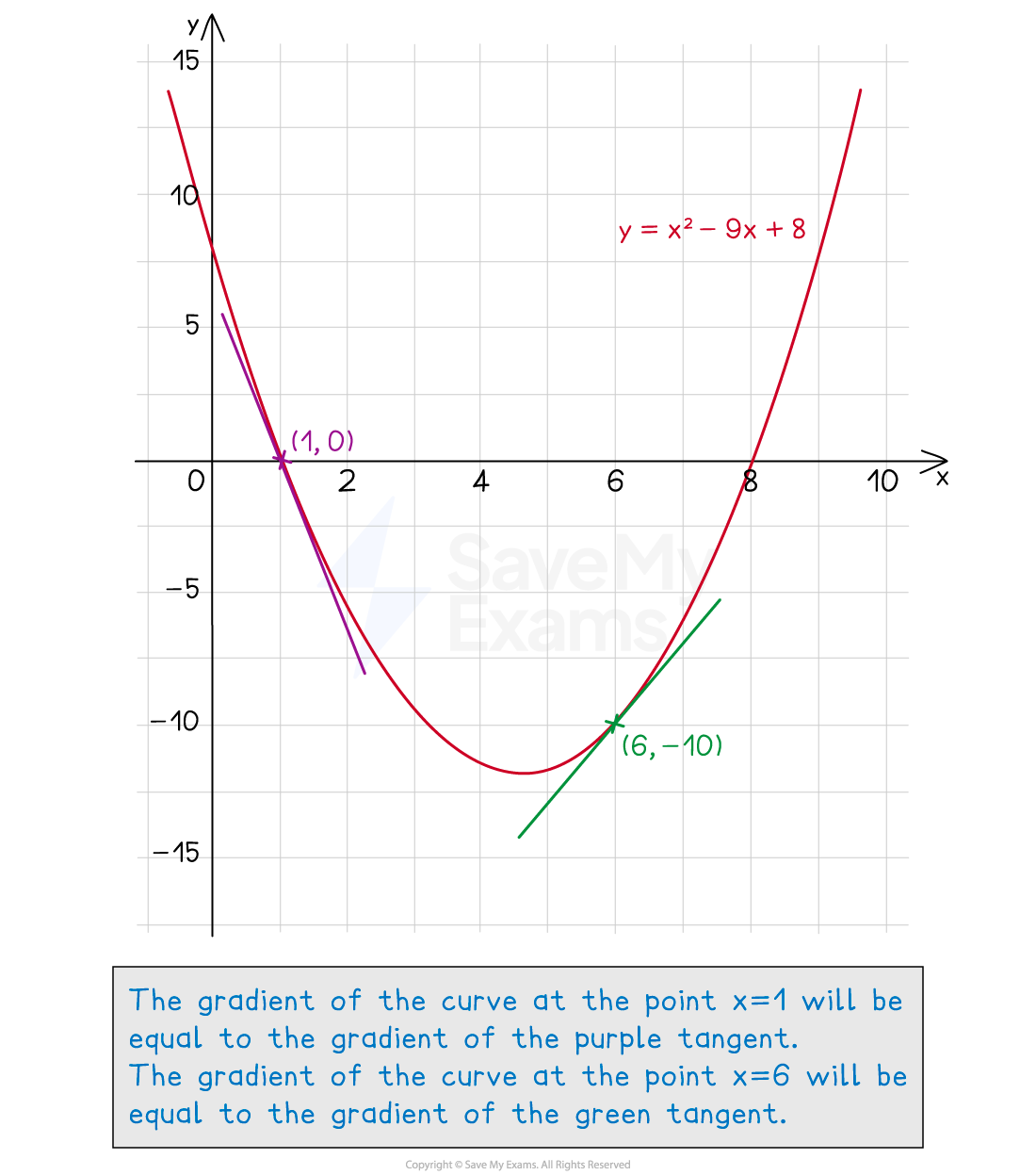
How are the gradients of graphs and tangents related?
The gradient of a graph at a point is equal to the gradient of the tangent to the curve at that point
A tangent is a line that touches a curve, but does not cross it
How do I estimate the gradient of a curve using a tangent?
To find an estimate for the gradient of a curve at a point:
Draw a tangent to the curve at the point
Find the gradient of the tangent using
Gradient = rise ÷ run
or difference in y ÷ difference in x
In the example below, the gradient of the tangent at x = 4 would be
Remember that the rise is negative if it is going down
This means the gradient of the curve at x = 4 is also -0.625
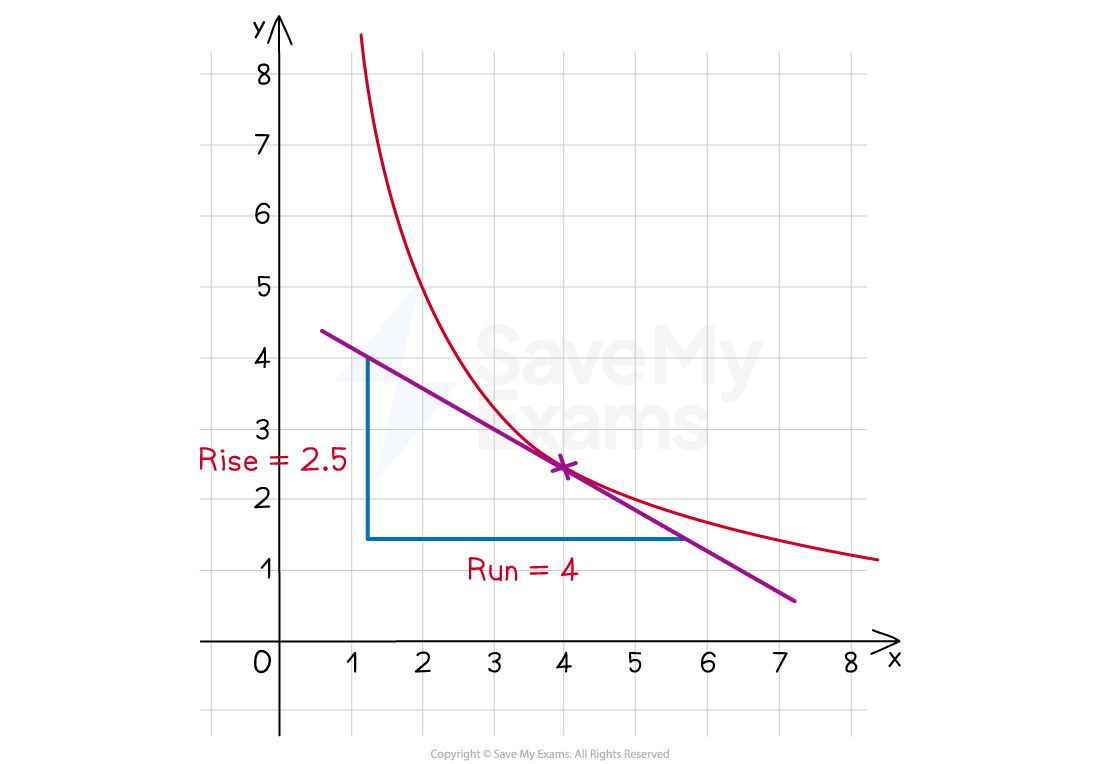
It is an estimate because the tangent has been drawn by eye and is not exact
To find the exact gradient we would need to use differentiation
What does the gradient represent?
The gradient represents the rate of change of y with x
I.e. For every increase in x by 1, how much does y increase?
Consider the quantities used for the axes to determine the meaning of the gradient
In general, the units of the gradient will be the units of y divided by the units of x
In a distance-time graph, the gradient is the rate of change of distance with time
This is the speed,
Common units for speed are metres per second or kilometres per hour
In a speed-time graph, the gradient is the rate of change of speed with time
This is the acceleration
Common units for acceleration are metres per second per second (metres per second2)
In a graph of volume against radius, e.g. as a balloon is inflated, the gradient is the rate of change of volume as the radius increases
This could be measured in m3 per m, which is equivalent to m2