StudyDeck

Quadratic Graphs

Exam code: 4024
Written by: Ashika|Reviewed by: Caroline Carroll|Updated 2 July 2026

Quadratic Graphs

Quadratic graphs

What is a quadratic graph?

  • A quadratic graph has the form y=ax2+bx+c{"language":"en","fontFamily":"Times New Roman","fontSize":"18","autoformat":true} 

    • where a{"language":"en","fontFamily":"Times New Roman","fontSize":"18","autoformat":true} is not zero

What does a quadratic graph look like?

  • A quadratic graph is a smooth curve with a vertical line of symmetry

    • A positive number in front of x2{"language":"en","fontFamily":"Times New Roman","fontSize":"18","autoformat":true} gives a u-shaped curve

    • A negative number in front of x2{"language":"en","fontFamily":"Times New Roman","fontSize":"18","autoformat":true} gives an n-shaped curve

  • The shape made by a quadratic graph is known as a parabola

  • A quadratic graph will always cross the y{"language":"en","fontFamily":"Times New Roman","fontSize":"18","autoformat":true}-axis

  • A quadratic graph intersects the x{"language":"en","fontFamily":"Times New Roman","fontSize":"18","autoformat":true}-axis twice, once, or not at all

    • The x values where the graph intersects the x{"language":"en","fontFamily":"Times New Roman","fontSize":"18","autoformat":true}-axis are called the roots

  • If the graph is a u-shape, it has a minimum point

  • If the graph is an n-shape, it has a maximum point

  • Minimum and maximum points are both examples of turning points

    • A turning point can also be called a vertex
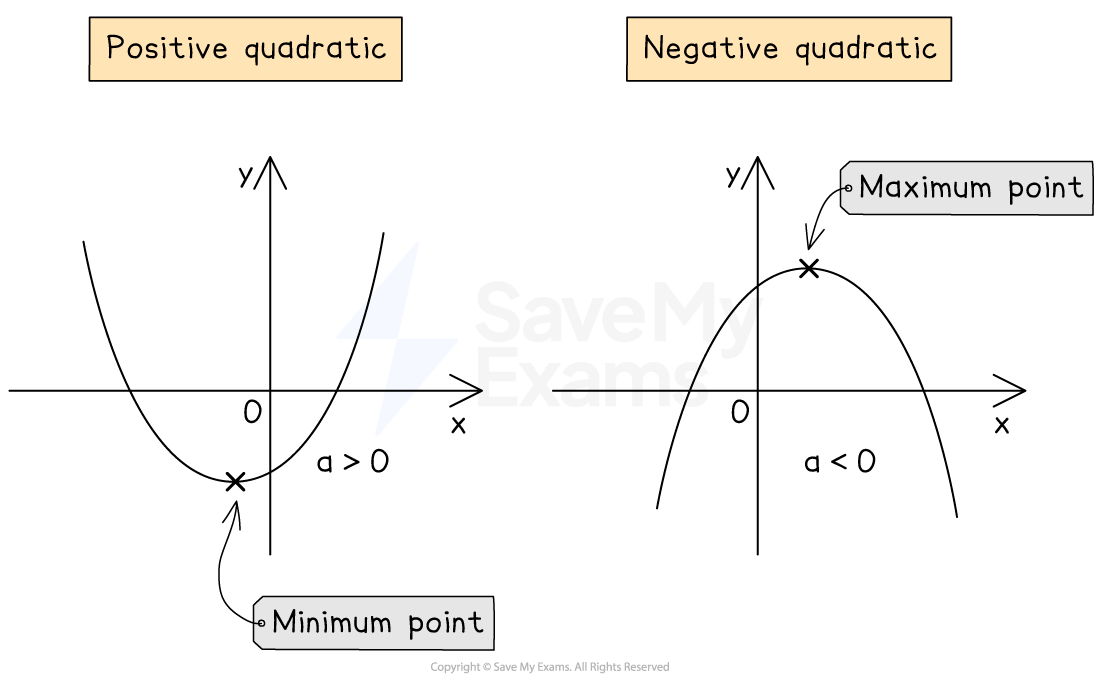
Diagram showing a positive quadratic curve with a minimum point and a negative quadratic curve with a maximum point.

How do I sketch a quadratic graph?

  • It is important to know how to sketch a quadratic curve

    • A simple drawing showing the key features is often sufficient

    • (For a more accurate graph, create a table of values and plot the points)

  • To sketch a quadratic graph:

    • First sketch the x{"fontFamily":"Times New Roman","fontSize":"18","autoformat":true,"toolbar":""} and y{"fontFamily":"Times New Roman","fontSize":"18","autoformat":true,"toolbar":""}-axes

    • Identify the y{"language":"en","fontFamily":"Times New Roman","fontSize":"18","autoformat":true}-intercept and mark it on the y{"fontFamily":"Times New Roman","fontSize":"18","autoformat":true,"toolbar":""}-axis

      • The y{"fontFamily":"Times New Roman","fontSize":"18","autoformat":true,"toolbar":""}-intercept of y=ax2+bx+c{"language":"en","fontFamily":"Times New Roman","fontSize":"18","autoformat":true} will be 0, c{"language":"en","fontFamily":"Times New Roman","fontSize":"18","autoformat":true}

      • It can also be found by substituting in x=0{"fontFamily":"Times New Roman","fontSize":"18","autoformat":true,"toolbar":""}

    • Find all root(s) (0, 1 or 2) of the equation and mark them on the x{"fontFamily":"Times New Roman","fontSize":"18","autoformat":true,"toolbar":""}-axis

      • The roots will be the solutions to y=0{"language":"en","fontFamily":"Times New Roman","fontSize":"18","autoformat":true}; ax2+bx+c=0{"language":"en","fontFamily":"Times New Roman","fontSize":"18","autoformat":true}

      • You can find the solutions by factorising, completing the square or using the quadratic formula

    • Identify if the number a{"fontFamily":"Times New Roman","fontSize":"18","autoformat":true,"toolbar":""} in ax2+bx+c{"fontFamily":"Times New Roman","fontSize":"18","autoformat":true,"toolbar":""} is positive or negative

      • A positive value will result in a u-shape

      • A negative value will result in an n-shape

    • Sketch a smooth curve through the x{"fontFamily":"Times New Roman","fontSize":"18","autoformat":true,"toolbar":""} and y{"fontFamily":"Times New Roman","fontSize":"18","autoformat":true,"toolbar":""}-intercepts

      • Mark on any axes intercepts

      • Mark on the coordinates of the maximum/minimum point if you know it

How do I find the coordinates of the turning point by completing the square?

  • The coordinates of the turning point (vertex) of a quadratic graph can be found by completing the square

  • For a quadratic graph written in the form y=ax-p2+q{"fontFamily":"Times New Roman","fontSize":"18","autoformat":true,"toolbar":""}

    • the minimum or maximum point has coordinates p, q{"fontFamily":"Times New Roman","fontSize":"18","autoformat":true,"toolbar":""}

  • Beware: there is a sign change for the x{"fontFamily":"Times New Roman","fontSize":"18","autoformat":true,"toolbar":""}-coordinate

    • A curve with equation y=x-32+2{"language":"en","fontFamily":"Times New Roman","fontSize":"18","autoformat":true}, has a minimum point at 3, 2{"language":"en","fontFamily":"Times New Roman","fontSize":"18","autoformat":true}

    • A curve with equation y=x+32+2{"fontFamily":"Times New Roman","fontSize":"18","autoformat":true,"toolbar":""}, has a minimum point at -3, 2{"fontFamily":"Times New Roman","fontSize":"18","autoformat":true,"toolbar":""}

  • The value of a{"fontFamily":"Times New Roman","fontSize":"18","autoformat":true,"toolbar":""} does not affect the coordinates of the turning point but it will change the shape of the graph

    • If it is positive, the graph will be a u-shape

      • The curve y=5x-32+2{"fontFamily":"Times New Roman","fontSize":"18","autoformat":true,"toolbar":""} has a minimum point at 3, 2{"language":"en","fontFamily":"Times New Roman","fontSize":"18","autoformat":true}

    • If it is negative, the graph will be an n-shape

      • The curve y=-8x-32+2{"fontFamily":"Times New Roman","fontSize":"18","autoformat":true,"toolbar":""} has a maximum point at 3, 2{"language":"en","fontFamily":"Times New Roman","fontSize":"18","autoformat":true}

How do I find the coordinates of the turning point using differentiation?

  • The coordinates of the turning point (maximum/minimum) of a quadratic can be found through differentiation

  • To find the coordinates of the turning point

    • Differentiate the quadratic equation y=ax2+bx+c{"fontFamily":"Times New Roman","fontSize":"18","autoformat":true,"toolbar":""}

      • This will give you dydx{"fontFamily":"Times New Roman","fontSize":"18","autoformat":true,"toolbar":""}

    • Set dydx=0{"language":"en","fontFamily":"Times New Roman","fontSize":"18","autoformat":true}  and solve for x{"fontFamily":"Times New Roman","fontSize":"18","autoformat":true,"toolbar":""}

      • The solution will be the x{"language":"en","fontFamily":"Times New Roman","fontSize":"18","autoformat":true}-coordinate of the turning point

    • Substitute the x{"fontFamily":"Times New Roman","fontSize":"18","autoformat":true,"toolbar":""} value into y=ax2+bx+c{"fontFamily":"Times New Roman","fontSize":"18","autoformat":true,"toolbar":""}

      • This will give you the y{"language":"en","fontFamily":"Times New Roman","fontSize":"18","autoformat":true}-coordinate of the turning point

How do I find the equation of a quadratic from its graph?

  • If the vertex and one other point are known

    • Use the form y=ax-p2+q{"fontFamily":"Times New Roman","fontSize":"18","autoformat":true,"toolbar":""} to fill in p{"fontFamily":"Times New Roman","fontSize":"18","autoformat":true,"toolbar":""} and q{"fontFamily":"Times New Roman","fontSize":"18","autoformat":true,"toolbar":""}

      • The vertex is at p, q{"fontFamily":"Times New Roman","fontSize":"18","autoformat":true,"toolbar":""}

    • Then substitute in the other known point x, y{"fontFamily":"Times New Roman","fontSize":"18","autoformat":true,"toolbar":""} to find a{"fontFamily":"Times New Roman","fontSize":"18","autoformat":true,"toolbar":""}

  • If the roots (x{"fontFamily":"Times New Roman","fontSize":"18","autoformat":true,"toolbar":""}-intercepts) and one other point are known

    • Use the form y=ax-x1x-x2{"fontFamily":"Times New Roman","fontSize":"18","autoformat":true,"toolbar":""} to fill in x1{"fontFamily":"Times New Roman","fontSize":"18","autoformat":true,"toolbar":""} and x2{"fontFamily":"Times New Roman","fontSize":"18","autoformat":true,"toolbar":""}

      • The roots are at x1 , 0{"fontFamily":"Times New Roman","fontSize":"18","autoformat":true,"toolbar":""} and x2 , 0{"fontFamily":"Times New Roman","fontSize":"18","autoformat":true,"toolbar":""}

    • Then substitute in the other known point x, y{"fontFamily":"Times New Roman","fontSize":"18","autoformat":true,"toolbar":""} to find a{"fontFamily":"Times New Roman","fontSize":"18","autoformat":true,"toolbar":""}

  • If a=1{"fontFamily":"Times New Roman","fontSize":"18","autoformat":true,"toolbar":""} then you only need either the vertex or the roots