The Nucleus
Composition of the Nucleus
Composition of the Nucleus
A nucleus is made up of positively charged protons and neutrally charged neutrons
The Protons, Neutrons and Electrons in an Atom
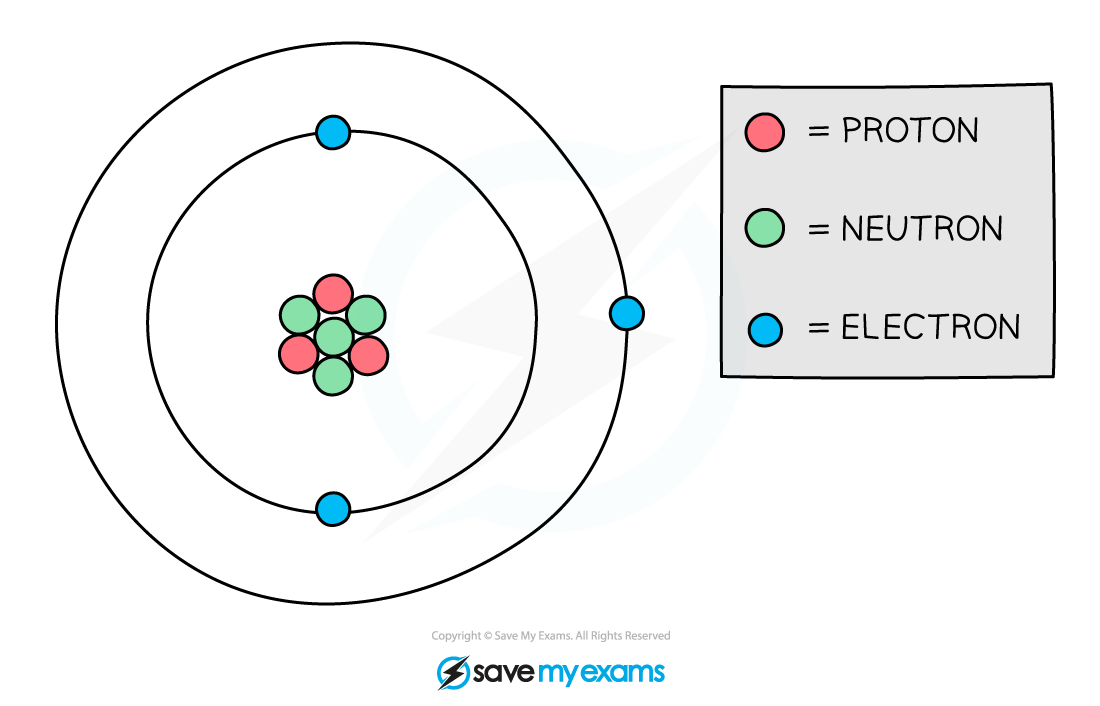
Protons and neutrons are found in the nucleus of an atom
Protons have a positive charge, whilst neutrons have no charge
This is why the nucleus is positive overall
Atoms & Ions
Atoms & Ions
An ion is an electrically charged atom or group of atoms formed by the loss or gain of electrons
An atom will lose or gain electrons to become more stable
A stable atom is normally electrically neutral
This means it has the same number of protons (positive charge) and electrons (negative charge)
Positive ions are therefore formed when atoms lose electrons
There will be more protons than electrons
Negative ions are therefore formed when atoms gain electrons
There will be more electrons than protons
Neutral, Positively and Negatively Charged Atoms
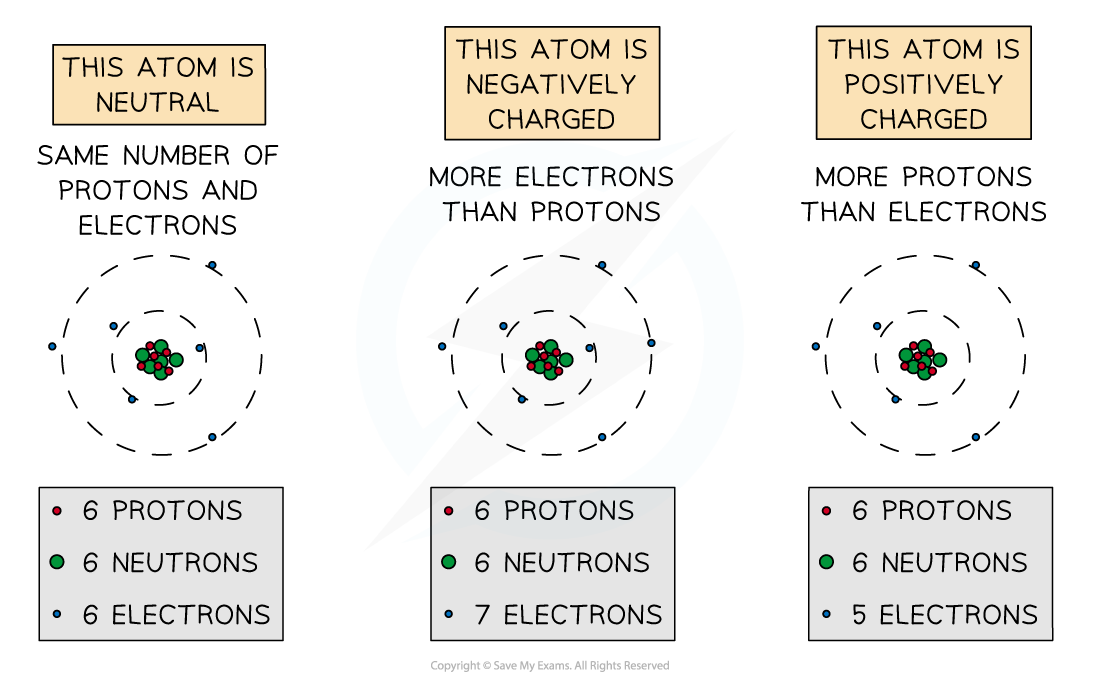
The difference between positive and negative ions depends on the number of elections
Describing the Nucleusvideo
Describing the Nucleus
Proton Number, Z
The number of protons in an atom is called its proton number (it can also be called the atomic number)
Elements in the periodic table are ordered by their atomic number
Therefore, the number of protons determines which element an atom is
The atomic number of a particular element is always the same
For example:
Hydrogen has an atomic number of 1. It always has just one proton
Sodium has an atomic number of 11. It has 11 protons
Uranium has an atomic number of 92. It has 92 protons
The atomic number is also equal to the number of electrons in an atom
This is because atoms have the same number of electrons and protons in order to have no overall charge
Nucleon Number, A
The total number of particles in the nucleus of an atom is called its nucleon number (or mass number)
The mass number is the number of protons and neutrons in the atom
Calculating the Number of Neutrons
The number of neutrons can be found by subtracting the atomic number from the mass number
Number of Neutrons = Nucleon Number - Proton Number
For example, if a sodium atom has a mass number of 23 and an atomic number of 11, then the number of neutrons would be 23 – 11 = 12
Nuclide Notation
Nuclide Notation
A nuclide is a group of atoms containing the same number of protons and neutrons
For example, 5 atoms of oxygen are all the same nuclide but are 5 separate atoms
Atomic symbols are written in a specific notation called nuclide or ZXA notation
Nuclide Notation

Atomic symbols in AZX Notation describe the constituents of nuclei
The top number A represents the nucleon number or the mass number
Nucleon number (A) = total number of protons and neutrons in the nucleus
The lower number Z represents the proton or atomic number
Proton number (Z) = total number of protons in the nucleus
Note: In Chemistry, the nucleon number is referred to as the mass number and the proton number as the atomic number.
The Atomic Symbol of Lithium
An example of an atomic symbol is:

Atomic symbols, like the one above, describe the constituents of nuclei
Isotopesvideo
Isotopes
Although the number of protons in a particular element is always the same, the number of neutrons can be different
Isotopes are atoms of the same element that have an equal number of protons but a different number of neutrons
This means that each element can have more than one isotope
Isotopes tend to be more unstable due to their imbalance of protons and neutrons
This means they're more likely to decay
In the diagram below are three isotopes of Hydrogen:
The Three Isotopes of Hydrogen
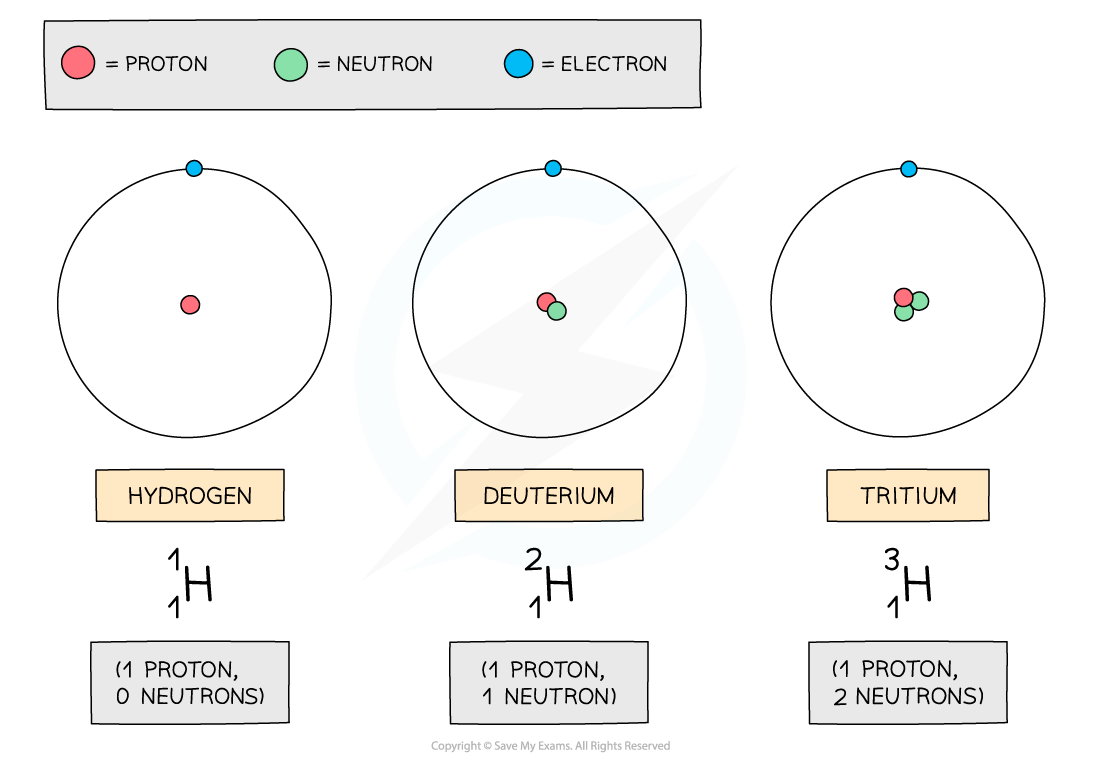
Hydrogen has three isotopes, each with a different number of neutrons
Isotopes occur naturally, but some are more rare than others
For example, about 2 in every 10,000 Hydrogen atoms is Deuterium
Tritium is even more rare (about 1 in every billion billion hydrogen atoms)