Radioactive Decay
Radioactive Decay
Radioactive Decay
Some atomic nuclei are unstable
This is because of an imbalance in the forces within the nucleus
Forces exist between the particles in the nucleus
This is commonly due to the nucleus having too many protons or neutrons
Carbon-14 is an isotope of carbon which is unstable
It has two extra neutrons compared to stable carbon-12
Isotopes of Carbon-12 and Carbon-14
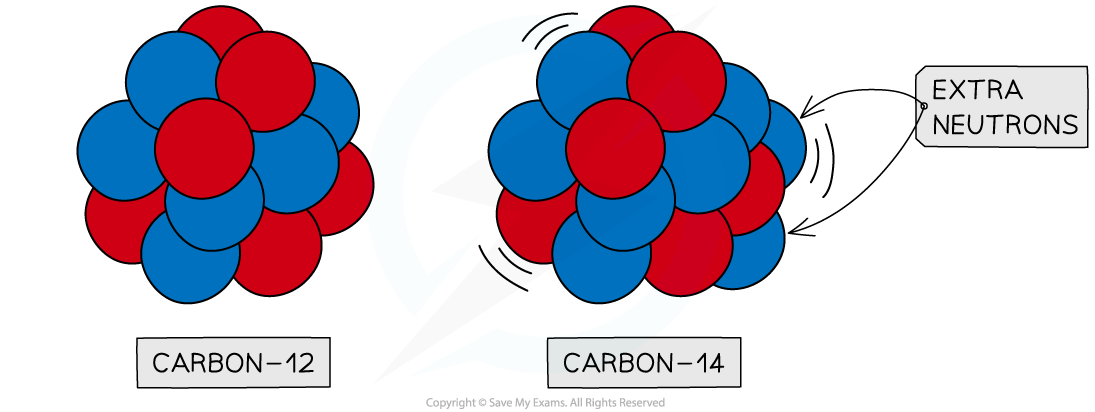
Carbon-12 is stable, whereas carbon-14 is unstable. This is because carbon-14 has two extra neutrons
Some isotopes are unstable because of their large size or because they have too many or too few neutrons
Unstable nuclei can emit radiation in the form of α-particles to become more stable
An Unstable Nucleus Emitting an Alpha Particle
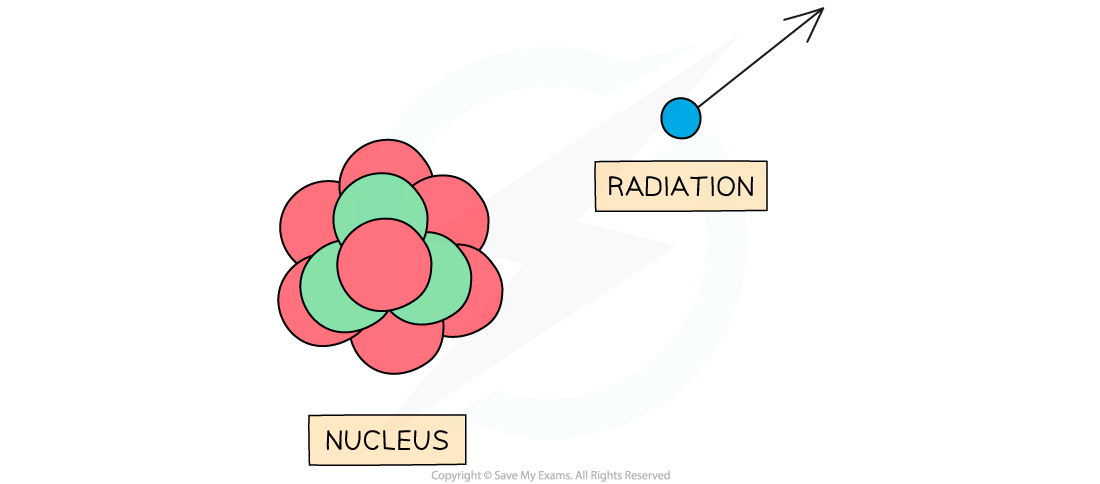
Unstable nuclei decay by emitting α-particles
As the α-particle moves away from the nucleus, it takes some energy with it
This reduces the overall energy of the nucleus
It makes the nucleus more stable
The process of emitting α-particles is called radioactive decay
Radioactive decay is a random process
There is an equal probability of any nucleus decaying
It cannot be known which particular nucleus will decay next
It cannot be known at what time a particular nucleus will decay
The rate of decay is unaffected by the surrounding conditions
It is only possible to estimate the probability of a nucleus decaying in a given time-period
Therefore, the emission of radiation is:
Spontaneous
Random in direction
Decay Equationsvideo
Decay Equations
Radioactive decay events can be shown using a decay equation
A decay equation is similar to a chemical reaction equation
The particles present before the decay are shown before the arrow
The particles produced in the decay are shown after the arrow
During decay equations, the sum of the mass and atomic numbers before the reaction must be the same as the sum of the mass and atomic numbers after the reaction
Alpha Decay Equations
When the alpha particle is emitted from the unstable nucleus, the mass number and atomic number of the nucleus changes
The mass number decreases by 4
The atomic number decreases by 2
The Alpha Decay Equation
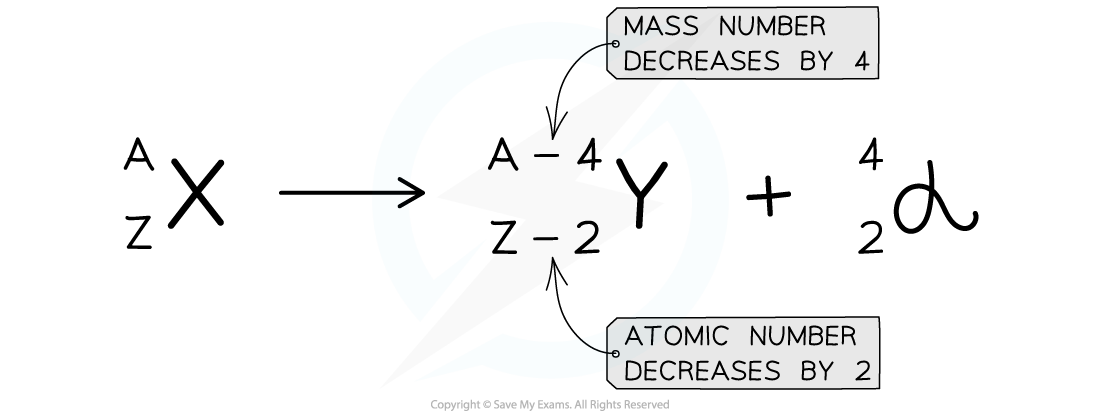
Alpha decay equation showing the change in mass and atomic numbers
The following decay equation shows Polonium-212 undergoing alpha decay
It forms Lead-208 and an alpha particle
An alpha particle can also be written as a helium nucleus (Symbol He)
e.g.
Beta Decay Equation
During beta decay, a neutron changes into a proton and an electron
The electron is emitted and the proton remains in the nuclei
The Beta Decay Equation
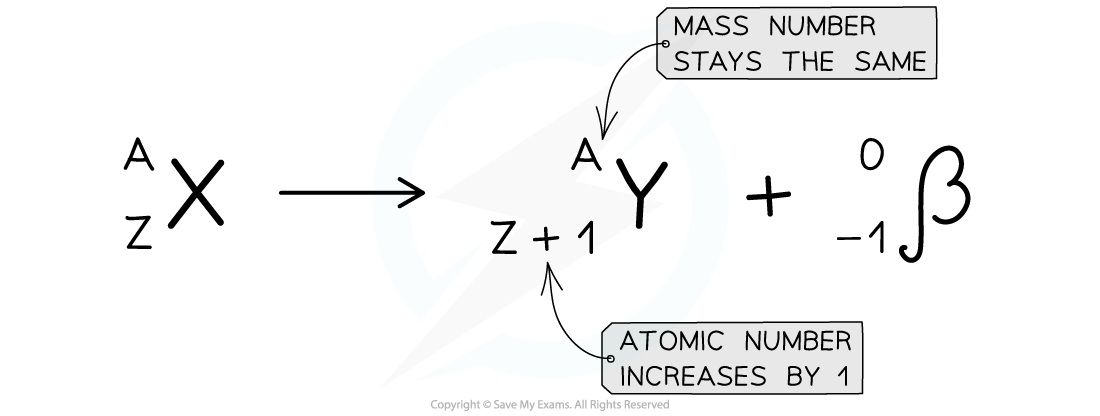
Beta decay equation showing the change in atomic number
Gamma Decay
The gamma ray that is emitted has a lot of energy, but no mass or charge
Here is an example of Uranium-238 undergoing gamma decay
Notice that the mass number and atomic number of the unstable nuclei remain the same during the decay
The Gamma Decay Equation

Gamma decay equation showing no change in mass or atomic number