The Three Types of Emission
Emission of Radiation from a Nucleus
Emission of Radiation from a Nucleus
Unstable nuclei can emit radiation to become more stable
Radiation can be in the form of a high-energy particle or wave
The process of emitting radiation is called radioactive decay
Radioactive Decay
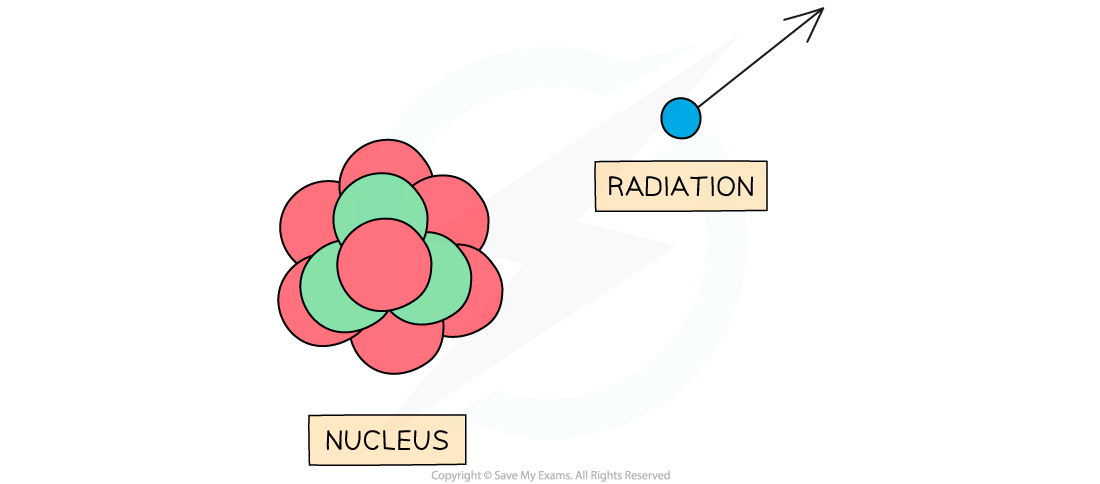
Unstable nuclei decay by emitting high-energy particles or waves
As the radiation moves away from the nucleus, it takes some energy with it
This reduces the overall energy of the nucleus
This makes the nucleus more stable
Radioactive decay is a spontaneous and random process
A random process means:
It is not possible to know exactly when, or in which direction, a particular nucleus will decay
A spontaneous process means:
Radioactive decay cannot be affected by environmental factors such as temperature, pressure, or chemical conditions
Types of Radioactive Decay
Types of Radioactive Decay
When an unstable nucleus decays, it emits radiation called nuclear radiation
There are different types of radiation that can be emitted:
Alpha (α) particles
Beta (β-) particles
Gamma (γ) radiation
These changes are spontaneous and random
Alpha Particles
The symbol for alpha is α
An alpha particle is the same as a helium nucleus
This is because they consist of two neutrons and two protons
Alpha particles have a charge of +2
This means they can be affected by an electric field
Beta Particles
The symbol for beta is β-
Beta particles are fast-moving electrons
They are produced in nuclei when a neutron changes into a proton and an electron
Beta particles have a charge of -1
This means they can be affected by an electric field
Gamma Rays
The symbol for gamma is γ
Gamma rays are electromagnetic waves
They have the highest energy of the different types of electromagnetic waves
Gamma rays have no charge
Alpha Particles, Beta Particles and Gamma Rays
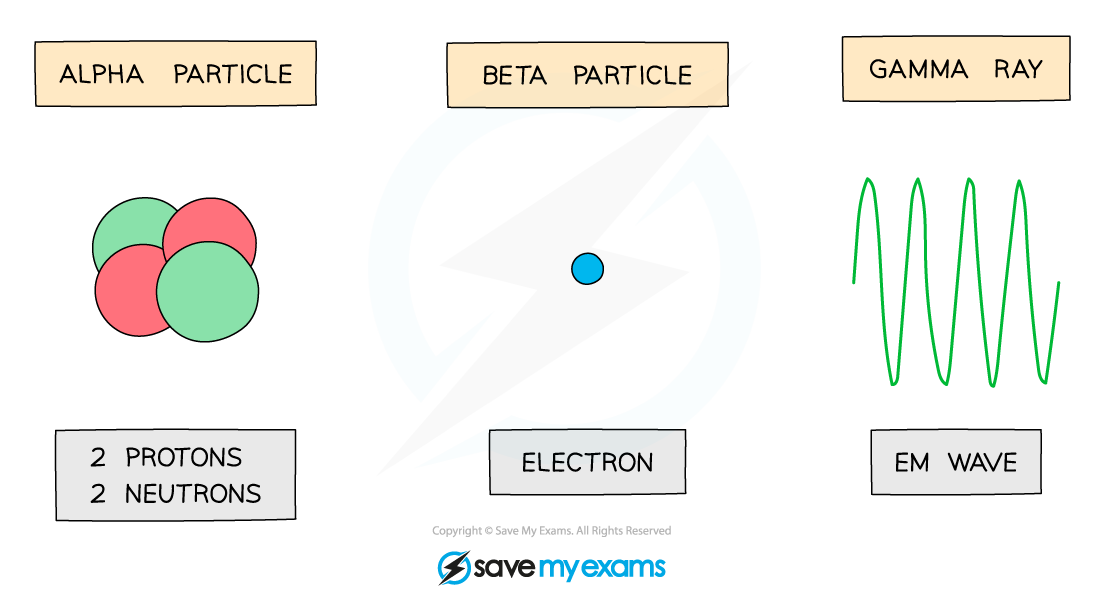
Alpha particles, beta particles and gamma waves can be emitted from unstable nuclei
Alpha, Beta & Gamma Emissionvideo
Alpha, Beta & Gamma Emission
α, β and γ radiation can be identified by the emission from a nucleus by recalling their:
Nature (what type of particle or radiation they are)
Their relative ionising effects (how easily they ionise other atoms)
Their relative penetrating abilities (how far can they travel before they are stopped completely)
The properties of alpha, beta and gamma are given in this table and then described in more detail
Different Properties of Nuclear Radiation
Particle | What is it | Charge | Range in Air | Penetration | Ionisation |
|---|---|---|---|---|---|
Alpha (α) | 2 protons + 2 neutrons | +2 | Few cm | Stopped by Paper | High |
Beta (β−) | Electron | −1 | A few tens of cm | Stopped by a few mm of Aluminium | Medium |
Gamma (γ) | Electromagnetic Wave | 0 | Infinite | Reduced by a Few mm Lead | Low |
The trend down the table shows:
The range increases
Penetrating power increases
Ionisation decreases
Penetrating Power
Alpha, beta and gamma radiation penetrate materials in different ways
This means they are stopped by different materials
Penetrating Power of Alpha, Beta and Gamma Radiation
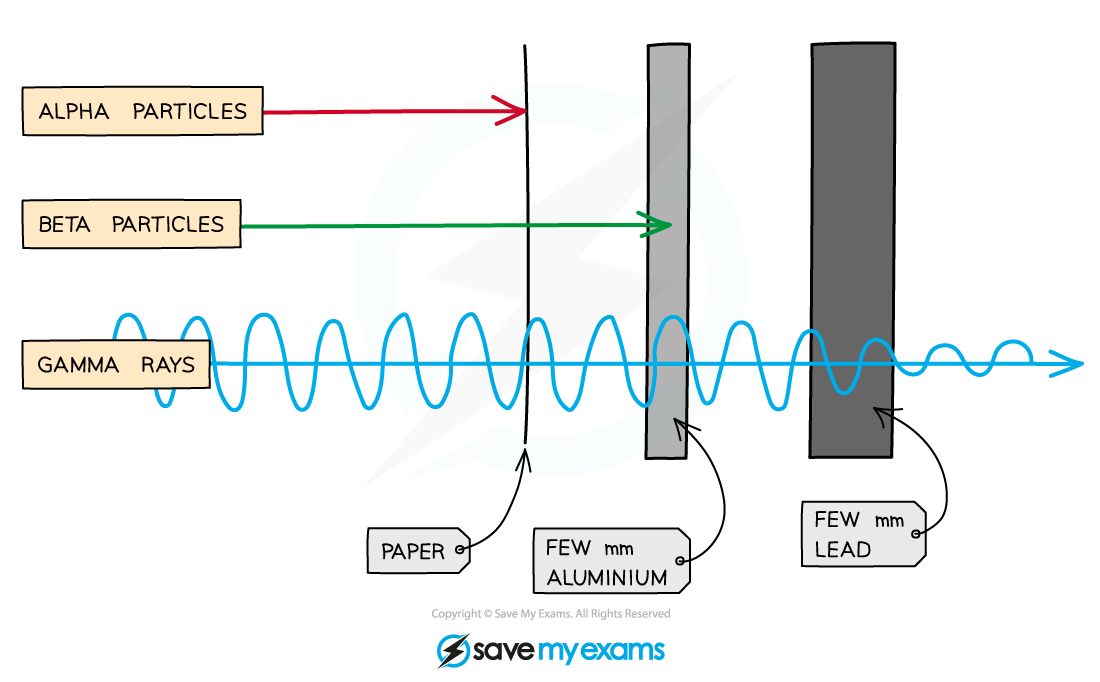
Alpha, beta and gamma are different in how they penetrate materials. Alpha is the least penetrating, and gamma is the most penetrating
Alpha is stopped by paper, whereas beta and gamma pass through it
Beta is stopped by a few millimetres of aluminium
Gamma can pass through aluminium
Gamma rays are only partially stopped by thick lead
Deflection in Electric & Magnetic Fields
Deflection in Electric & Magnetic Fields
A particle is deflected in an electric field if it has charge
A particle is deflected in a magnetic field if it has charge and is moving perpendicular to it
Therefore, since gamma (γ) particles have no charge, they are not deflected by either electric or magnetic fields
Only alpha (α) and beta (β) particles are
Electric Fields
Alpha particles have a charge of +2 (charge of a helium nucleus)
Beta particles have a charge of −1 (charge of an electron)
Therefore, between an electric field created between a negatively charged and positively charged plate
Alpha particles are deflected towards the negative plate
Beta particles are deflected towards the positive plate
Gamma radiation is not deflected and travels straight through between the plates
The Deflection of Alpha, Beta and Gamma Particles in a Magnetic Field
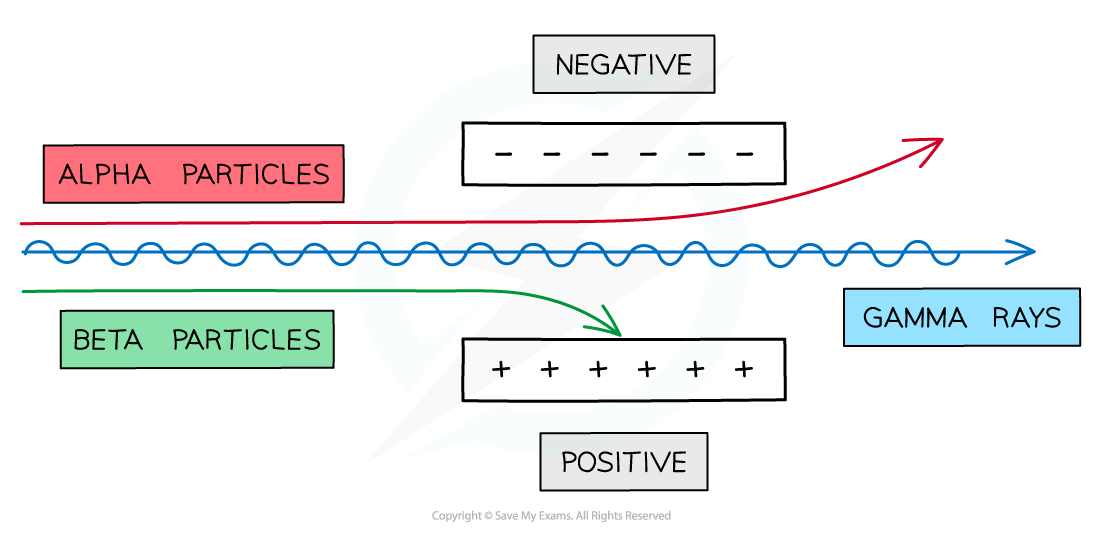
Alpha and Beta particles can be deflected by electric fields
Alpha particles are heavier than beta particles
Therefore, beta particles are deflected more in the electric field and alpha is deflected less
Magnetic Fields
Similarly, alpha and beta particles are deflected by magnetic fields whilst they are moving
They are deflected in opposite directions due to their opposite charges
The Deflection of a Beta Particle in a Magnetic Field
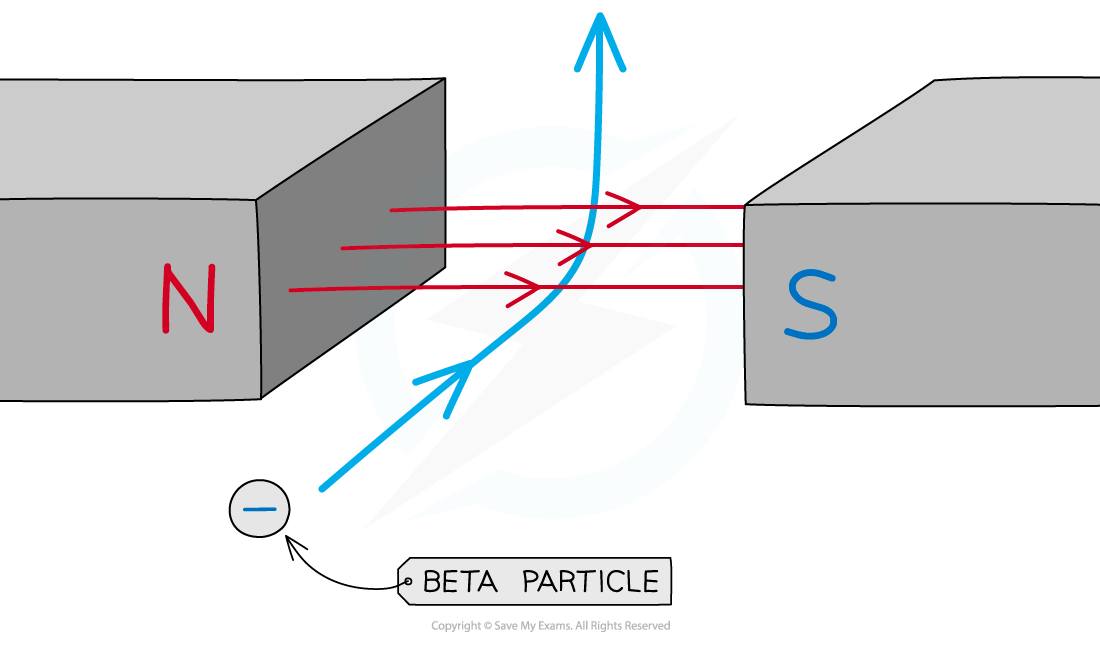
Alpha and Beta particles can also be deflected by magnetic fields