Background Radiation
Background Radiation
Background Radiation
Background radiation is the radiation that is always present around us in the environment
A Pie Chart Showing Sources of Background Radiation
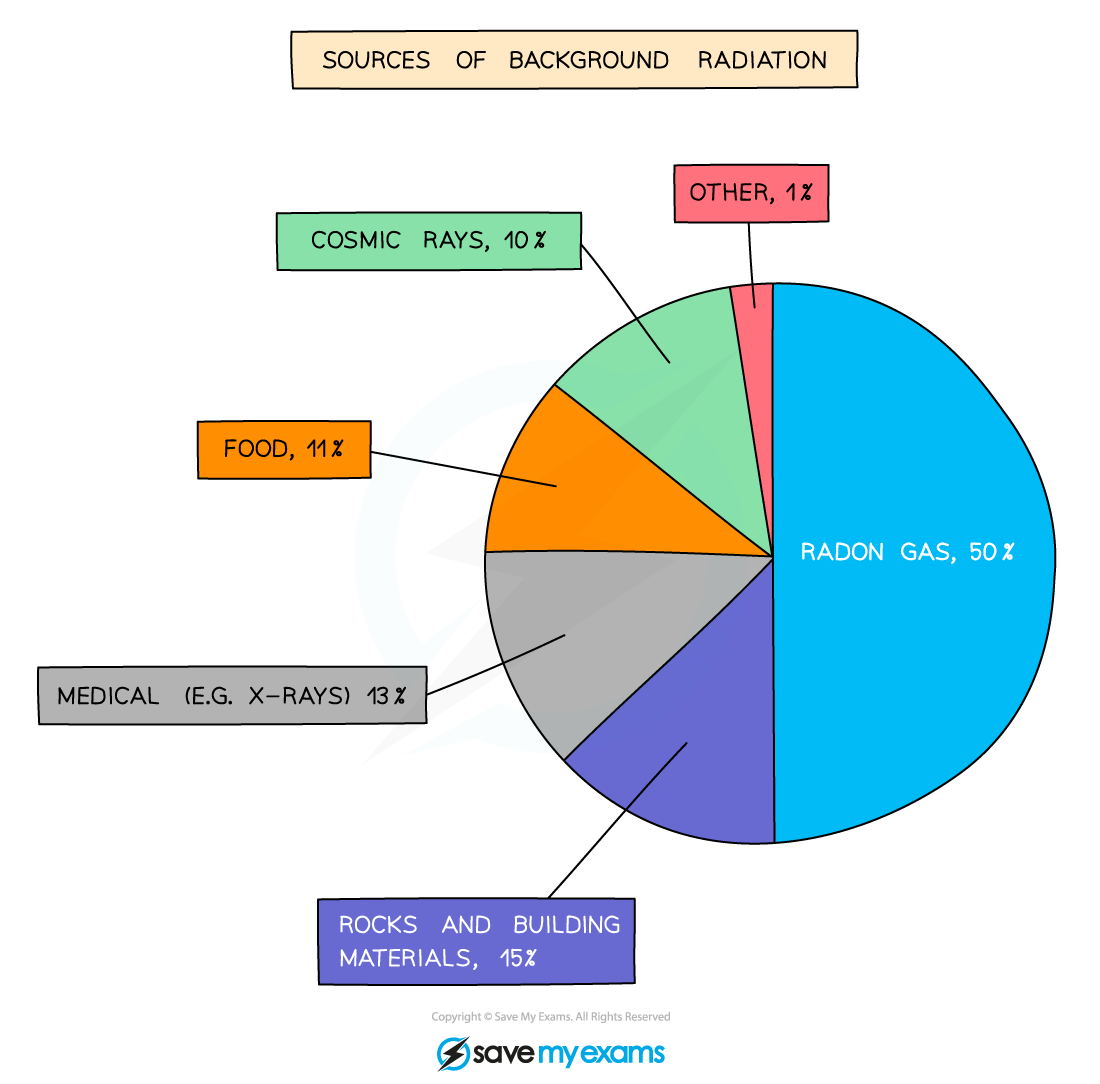
Background radiation is the radiation that is present all around in the environment
Although most background radiation is natural, a small amount of it comes from artificial sources, such as medical procedures (including X-rays)
Levels of background radiation can vary significantly from place to place
Radiation from Nuclear Power come to less than 0.1% of the total
Sources of Background Radiation
Sources of Background Radiation
Background radiation can come from natural sources on Earth or from space as well as man-made sources
Natural Sources
Radon gas (in the air)
Airborne radon comes from the ground
This is from the natural decay of uranium in rocks and soil
The gas is tasteless, colourless and oderless but it not generally a health issue
Rocks and Buildings
Heavy radioactive elements, such as uranium and thorium, occur naturally in rocks in the ground
Uranium decays into radon gas, which is an alpha emitter
This is particularly dangerous if inhaled into the lungs in large quantities
Natural radioactivity can be found in building materials, including decorative rocks, stone and brick
Cosmic rays from space
The sun emits an enormous number of protons every second
Some of these enter the Earth’s atmosphere at high speeds
When they collide with molecules in the air, this leads to the production of gamma radiation
Other sources of cosmic rays are supernovae and other high energy cosmic events
Carbon-14 in biological material
All organic matter contains a tiny amount of carbon-14
Living plants and animals constantly replace the supply of carbon in their systems hence the amount of carbon-14 in the system stays almost constant
Radioactive material in food and drink
Naturally occurring radioactive elements can get into food and water since they are in contact with rocks and soil containing these elements
Some foods contain higher amounts such as potassium-40 in bananas
However, the amount of radioactive material is minuscule and is not a cause for concern
Man-Made Sources
Medical sources
In medicine, radiation is utilised all the time
Uses include X-rays, CT scans, radioactive tracers, and radiation therapy
Nuclear waste
While nuclear waste itself does not contribute much to background radiation, it can be dangerous for the people handling it
Nuclear fallout from nuclear weapons
Fallout is the residue radioactive material that is thrown into the air after a nuclear explosion, such as the bomb that exploded at Hiroshima
While the amount of fallout in the environment is presently very low, it would increase significantly in areas where nuclear weapons are tested
Nuclear accidents
Accidents such as that in Chernobyl contributed a large dose of radiation into the environment
While these accidents are now extremely rare, they can be catastrophic and render areas devastated for centuries
Accounting for Background Radiation
Accounting for Background Radiation
Background radiation must be accounted for when taking readings in a laboratory
This can be done by taking readings with no radioactive source present and then subtracting this from readings with the source present
This is known as the corrected count rate