2.3.1 Coastal Processes
Coastal Processes
Coastal Processes
Coastal regions
Where the land meets the sea is called the coast
The coastline is the edge of the land marked through the high-water mark on a low-lying coast or the foot of steep sloped coasts
The area between the lowest tide point and the highest point is known as the shore
Tides are usually twice a day, but vary from coast to coast and with the time of the year
The difference between low and high tide is known as the tidal range
The tide controls high low and high the waves can work
It is the action of waves and currents that contribute to coastal features
Waves
Waves are marine processes that erode, transport and deposit material
Waves are formed by winds blowing over the surface of the sea
The size of a wave depends on:
The speed of the wind
The fetch (distance the wind travels)
The amount of time the wind blows (in the same direction)
The greater the strength, time and fetch of the wind, the larger the wave
As a wave approaches the coast and enters shallower water, friction from the seabed causes the wave to lean forward and eventually will crest and break onto the beach
The movement of water up the beach is called the swash, and the return movement is the backwash
There are two types of waves:
Destructive waves erode the beach. They have a short wavelength, high-frequency rate and a steep wave gradient. Their backwash is stronger than their swash, which scours the beach, dragging material out to sea
Constructive waves are beach builders. They have a long wavelength, low-frequency rate and a shallow wave gradient. The swash is stronger than its backwash, which carries material up onto the beach and deposits it there
Comparison of Wave Type
| Constructive Wave | Destructive Wave |
|---|---|---|
Swash | Strong | Weak |
Backwash | Weak | Strong |
Wavelength | Long with low height | Short with high height |
Frequency | Low (6-8 per minute) | High (10-12 per minute) |
Type of beach | Sandy - depositional | Shingle - erosional |
Energy | Low | High |
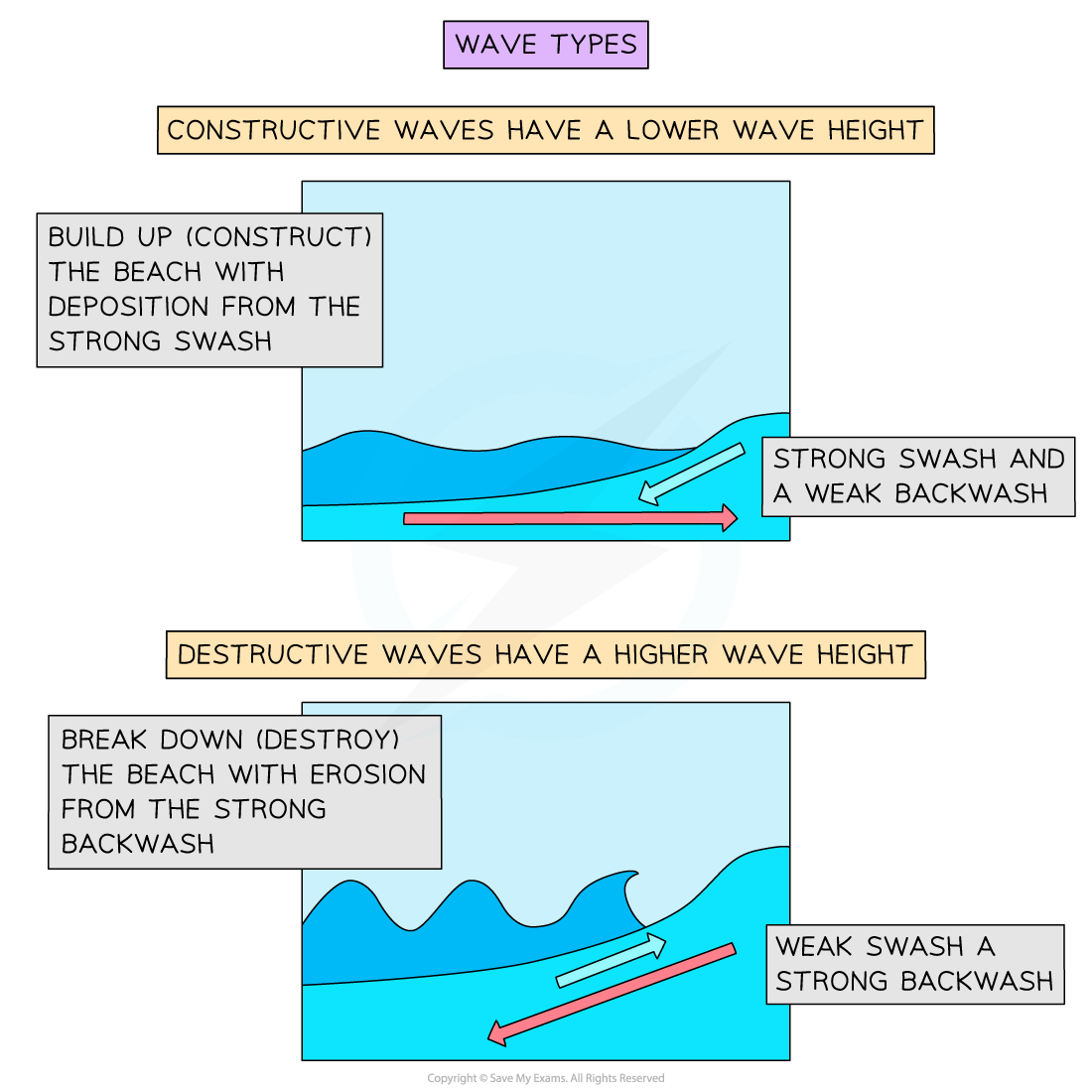
Marine erosion
Destructive waves are responsible for the majority of erosion that happens along a coast
They cut into the coastline in four ways:
Hydraulic Action
Attrition
Corrosion
Abrasion
The effects of attrition are enhanced when the waves move sediment further and longer
A large, rough bolder is eventually eroded into round sand grains (quartz) the longer it stays in the water and the further it travels along the coast
Rounded pebbles on a beach are known as shingle
Marine Transportation
Marine Transportation
The sea transports sediment that it gets from erosion in the same way as a river does
Material in the sea arrives from many sources:
Eroded from cliffs
Transported by longshore drift along the coastline
Brought inland from offshore by constructive waves
Carried to the coastline by a river
Once in the water, the material is moved in different ways:
Traction
Saltation
Suspension
Solution
Longshore Drift
It is the main process of transportation along the coast
Influenced by the prevailing wind, waves approach the beach at an angle
As the waves break, the swash carries material up the beach at the same angle
As the swash dies away, the backwash carries the material down the beach at right angles (90°)
The process repeats, transporting material along the beach in a zig-zag movement
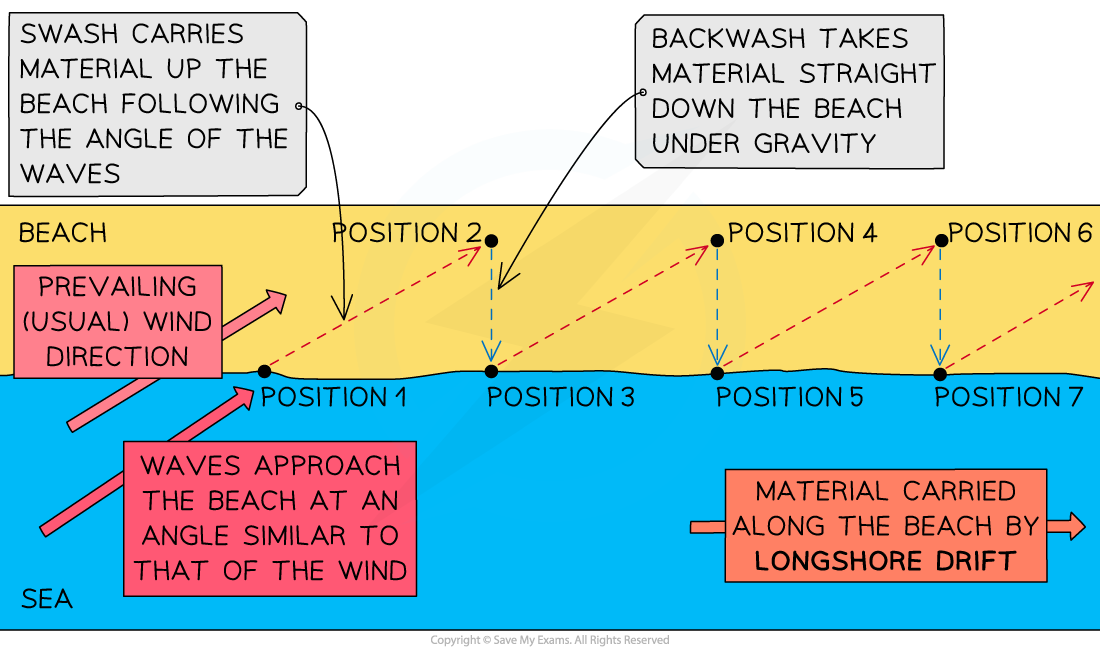
Process of longshore drift
On coasts where longshore drift in one direction, beach sediment is transported further down the coast
If obstructed, sediment is prevented from moving and the area further along the coast is deprived of sediment
This causes two issues:
Smaller beaches which are less attractive to tourists, causing a loss of income
Removes natural coastal protection
Marine Deposition
Marine Deposition
The movement of waves carries sand or shingle with them
Swash carries onto a beach
Backwash carries it away
When a constructive wave carries sediment up the beach, the largest material is deposited along the upper reach of the swash
As the backwash moves back down the beach, it loses water and therefore energy as it travels due to the porosity of the sand
Consequently, the deposition of sediment gets progressively smaller, and the beach is therefore, sorted by wave deposition, with the smallest mud particles settling in the low-energy environment offshore
If a destructive waveform due to a storm, then a large shingle is thrown above the usual high tide level to form a ridge at the top of the beach called a berm
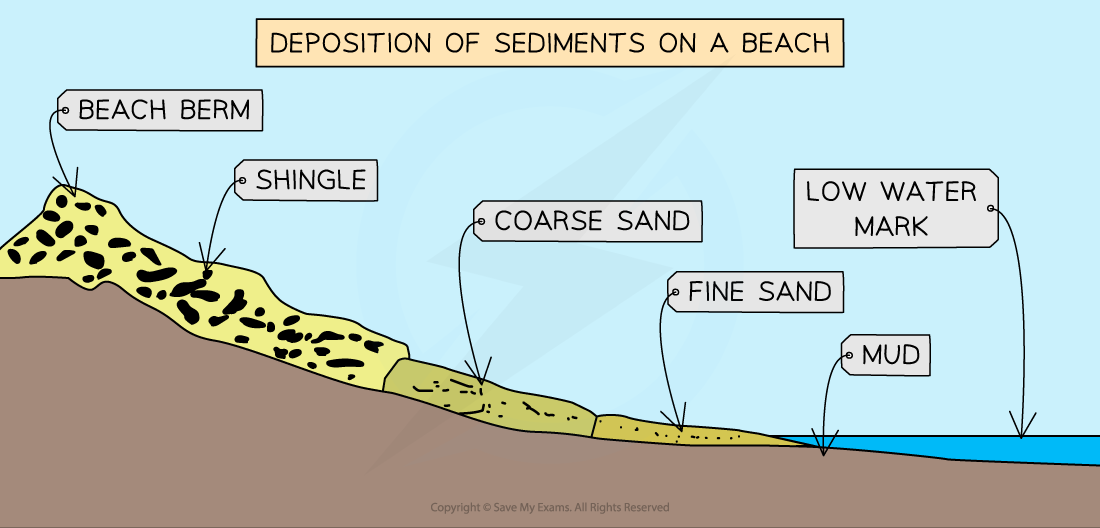
Sediment Deposition