2.5.3 Deforestation of Tropical Rainforest
Deforestation of Tropical Rainforest in Malaysia
Deforestation of Tropical Rainforest in Malaysia
Deforestation is the felling and clearance of trees
Malaysia, Brazil, India and Indonesia are experiencing the highest levels of deforestation in the world
The Malayan government has in the past failed to provide the Food and Agriculture Organisation (FAO) with figures for forest loss
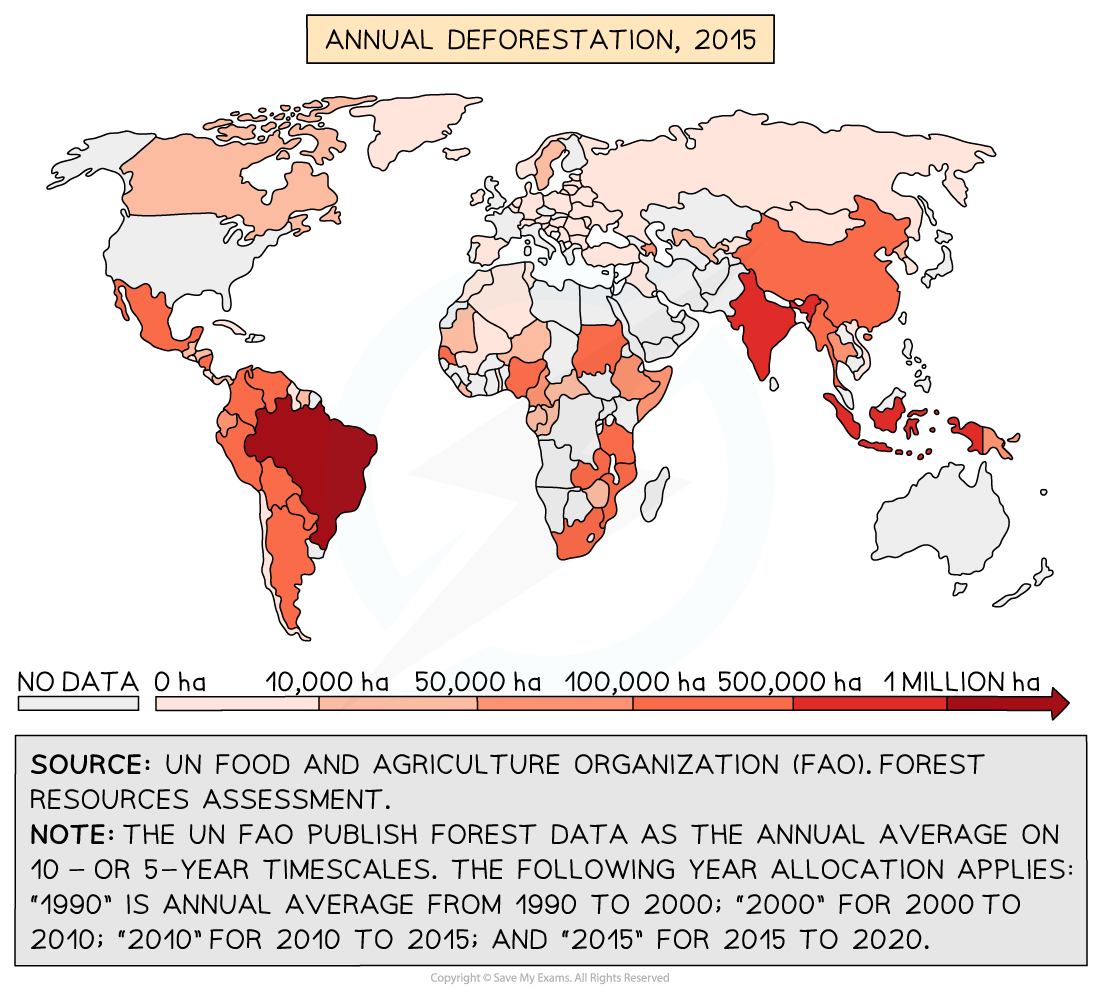
World Deforestation 2015
There are six main human causes of deforestation
Wildfires are a natural cause of deforestation:
The frequency and severity of wildfires have increased this is linked to human induced climate change
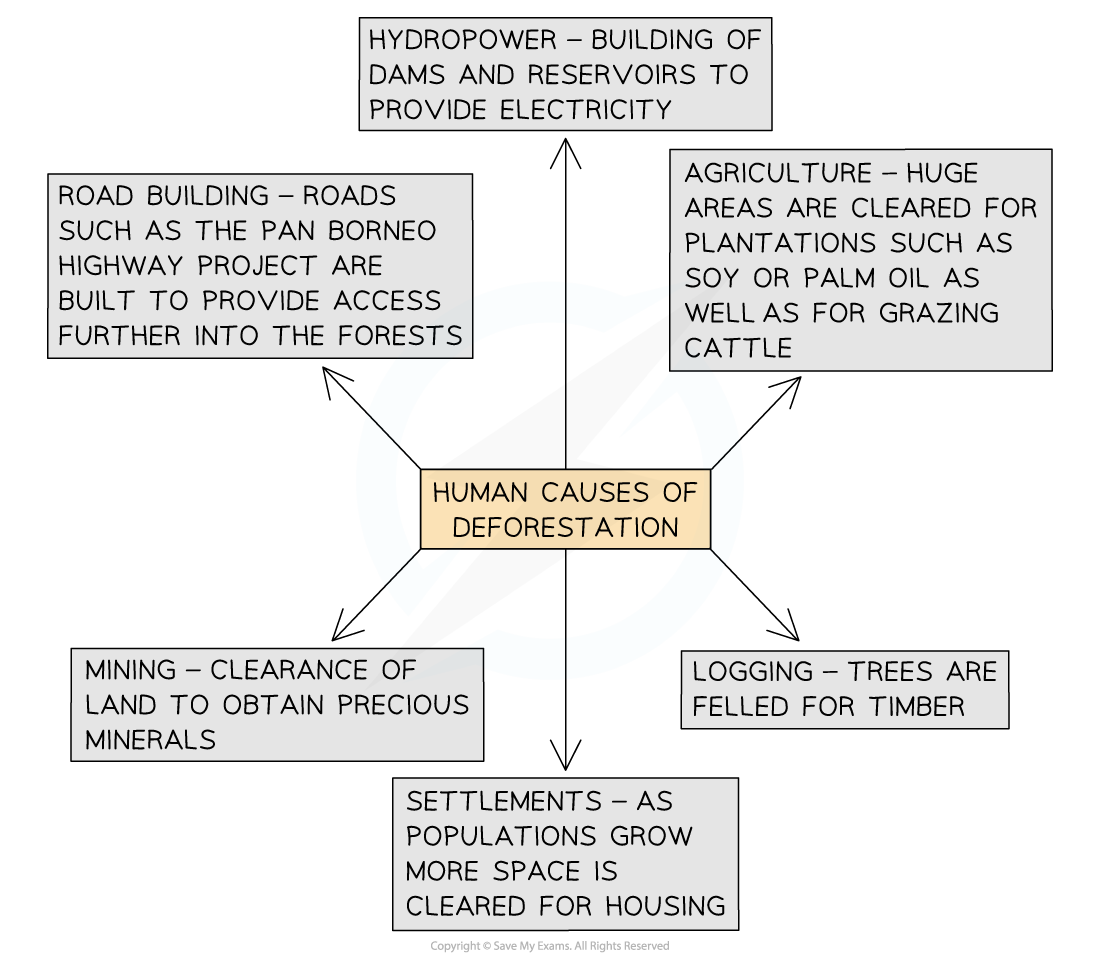
Human Causes of Deforestation
Environmental impacts of deforestation
Many of the impacts of deforestation are environmental including:
Areas that have been deforested are planted with monoculture which reduces biodiversity
Interception and infiltration decrease which reduces evapotranspiration and as a result precipitation decreases
This also increases overland flow which leads to soil erosion and sedimentation of the rivers
Sediment builds up on riverbeds reducing their capacity and increasing the flood risk
Lack of interception increases the leaching of nutrients
Fewer trees increase the amount of CO2 in the atmosphere adding to the enhanced greenhouse effect
Impact on the nutrient cycle
The majority of nutrients in the tropical rainforest are held in the biomass
When trees and vegetation are cleared by deforestation the main store of nutrients is removed
IMAGE
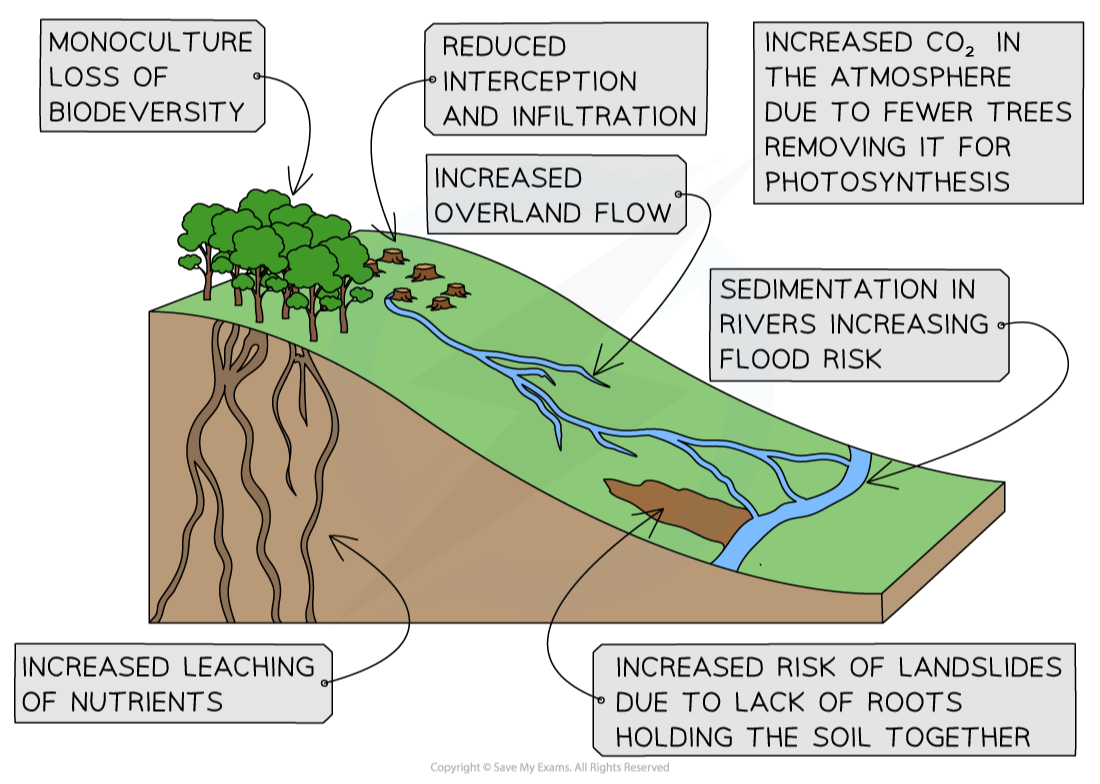
Environmental Impacts of Deforestation
Social impacts of deforestation
Indigenous communities have less land to sustain their traditional way of life this means:
Land does not get the opportunity to recover
Less food available
Improved quality of life for some people due to increased income and jobs
Indigenous communities may give up their way of life leading to a loss of culture and traditions
Increased risk of landslides which can destroy homes and block roads
Loss of potential medicines
Increased risk of flooding settlements
Economic impacts of deforestation
More jobs available in mining, forestry, agriculture and HEP
Increased income for the country through the export of goods from the forest - minerals, timber, crops
Almost a quarter of Brazil's GDP comes from activities in the deforested areas of the Amazon
Example Case Study: Malaysia
Example Case Study: Malaysia
Malaysia is located in Southeast Asia
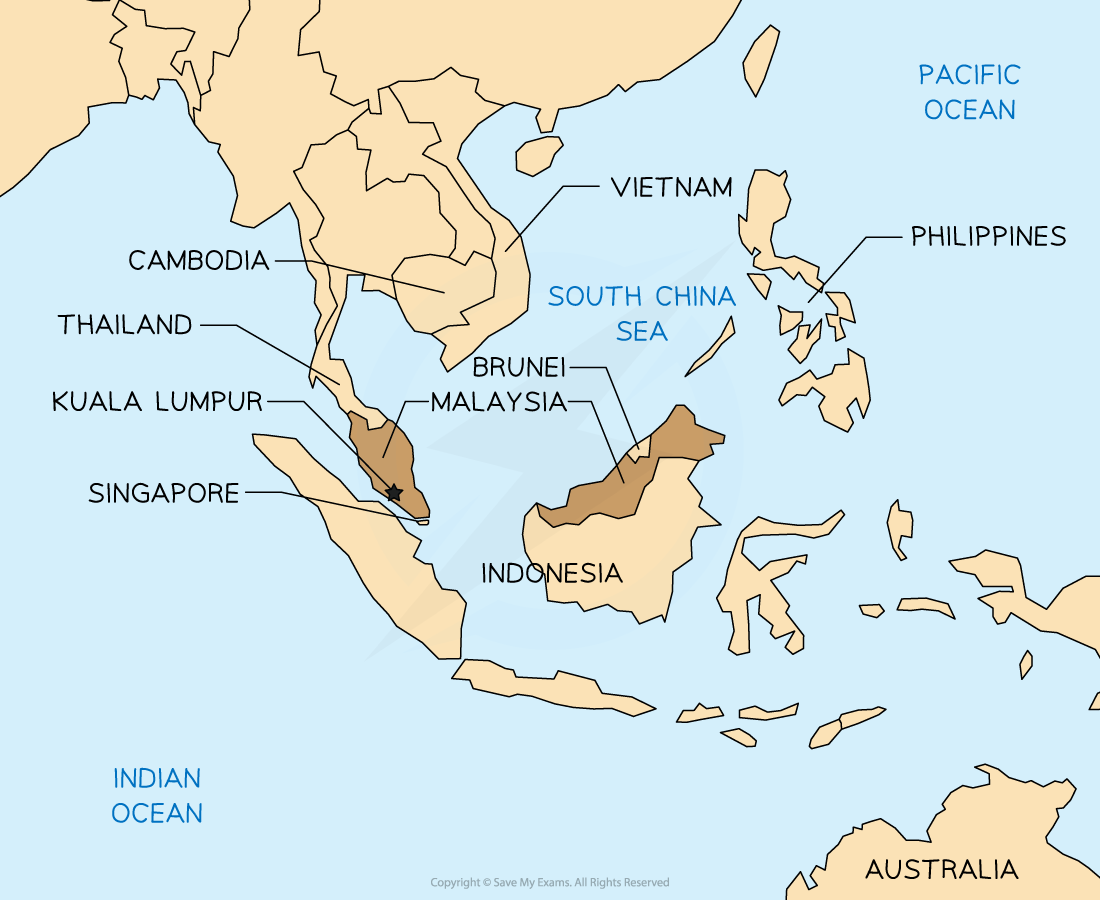
Location of Malaysia
Almost 70% of the land is covered by tropical rainforest
Climate
The climate of Malaysia is typical of tropical rainforest climates with high rainfall and high temperatures all year round
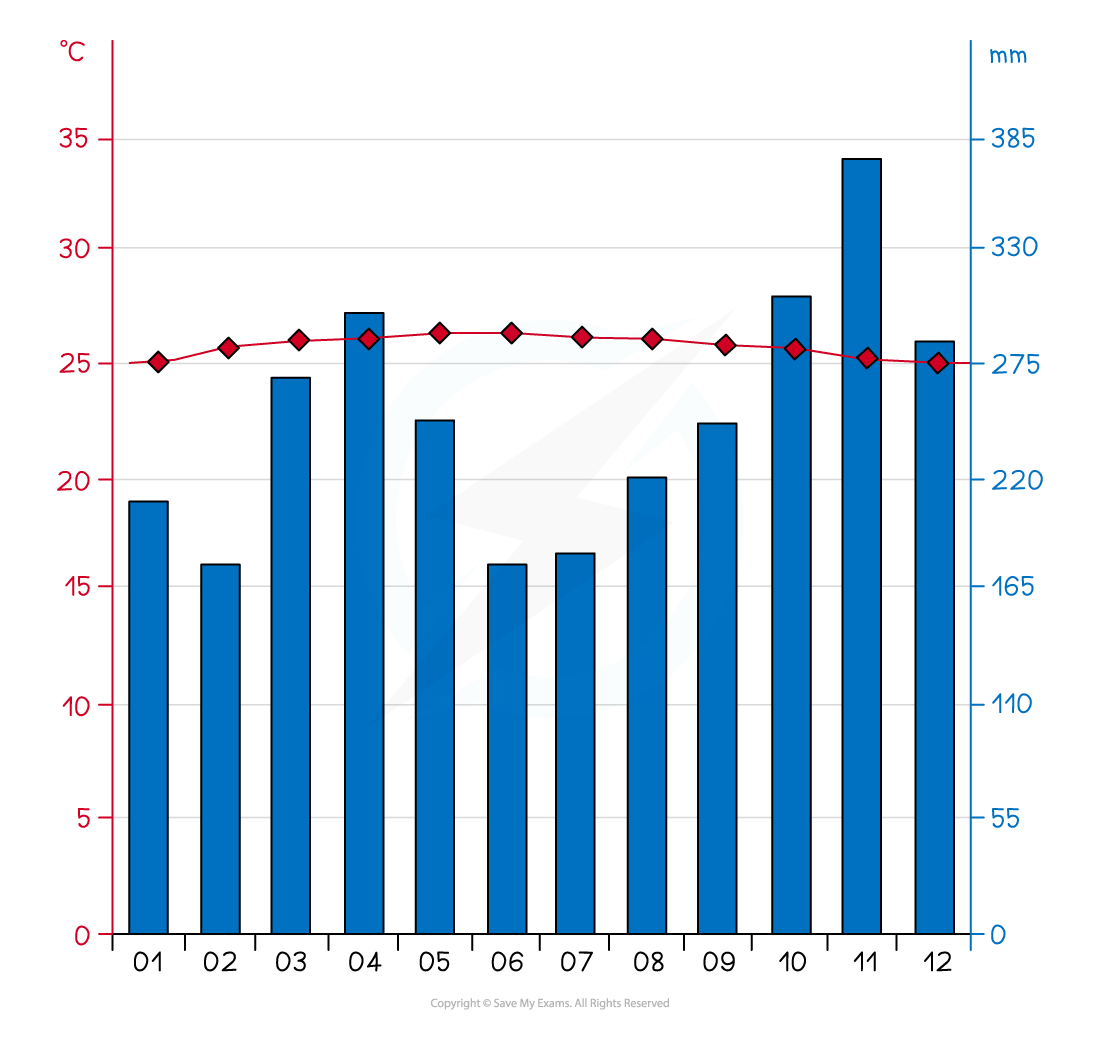
Climate Graph of Kuala Lumbar, Malaysia
The Malaysian rainforest has high biodiversity with over:
15,000 plant species, including 5,500 flowering plants and 2,600 tree species
750 bird species
250 mammal species
350 reptile species
190 amphibian species
350 fish species
1000 butterfly species
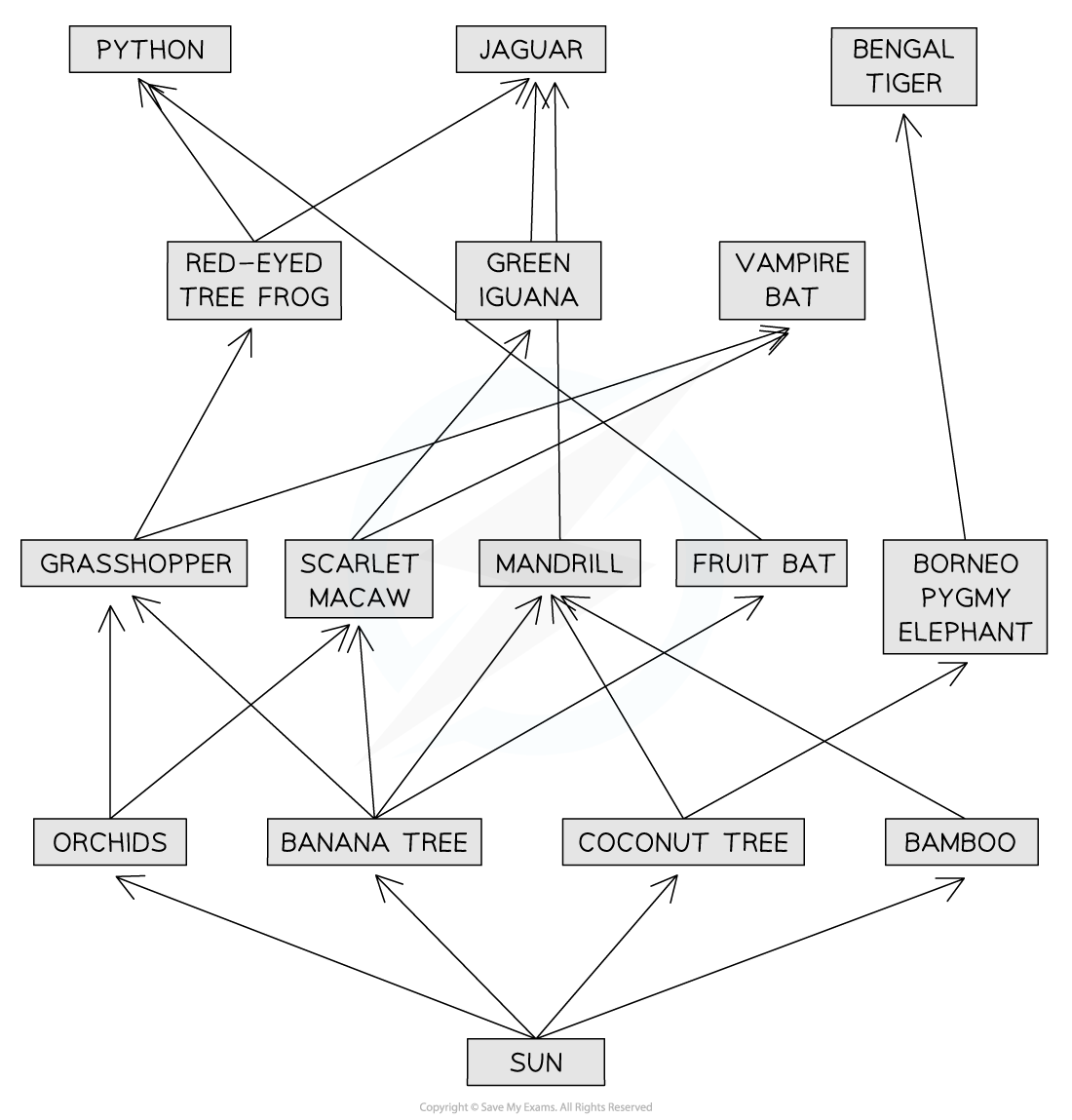
Malaysian Rainforest Food Web
Adaptations
There are many ways in which the animals and plants have adapted to the rainforest climate including:
Plants | Animals |
|---|---|
Pitcher plants - some of these are epiphytes which grow on other structures like trees and get their nutrients from capturing insects in a funnel which contains a sticky acidic liquid which dissolves the insect | Hornbill - the distinctive bill has multiple uses. The bird uses it to help it climb trees, like a trowel for digging |
Orchids - these are epiphytes which grow on other structures such as trees to reach the light | Orangutans - long and very strong arms which enable them to move easily through the trees. Fingers and toes are long used for gripping tree branches |
Lianas - these are vines which attach themselves or wrap themselves around trees to reach the light | Malayan Tapir - their colour pattern helps to camouflage them, and they use their long nose to forage on the forest floor for leaves, fruit and nuts |
Kapur tree - grows up to a height of 60m to reach the light. It has a straight branchless trunk to deter epiphytes and lianas from growing on it | Mulu Flying Frog - can change colour to camouflage it and it uses flaps of skin on its legs to glide from tree to tree |
Deforestation in Malaysia
It is estimated that Malaysia has the fastest rate of deforestation in the world
Since 2000 an average of over 140,000 hectares of forest has been felled and cleared each year
Causes
Logging
Malaysia is the largest exporter of tropical hardwoods
Although Malaysia has environmental protection policies there is still evidence of illegal logging in areas of Borneo
Selective logging is the dominant type of logging but this requires road construction and settlements which result in deforestation
Energy
The construction of dams to provide Hydroelectric power result in flooding of large areas of forest
The Bakun Dam will result in 700km2 of land being underwater in Sarawak, Malaysia
Mining
Tin mines are widespread and require deforestation for the mine itself but also for road construction
An iron ore mine planned for the Som Forest Reserve will result in the deforestation of over 60 hectares
There is also drilling for oil and gas
Commercial plantations
Malaysia exports over 30% of the world's palm oil and is the second largest producer
Many palm oil processes now adopting a zero-deforestation policy so that they do not buy palm oil from deforested areas. However, Clear felling permits are sometimes used in Malaysia to clear land and then sometime later another company will plant palm oil
Settlements
Up to 1980 people were encouraged to move to rural areas from the cities to try and reduce the pressure on urban areas
This led to the deforestation of approximately 15,000 hectares of rainforest
Subsistence farming
This can sometimes involve slash and burn where areas are cleared using fires - these can sometimes get out of control and destroy large areas of rainforest
Effects of deforestation
Soil erosion
Without the tree roots to bind the soil, the soil is more easily eroded by wind and rain
Exposed soil is more vulnerable to leaching of nutrients and the soil becomes less fertile
Loss of biodiversity
Habitats are destroyed and the ecosystem affected by deforestation so the variety of plants and animals decreases
Oil Palm plantations lead to a 35% reduction in species
Orangutans, pygmy elephants, Sumatran Rhino and Malayan tigers are all endangered
Local climate change
Reduced transpiration and evaporation leads to a decrease in precipitation and an increase in temperatures
Rainfall patterns become less reliable and more extreme
Global climate change
Felling of the trees leads to a decrease in the absorption of carbon dioxide
Increases carbon dioxide concentrations in the atmosphere and as this is a greenhouse gas this increases human induced climate change
Use of fire for clearance also increases carbon dioxide emissions
Indigenous communities
Indigenous communities such as the Orang Asli and Temiar have been forced off land
Pollination of fruits has reduced due to a decrease in pollinating insects and animals such as bats
This has reduced the available food sources
In Kuala Koh village 2019 at least 15 indigenous Batek died after an outbreak of disease possibly transmitted by loggers working near to the village
Example Case Study: Hot Desert, Namib Desert
Example Case Study: Hot Desert, Namib Desert
The Namib Desert is located mainly in Nambia on the west coast of Southern Africa
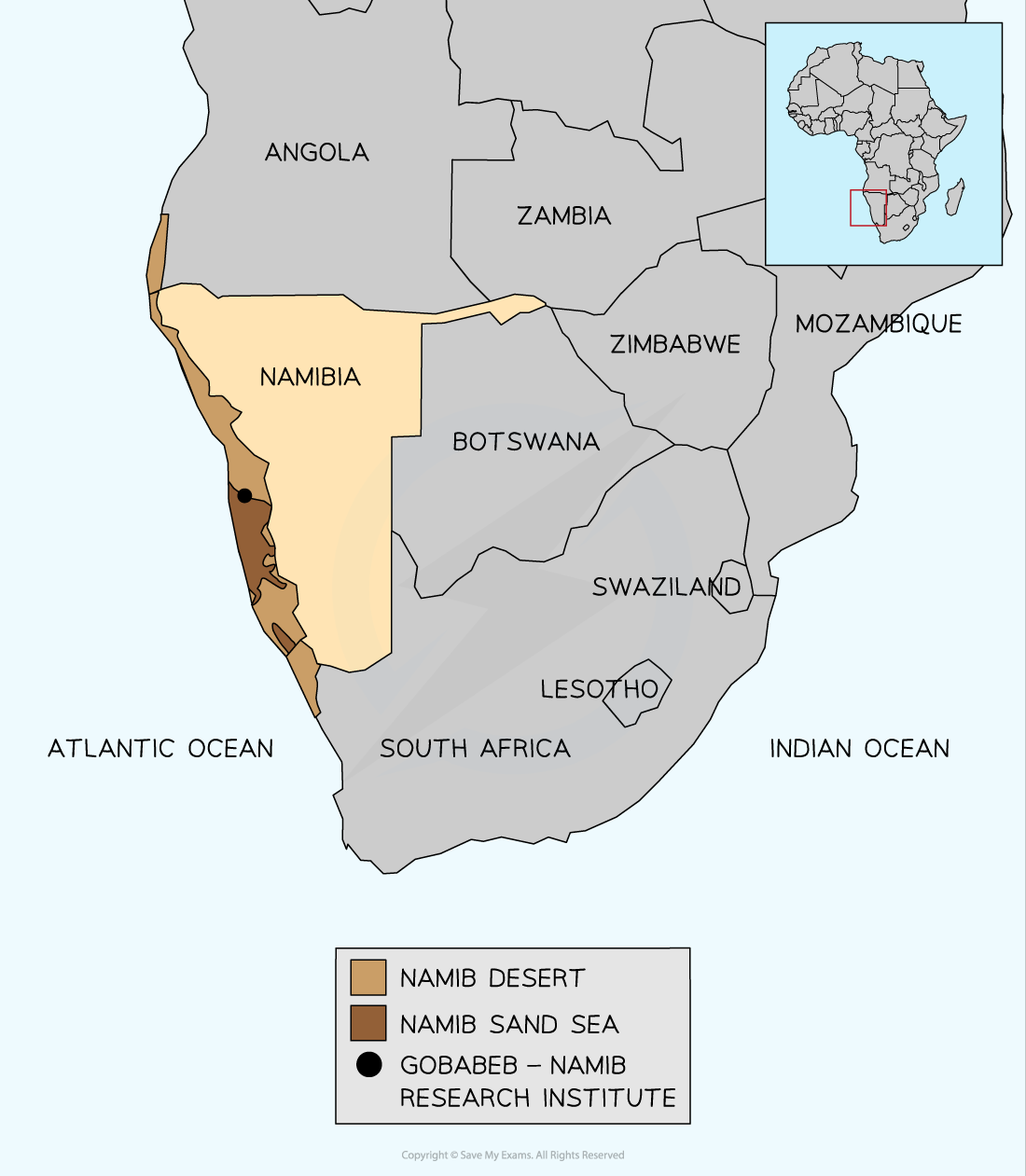
Location of the Namib Desert
Stretching for over 2,000km from Angola in the north to South Africa to the south
The desert is 160km wide
Climate
The highest day time temperatures can reach over 45oC
Night time temperatures can be as low as 0oC
The areas nearest to the coast are cooler due to the effect of a cold ocean current - the Benguela current
The cooling effect of the ocean can also lead to the formation of fog which can affect coastal areas more than half the year
Annual precipitation varies between 2-200mm a year
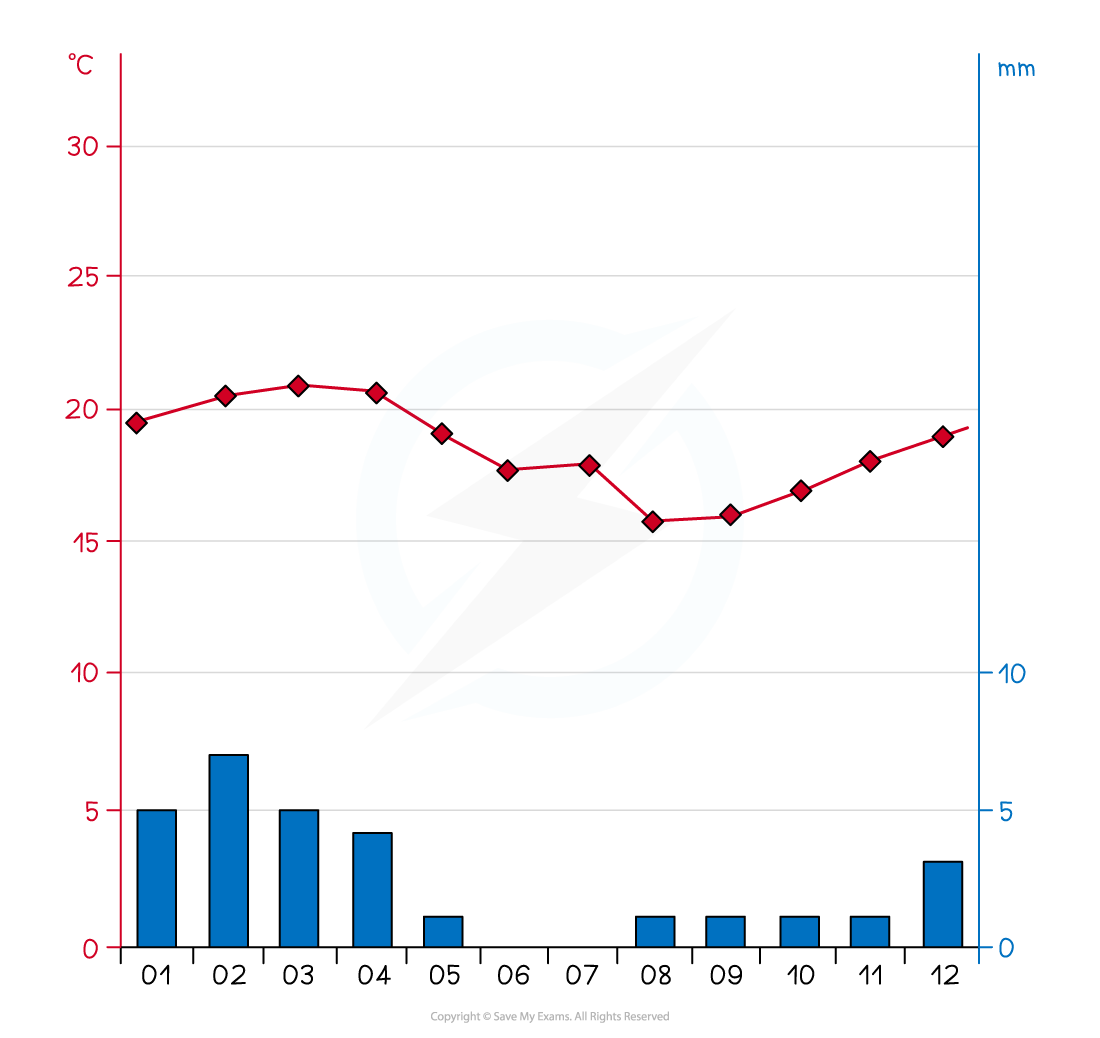
Climate Graph of Swakopmund
The Namib Desert has many species which are endemic and has higher levels of biodiversity than other hot desert areas
There are approximately 3,500 plant species over 50% of which are endemic
200 mammal species
268 reptile species
Over 6000 insect species
Adaptations
There are many ways in which plants and animals have adapted to the Namib Desert's unique climate, including:
Plants | Animals |
|---|---|
Welwitschia mirabilis - with just two leaves this plant only grows when conditions are favourable. The long leaves wrap around the bottom of the plant to give shade to the roots and reduce water loss. The colour of the leaves change turning red when it is very hot to protect the plant from the sun | Fog basking beetle - gathers water by standing on its head in a morning whilst the fog condensates on its back and trickles down to its mouth |
Nara plant - this plant has spikes instead of leaves to reduce water loss and it absorbs the water droplets from fog through its stems. The bottom of the plant dies off as it is covered with sand, this provides nutrients for the new growth | Desert elephant - have smaller bodies, broader feet and longer legs than other elephants. The broader feet help to spread their weight on the sand and the smaller body. |
Quiver Tree - these are succulents, they can store water in their trunks and branches due to the spongy fibre. Their leaves also store water and have a smooth waxy surface to reduce water loss. The yellowish bark helps to reflect the sun's heat | Wheel spider - these are nocturnal and so hunt at night when temperatures are cooler |
Camel Thorn Tree - has a strong tap root which can grow up to 60 meters allowing it to absorb water from deep underground | Golden mole - with powerful digging claws, dense fur which repels dirt so they can almost swim through the sand. With very efficient kidneys they do not need to drink much water all |
Threats and impacts on the desert ecosystem
Tourism
Increasing tourism to the Namib desert has led to more activities such as off-roading and sand boarding
Estimates suggest that desert soil takes over 2000 years to recover from being driven over
Vehicles destroy the small, but essential lichens and plants which are the foundation of the food web
Mining
Mining for diamonds, uranium, copper and zinc all occur in the Namib desert including the Rössing uranium mine near Swakopmund
Involves the removal of large areas of sand which then destroys plant and animal habitats
Increased pressure on scarce water resources due to the amount of water used in processing
Increase in air, soil and water pollution
Toxic waste may leach into the ground (leachate) which affects water sources
Agriculture
Irrigation increases salt levels in the soil and reduces the plant life
Increases the pressure on scarce water resources
Over-grazing in increasingly limited areas reduces the number of plant species and has impacted on the Golden Mole population
Farmers shoot and kill the desert lion as they view it as a threat to their livestock. This lion is now on the vulnerable species list
Poaching
Illegal poaching of animals such as the pangolin has impacted on the food web
Black rhino numbers have also decreased significantly as a result of illegal poaching