2.5.2 Ecosystem Characteristics
Tropical Rainforest Ecosystem Characteristics
Tropical Rainforest Ecosystem Characteristics
The Tropical rainforest (TRF) biome is mainly found in a band between 15o north and 15o south of the equator within the equatorial climate zone
Covering only 6% of the Earth's surface the main areas of tropical rainforest ecosystem are in the following countries;
Amazon which is the largest remaining rainforest on Earth usually associated with Brazil but covers parts of seven other countries
Central America including parts of Belize, Costa Rica, El Salvador, Guatemala, Honduras, Nicaragua, and Panama
Central Africa including Cameroon, the Central African Republic, the Republic of Congo, the Democratic Republic of Congo (DRC), Equatorial Guinea and Gabon
Indo-Malaysia, including Malaysia, Indonesia and a number of other countries in South-East Asia
Biodiversity
TRFs contain the highest biodiversity of plants and animals on Earth
Estimates range from over 50% to 80% of the world's plant and animal species
One 10 km2 area can contain up to 1,500 flowering plants, 750 species of trees, 400 species of birds and 150 species of butterflies
Nutrient cycle
The TRFs have a continual growing season with high rainfall and temperatures all year round
The nutrient cycle is rapid
Trees and plants lose their leaves all year round
The high level of moisture and high temperatures leads to rapid decomposition and recycling of nutrients
Plants grow quickly which leads to a rapid uptake of nutrients from the soil
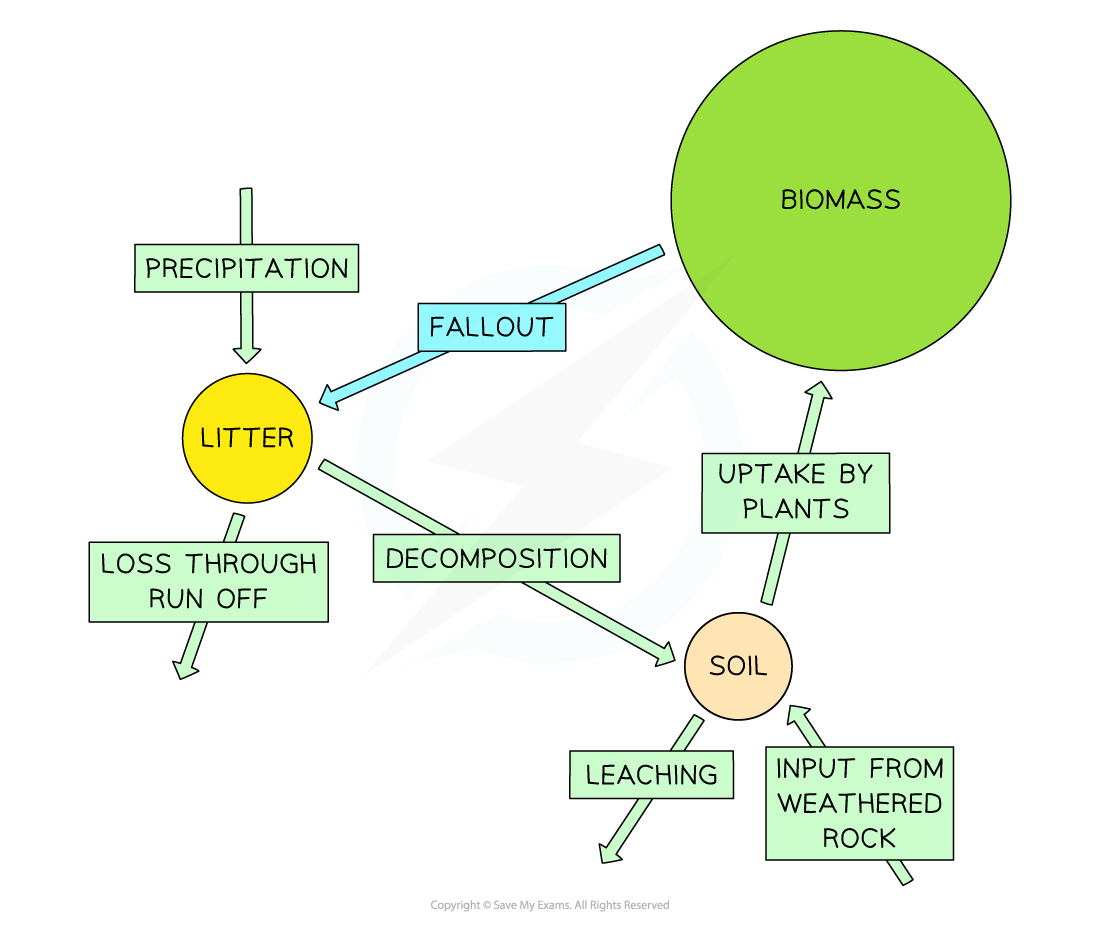
Tropical rainforest nutrient cycle
The result of this rapid nutrient cycle is that the soil in the TRF is not very fertile
Structure of the tropical rainforest
The TRF has five distinct layers
Ground layer (0m)
Shrub layer (3-4m)
Under canopy (15m)
Canopy (30m)
Emergents (45-55m)
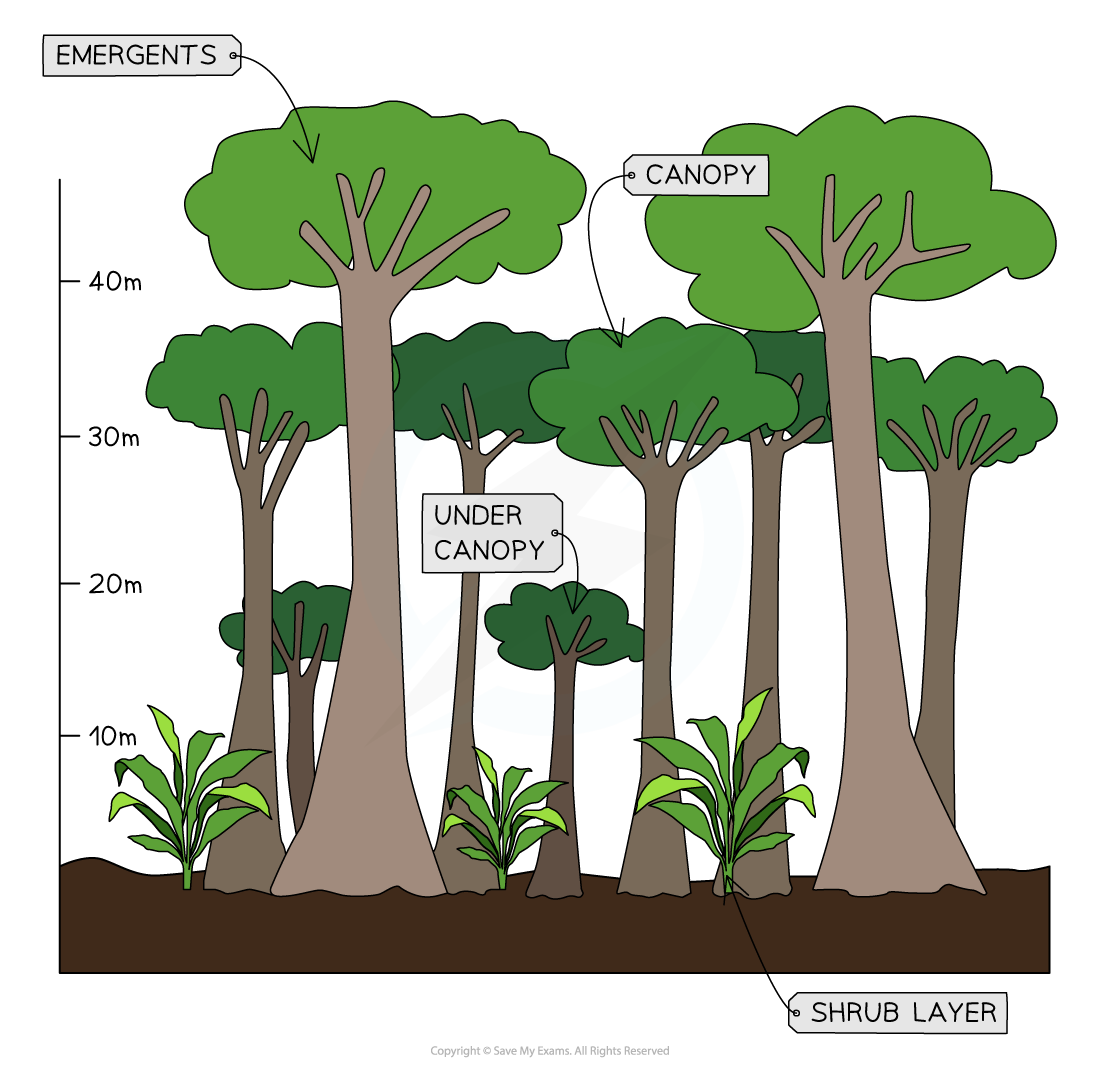
Tropical rainforest structure
Adaptations
The plants and animals within the TRF are very well adapted to the climate conditions
Plants | Animals |
|---|---|
Waxy leaves with drip tips - these ensure that rainwater runs off the leaf and does not remain which would encourage mould growth or break the leaf | Sloth - algae grow in the fur of the sloth helping to camouflage it |
Buttress roots - these large roots above the ground which help to support the very tall trees because the roots below the surface are shallow | Toucan - has a large bill to reach and cut fruit from the branches of trees |
Lianas - vines which use the tall trees as support to reach the sunlight | Primates - have prehensile tails to help them climb trees |
Epiphytes - these are plants which grow on trunks and branches of trees getting nutrients from air, rain or debris accumulating around the plant | Geckos - have large, flattened toe pads with sticky scales which allow them to grip the smooth tree trunks |
Straight, smooth trunks - to reduce the number of epiphytes using the tree | Stick Insects - their stick and leave shapes help them to be camouflaged |
Food web
As in all ecosystems the TRF has a complex food web which includes
Producers
Primary consumers
Secondary consumers
Tertiary consumers

Tropical rainforest food web
Hot Desert Ecosystem Characteristics
Hot Desert Ecosystem Characteristics
Hot desert biomes are mostly found in a band around the Tropic of Cancer and Tropic of Capricorn
Approximately 20% of the Earth's surface is covered by hot desert ecosystems including in the following areas;
North America - the Mojave and Sonoran Deserts of the USA and Mexico
South America - the Sechura Desert in Peru and the Atacama Desert in Chile
Africa - the Sahara, Kalahari, Namib and Somali Deserts
Middle East - the Arabian Desert
Asia - the Dasht-e Lut in Iran, the Gobi, Turkestan, Thar and Taklamakan Deserts
Oceania - the Australian Desert
Biodiversity
Hot deserts have one of the lowest biodiversity of plants and animals on Earth
The hot desert biome supports approximately 5000-6000 plant species, many invertebrates and up to 20 species of bird
Nutrient cycle
The growth of plants is limited due to the extremes of temperature and lack of water
The nutrient cycle is very slow
Most nutrients are stored in the soil
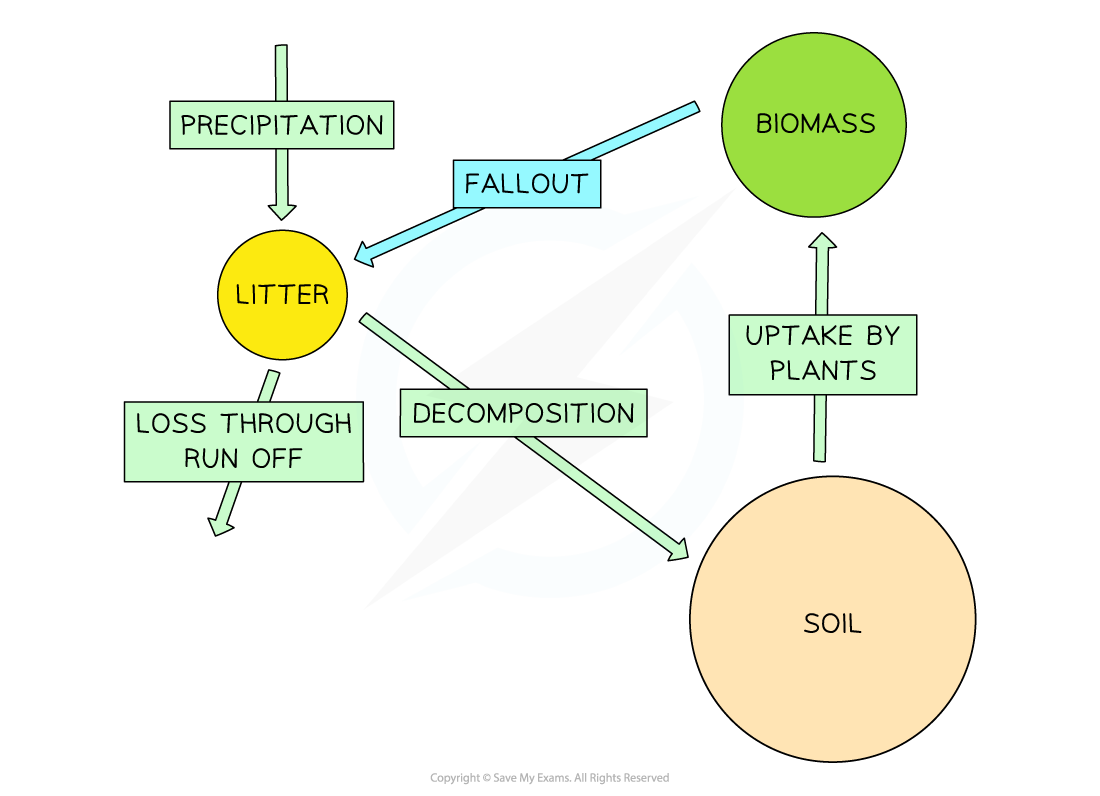
Hot desert nutrient cycle
Due to a lack of organic matter the soils are coarse, sandy and low in nutrients
Adaptations
To be able to survive the extreme temperatures and lack of rainfall the plants and animals are extremely well adapted
Plants | Animals |
|---|---|
Low growing - this helps to avoid water loss due to strong winds | Camels have a range of adaptations including two sets of eyelashes and nostrils which close to keep sand out of their ears and noses. They also store fat in their humps so they can survive for long periods without food or water |
Thick stems - used to store water | Fennec Fox - have large ears which help them to lose heat |
Shallow roots - these spread out near the surface to catch whatever rain falls | Burrowing - many animals burrow to avoid the intense day time heat |
Long roots - some plants have long tap roots instead of shallow roots to reach water deep underground | Insects and reptiles have waterproof skin to reduce water loss |
Small leaves or needles - the smaller surface area reduces water loss | Nocturnal - some animals hunt at night to avoid the daytime heat |
Food web
As in all ecosystems hot deserts have a complex food web which includes
Producers
Primary consumers
Secondary consumers
Tertiary consumers

Hot desert food web