StudyDeck

Types of Business Growth

Exam code: 7115
Written by: Ashika|Reviewed by: Caroline Carroll|Updated 2 July 2026

Reasons for Business Growth

Reasons for business growth

  • Many firms start small & will grow into large companies or even multi-national corporations

    • E.g. Amazon and Dell both started in entrepreneurs' garages

Reasons why businesses grow

  • The owner's or manager's desire to run a large business & continually seek to grow it

  • The owner's desire for higher levels of market share and profitability

  • The desire for stronger market power (monopoly) over its customers and suppliers

  • The desire to reduce costs by benefiting from lower unit costs as output increases

  • Growth provides opportunities for product diversification

  • Larger firms often have easier access to finance 


Methods of Business Growth

Methods of business growth

  • Business growth can be achieved by growing organically, or inorganically (mergers and takeovers)

1. Organic (internal) growth

  • Organic growth is growth that is driven by internal expansion using reinvested profits or loans

  • It is usually achieved by:

    • Gaining a greater market share

    • Product diversification

    • Opening new outlets

    • International expansion (new markets)

    • Investing in new technology/production machinery

Examples of organic growth

Business

Explanation

Apple

  • International expansion (new markets): Apple expanded into new markets by opening its stores in new countries, such as China and India, and by partnering with telecom providers to sell its products.

    • This helped them to organically increase their market share, sales revenue and profitability

Google

  • Product innovation: Google introduced new products, such as Google Drive and Google Maps, to complement its search engine and advertising businesses

    • This helped them to organically increase their market penetration, sales revenue and profitability

Disney

  • Product diversification: Disney has diversified into several areas, such as theme parks, cruise lines, television networks, and movie studios.

    • The brand strength has helped them organically increase market penetration in each of these markets, resulting in higher sales revenue and profitability

  • Product diversification opens up new revenue streams for a business

    • Firms may spend money on research and development, or innovation to existing products to help create a new revenue stream

  • Firms will often grow organically to the point where they are in a financial position to integrate (merge or buy) with others

    • Integration speeds up growth but also creates new challenges

Evaluating internal growth

Advantages

Disadvantages

  • The pace of growth is manageable

  • Less risky as growth is financed by profits and there is existing business expertise in the industry

  • The management knows & understands every part of the business

  • The pace of growth can be slow and frustrating

  • Not necessarily able to benefit from lower unit costs (e.g. bulk purchasing discounts from suppliers) as larger firms would be able to

  • Access to finance may be limited

2. Inorganic (external) growth

  • Firms will often grow organically to the point where they are in a financial position to integrate (merge or takeover) with others

    • Integration in the form of mergers or takeovers results in rapid business growth and is referred to as external or  inorganic growth

  • A merger occurs when two or more companies combine to form a new company

    • The original companies cease to exist and their assets and liabilities are transferred to the newly created entity

  • A takeover occurs when one company purchases another company, often against its will

    • The acquiring company buys a controlling stake in the target company's shares (>50%) and gains control of its operations

Vertical integration

  • Vertical integration refers to the merger or takeover of another firm in the supply chain or different stage of the production process

    • Forward vertical integration involves a merger with or takeover of a firm further forward in the supply chain

      • E.g. A dairy farmer merges with an ice cream manufacturer

    • Backward vertical integration involves a merger with or takeover of a firm further backwards in the supply chain

      • E.g. An ice cream retailer takes over an ice cream manufacturer
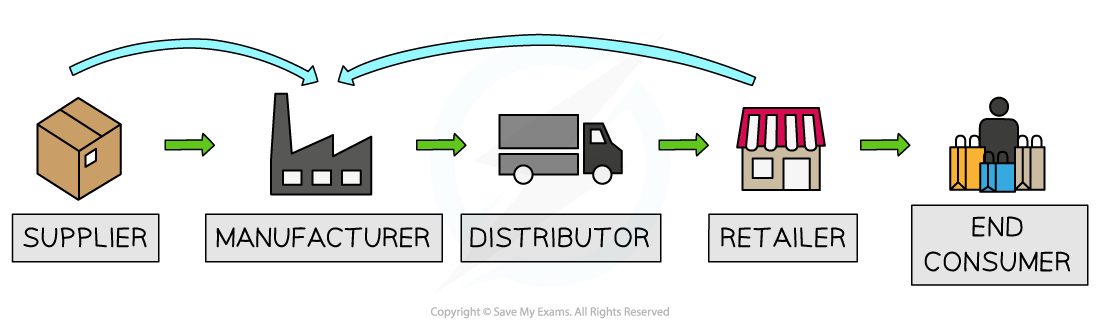
A firm can grow through forward or backward vertical integration, merging or taking over another business within the supply chain
A firm can grow through forward or backward vertical integration, merging with or taking over another business in the supply chain

Horizontal integration

  • Horizontal integration is the merger or takeover of a firm at the same stage of the production process

    • E.g. An ice cream manufacturer merges with another ice cream manufacturer

Evaluating external growth

Type of growth

Advantages

Disadvantages

Vertical integration
(Inorganic growth)

  • Reduces the cost of production as middle man profits are eliminated

  • Lower costs make the firm more competitive

  • Greater control over the supply chain reduces risk as access to raw materials is more certain

  • Quality of raw materials can be controlled

  • Forward integration adds additional profit as the profits from the next stage of production are assimilated

  • Forward integration can increase brand visibility

  • Diseconomies of scale occur as costs increase e.g. unnecessary duplication of management roles

  • There can be a culture clash between the two firms that have merged

  • Possibly little expertise in running the new firm results in inefficiencies

  • The price paid for the new firm may take a long time to recoup

Horizontal integration
(Inorganic growth)

  • Rapid increase of market share

  • Reductions in the cost per unit due to economies of scale

  • Reduces competition

  • Existing knowledge of the industry means the merger is more likely to be successful

  • Firm may gain new knowledge or expertise

  • Diseconomies of scale may occur as costs increase e.g. unnecessary duplication of management roles

  • There can be a culture clash between the two firms that have merged