Choosing a Suitable Type of Business Organisation
Determining a suitable ownership type
Determining a suitable ownership type
An entrepreneur must choose the ownership structure that suits the business needs, circumstances and the level of personal liability involved
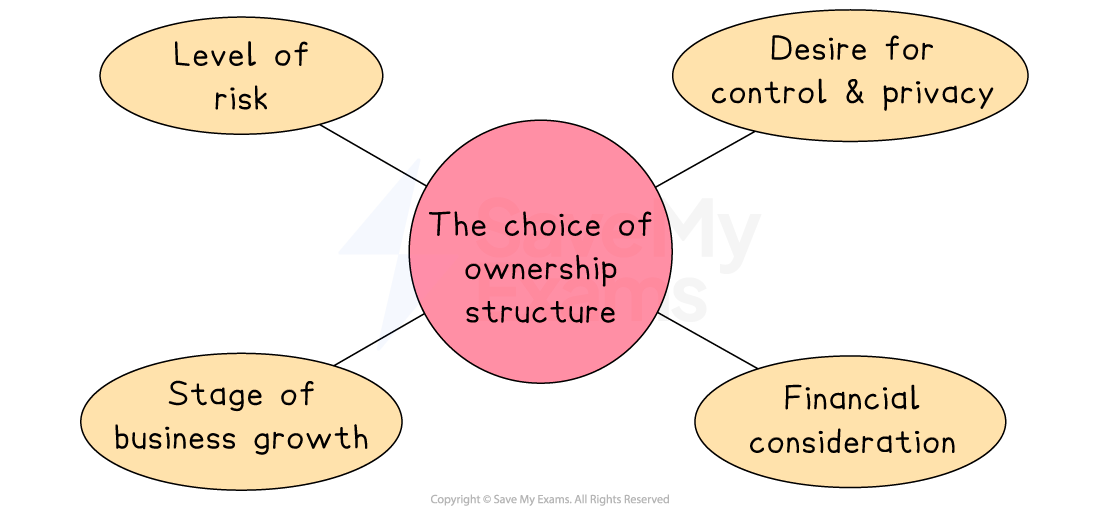
Factors affecting the choice of ownership structure
Level of risk
Entrepreneurs who want to protect their personal assets may choose a company structure with limited liability
If the business is small and the owner is willing to take personal financial risk, a sole trader structure may be enough.
For example, a builder setting up alone may accept the risk of unlimited liability, but a software company seeking funding might choose the security of limited liability
Desire for control and privacy
Sole traders have full control and can make quick decisions
Partnerships share decision-making but may have disagreements
Companies are run by directors, decisions may be slower or involve more people and accounts need to be published
For example, a freelance designer may prefer to be a sole trader for full independence
Financial considerations
Larger businesses often need more capital, which may not be possible as a sole trader or partnership
Companies can raise money by selling shares
For example, a technology start-up needing finance may choose to become a private limited company to attract investors
Stage of business growth
Businesses planning to grow quickly or expand internationally may choose a company structure to attract shareholders and funding
Those aiming to stay small and local might prefer a simpler ownership type.
EFor example, a café wanting to open branches across the country may change from a partnership to a private limited company
Business organisation for small firms
Business organisation for small firms
When starting a business, entrepreneurs often choose simple and flexible ownership structures that match their goals, resources and attitude to risk
Comparison of ownership types for small firms
Ownership type | Why it’s a good choice | Best for |
|---|---|---|
Sole trader |
|
|
Partnership |
|
|
Private limited company |
|
|
Business organisation for growing firms
Business organisation for growing firms
As a business grows, its needs become more complex, and choosing the right ownership structure becomes even more important
Growing businesses often require more finance, better risk management, and stronger organisational structures to support expansion
Comparison of ownership types for growing firms
Ownership type | Why it’s a good choice | Example |
|---|---|---|
Partnership |
|
|
Private limited company |
|
|
Public limited company |
|
|