StudyDeck

Measuring Business Size

Exam code: 7115
Written by: Ashika|Reviewed by: Caroline Carroll|Updated 2 July 2026

Methods of measuring business size

Methods of measuring business size

  • A simple way to classify businesses is to consider their size 
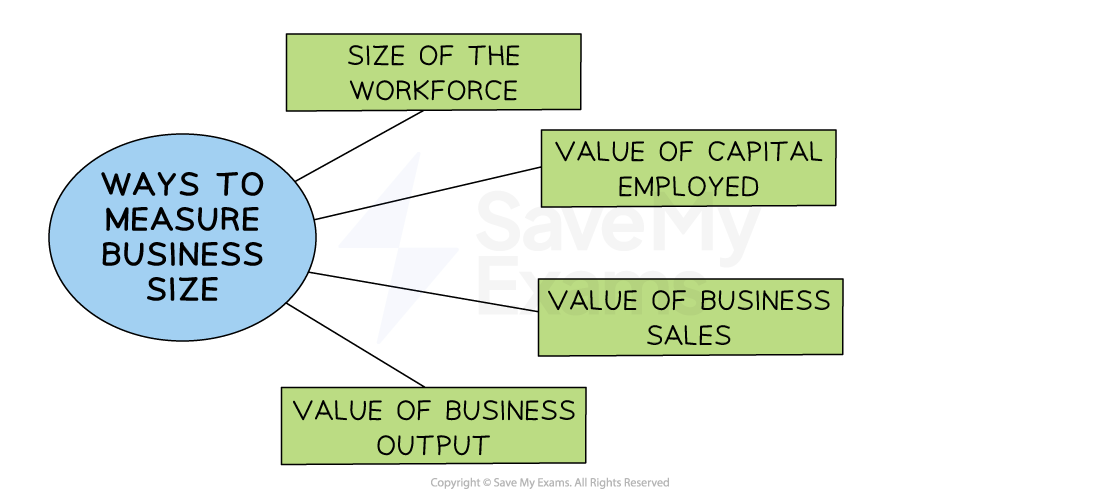
Flowchart showing ways to measure business size: workforce size, capital employed, sales value, and business output value.
Business size can be measured in several ways, including the size of the workforce, the value of capital employed and the value of sales or output

Size of the workforce

  • A measure of how many workers are in the business

  • Small and medium-sized businesses (SMEs) employ less than 250 employees

  • Large businesses have 250 or more employees

Value of capital employed by the business

  • Capital employed is a measure of all the capital (money, equipment, buildings) that is currently invested in a business

Value of business sales

  • The total sales revenue achieved during a trading period

  • It is calculated using the formula:

Price × Quantity{"fontFamily":"Times New Roman","fontSize":"18","autoformat":true,"toolbar":""}

  • The volume of sales can also be used to measure business size

Value of business output

  •  The financial worth of goods produced, even though they may not all be sold

  • It is calculated using the formula:

Total costs × Quantity{"fontFamily":"Times New Roman","fontSize":"18","autoformat":true,"toolbar":""}

  • The volume of output can also be used to measure business size

Problems when measuring business size

Problems when measuring business size

  • Each method of measuring business size has significant limitations

Limitations of measures of business size

Method

Limitations

Size of the workforce

  • The method of production can influence this metric significantly

    • Capital-intensive businesses produce high levels of output with few employees

    • Labour-intensive businesses have many employees that may generate a small volume of output

  • The nature of workers' contracts can make this measure unreliable

    • Some businesses hire part-time workers, while others prefer full-time workers

    • Short-term, zero hours or agency worker contracts may not be included in workforce measurement

Value of capital employed

  • Not accurate when comparing labour-intensive and capital-intensive production methods

    • European manufacturing businesses tend to have high levels of capital, such as robots or advanced machinery, compared to those located in countries such as Vietnam and Indonesia

    • Property values differ significantly across the world, and even between regions

      • For example, the value of property in Singapore is significantly greater than property in mainland China

Value of sales

  • Businesses sell very different products

    • Comparing a market stall selling sweets with a retailer of luxury handbags would be unrealistic, as their prices and volumes sold are very different

  • Selling prices vary between markets

    • Businesses may sell products to customers in low-income markets at a lower price than in a higher-income market

 Value of output

  • High-value output can be produced by businesses with very few employees or with limited capital employed

    • For example, a bespoke jewellery maker may produce only a few expensive items each year

  • The value of output does not measure how successful a business has been at selling goods produced. If they are left unsold, they are a poor measure of business size