Business Objectives
The Importance of Business Objectives
The importance of business objectives
Business aims are the long-term aspirations of an organisation
Business objectives are specific, measurable, achievable, relevant, and time-bound targets (SMART targets) that must be achieved to realise business aims
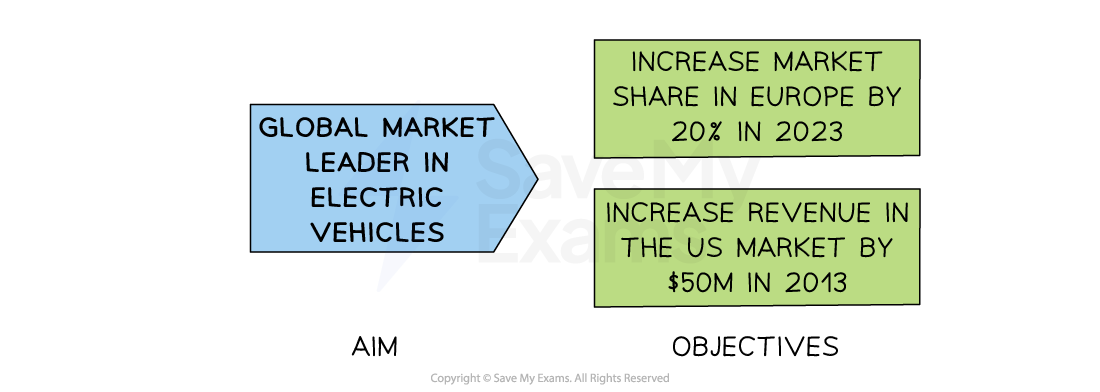
Every successful business needs to have clear aims and objectives that guide its operations and focus the efforts of all employees towards the same goal
Aims and objectives are critical for businesses to function effectively and achieve long-term success
A business aim may be to become the market leader in a particular industry
The corresponding objectives may include increasing sales by 25% over the next three years, improving customer satisfaction by 15%, and expanding into new geographic markets
The Most Common Business Objectives
The most common business objectives
Objectives provide a focus or target for managers and employees
Managers can determine how well the business or particular departments have performed over a period of time
Employees may be rewarded for their progress towards meeting objectives
Common business objectives
Objective | Explanation |
|---|---|
Survival |
|
Growth |
|
Profit |
|
Market share |
|
As businesses grow, their objectives often change over time
E.g. They may shift from survival and break-even to growth and profit maximisation
The Objectives of Social Enterprise
The objectives of social enterprises
Social entrepreneurs set socially-focused objectives for their business. They are in the private sector but do not have making a profit as their primary focus
They seek to make a profit in order to spend the money on achieving their social objective
Objectives may include
Social: to provide jobs and support for disadvantaged groups in society, such as the disabled or homeless
Environmental: to protect the environment
Ethical: to operate the business in a responsible way
Financial: to make a profit to invest back into the social enterprise to expand the social work that it performs
Butterfly Books is a social enterprise that publishes children’s educational books in the UK
Their aim is to 'work to educate, inspire and entertain children, aiming to change future generations by reducing gender bias in job roles'
A recent book entitled 'My Mummy is an Engineer' challenges gender stereotypes
Differences in Private & Public Sector Business Objectives
Differences in private and public sector business objectives
As discussed in Topic 1.2 (Classification using the public and private pector), businesses in the public and private sector have a different focus in terms of business objectives due to their ownership
Firms in the private sector are owned by individuals or other firms, while those in the public sector are owned and controlled by the government
Goals and objectives are mainly financial in the private sector, whereas the public sector's are generally for the greater good of society
Public versus private sector objectives
Public sector objectives
Usually focused on providing services to the local community, such as healthcare or education
Objectives are measurable, similar to private sector targets
E.g. patient waiting times for operations or railway punctuality targets
Social objectives
Improving community access to services (e.g. public libraries)
Creating employment opportunities in poorer areas
Financial objectives
Generating financial returns for the government to reinvest
Achieving a positive financial return, although not the primary aim
Private sector objectives
The main objective is often profit maximisation
Other common objectives include
Growth
Increasing shareholder returns
Increasing market share
Survival
Providing a service to the community