StudyDeck

Factor & Remainder Theorem

Exam code: 4037
Written by: Ashika|Reviewed by: Caroline Carroll|Updated 2 July 2026

Factor Theoremvideo

Factor Theorem

Factor theorem

What is the factor theorem?

  • The factor theorem is a useful result concerning the roots and factors of polynomials

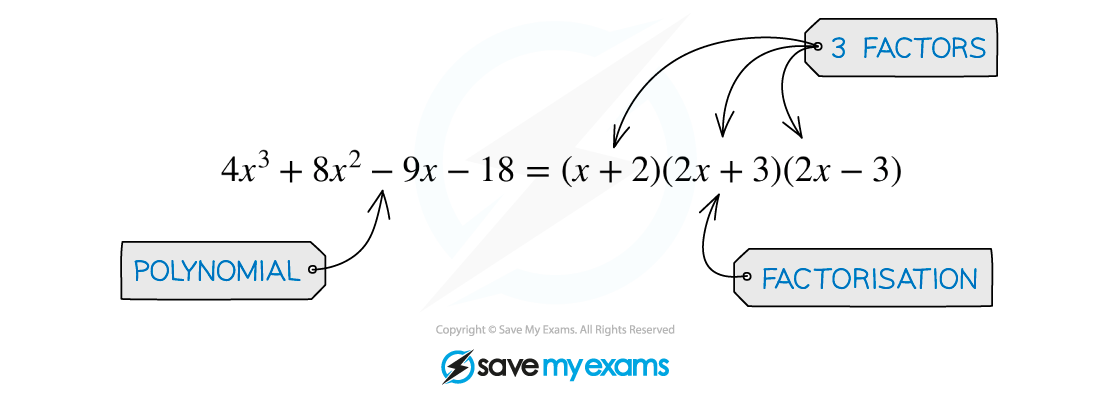
    • In the example below, the polynomial 4x3+8x2-9x-18{"language":"en","fontFamily":"Times New Roman","fontSize":"18","autoformat":true} has three (linear) factors

      • x+2, 2x+3{"language":"en","fontFamily":"Times New Roman","fontSize":"18","autoformat":true} and 2x-3{"language":"en","fontFamily":"Times New Roman","fontSize":"18","autoformat":true}

      • and so it has the three roots x=-2, x=-32{"language":"en","fontFamily":"Times New Roman","fontSize":"18","autoformat":true} and x=32{"language":"en","fontFamily":"Times New Roman","fontSize":"18","autoformat":true}

Factorised polynomial with 3 factors
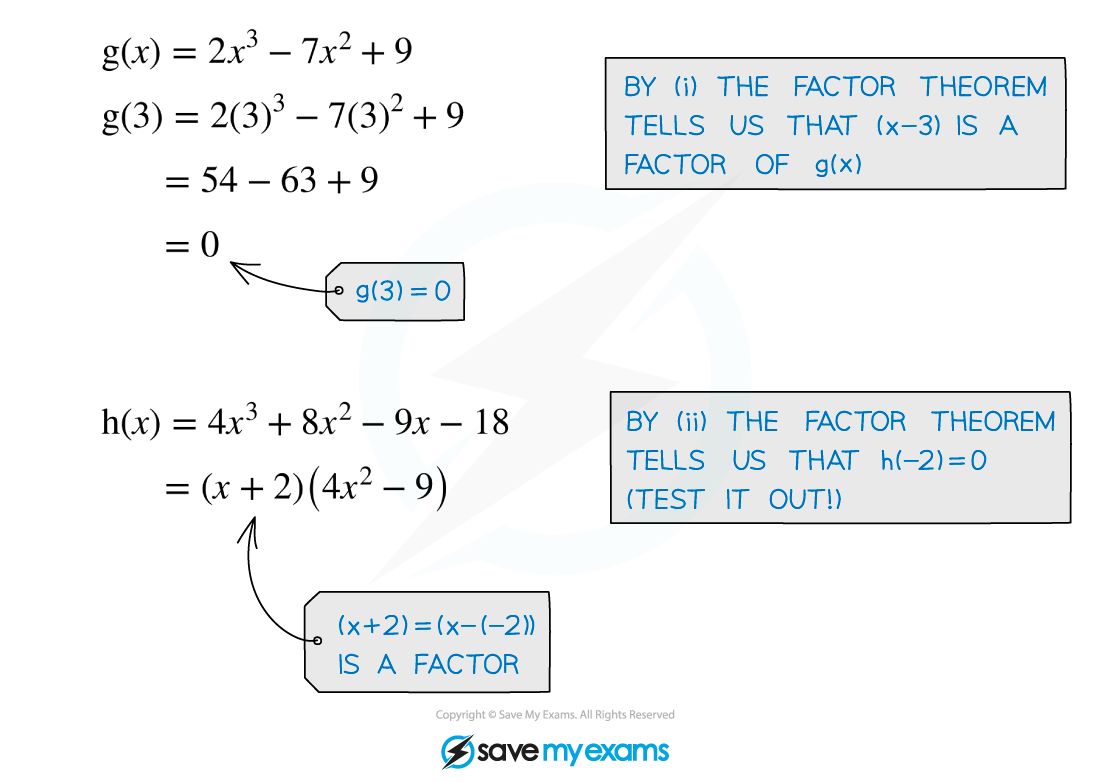
  • For a polynomial fx{"language":"en","fontFamily":"Times New Roman","fontSize":"18","autoformat":true} the factor theorem states that:

i) if fp=0{"language":"en","fontFamily":"Times New Roman","fontSize":"18","autoformat":true}, then x-p{"language":"en","fontFamily":"Times New Roman","fontSize":"18","autoformat":true} is a factor of fx{"language":"en","fontFamily":"Times New Roman","fontSize":"18","autoformat":true}
(x=p{"language":"en","fontFamily":"Times New Roman","fontSize":"18","autoformat":true} is a root of fx{"language":"en","fontFamily":"Times New Roman","fontSize":"18","autoformat":true})

and

ii) if x-p{"language":"en","fontFamily":"Times New Roman","fontSize":"18","autoformat":true} is a factor of fx{"language":"en","fontFamily":"Times New Roman","fontSize":"18","autoformat":true}, then fp=0{"language":"en","fontFamily":"Times New Roman","fontSize":"18","autoformat":true}

explanation of the factor theorem

Remainder Theorem

Remainder theorem

What is the remainder theorem?

  • The factor theorem is actually a special case of the more general remainder theorem

  • The remainder theorem states that when the polynomial fx{"language":"en","fontFamily":"Times New Roman","fontSize":"18","autoformat":true} is divided by x-a{"language":"en","fontFamily":"Times New Roman","fontSize":"18","autoformat":true} the remainder is fa{"language":"en","fontFamily":"Times New Roman","fontSize":"18","autoformat":true}

    • You may see this written formally as fx=x-aQx+fa{"language":"en","fontFamily":"Times New Roman","fontSize":"18","autoformat":true}

    • In polynomial division

      • Qx{"language":"en","fontFamily":"Times New Roman","fontSize":"18","autoformat":true} would be the result (at the top) of the division (the quotient)

      • fa{"language":"en","fontFamily":"Times New Roman","fontSize":"18","autoformat":true} would be the remainder (at the bottom)

      • x-a{"language":"en","fontFamily":"Times New Roman","fontSize":"18","autoformat":true} is called the divisor

    • In the case when fa=0, fx=x-aQx{"language":"en","fontFamily":"Times New Roman","fontSize":"18","autoformat":true} and hence x-a{"language":"en","fontFamily":"Times New Roman","fontSize":"18","autoformat":true} is a factor of fx{"language":"en","fontFamily":"Times New Roman","fontSize":"18","autoformat":true} – the factor theorem!

How do I solve problems involving the remainder theorem?

  • If it is the remainder that is of particular interest, the remainder theorem saves the need to carry out polynomial division in full

    • e.g.  The remainder from (x2-2x)÷(x-3){"language":"en","fontFamily":"Times New Roman","fontSize":"18"} is 32-2×3=3{"language":"en","fontFamily":"Times New Roman","fontSize":"18"}

    • This is because if fx=x2-2x{"language":"en","fontFamily":"Times New Roman","fontSize":"18","autoformat":true} and a=3{"language":"en","fontFamily":"Times New Roman","fontSize":"18","autoformat":true}

  • If the remainder from a polynomial division is known, the remainder theorem can be used to find unknown coefficients in polynomials

    • g. The remainder from (x2+px)÷(x-2){"language":"en","fontFamily":"Times New Roman","fontSize":"18"} is 8 so the value of p can be found by solving 22+p2=8{"language":"en","fontFamily":"Times New Roman","fontSize":"18"}, leading to p = 2{"language":"en","fontFamily":"Times New Roman","fontSize":"18"}

    • In harder problems there may be more than one unknown in which case simultaneous equations would need setting up and solving

  • The more general version of remainder theorem is if fx{"language":"en","fontFamily":"Times New Roman","fontSize":"18","autoformat":true} is divided by ax-b{"language":"en","fontFamily":"Times New Roman","fontSize":"18","autoformat":true} then the remainder is  f(ba){"language":"en","fontFamily":"Times New Roman","fontSize":"18"}

    • The remainder is still found by evaluating the polynomial at the value of x{"language":"en","fontFamily":"Times New Roman","fontSize":"18","autoformat":true} such that ax-b=0{"language":"en","fontFamily":"Times New Roman","fontSize":"18","autoformat":true} (the divisor is zero) but it is not necessarily an integer