StudyDeck

Logarithmic Functions

Exam code: 4037
Written by: Ashika|Reviewed by: Caroline Carroll|Updated 2 July 2026

Logarithmic Functionsvideo

Logarithmic Functions

Logarithmic functions

What are logarithmic functions?

  • A logarithm is the inverse of raising to a power 

  • If a = bx{"language":"en","fontFamily":"Times New Roman","fontSize":"18","autoformat":true} then logba = x{"language":"en","fontFamily":"Times New Roman","fontSize":"18","autoformat":true}

    • a > 0{"language":"en","fontFamily":"Times New Roman","fontSize":"18","autoformat":true}

    • b{"language":"en","fontFamily":"Times New Roman","fontSize":"18","autoformat":true} is called the base of the logarithm

  • Try to get used to ‘reading’ logarithm statements to yourself

    •  log...... ={"language":"en","fontFamily":"Times New Roman","fontSize":"18","autoformat":true} would be read as “the power that you raise ... to, to get ..., is ”

    • So log5125=3{"language":"en","fontFamily":"Times New Roman","fontSize":"18","autoformat":true} would be read as “the power that you raise 5 to, to get 125, is 3”
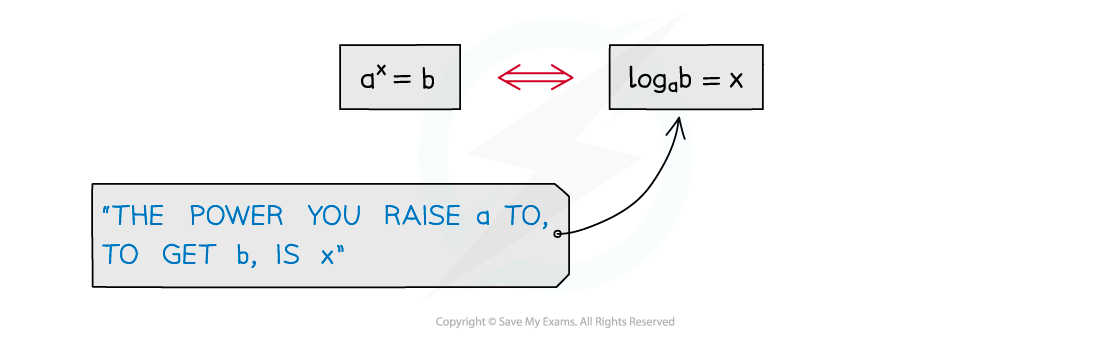
Connection between exponentials and logarithms
  • A logarithm is the inverse of raising to a power so we can use rules to simplify logarithmic functions
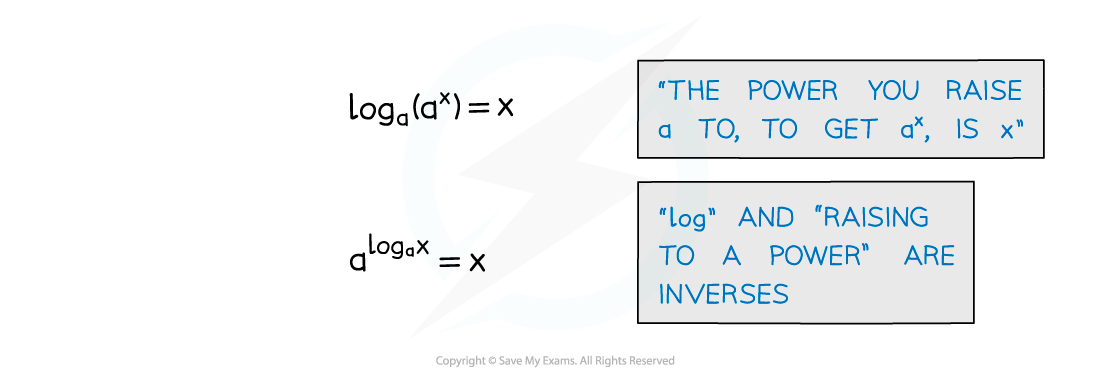
Logarithms as functions with their inverses

Why use logarithms?

  • Logarithms allow us to solve equations where the exponent is the unknown value

    • We can solve some of these by inspection

      • For example, for the equation 2x = 8 we know that x must be 3

    • Logarithms allow use to solve more complicated problems

      • For example, the equation 2x = 10 does not have a clear answer

      • Instead, we can use our calculator to find the value of log210{"language":"en","fontFamily":"Times New Roman","fontSize":"18"}

How do I use logarithms?

Finding the values of logarithms
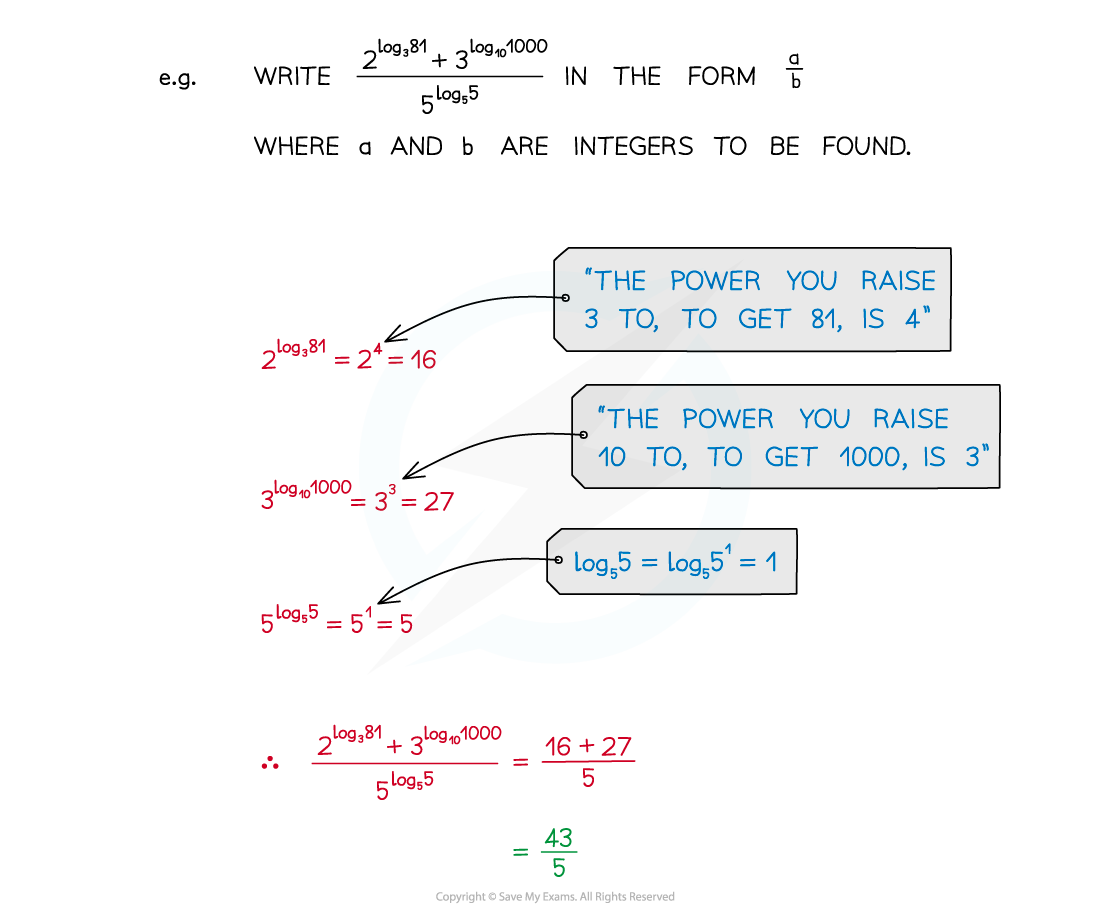
  •  Recognising the rules of logarithms allows expressions to be simplified
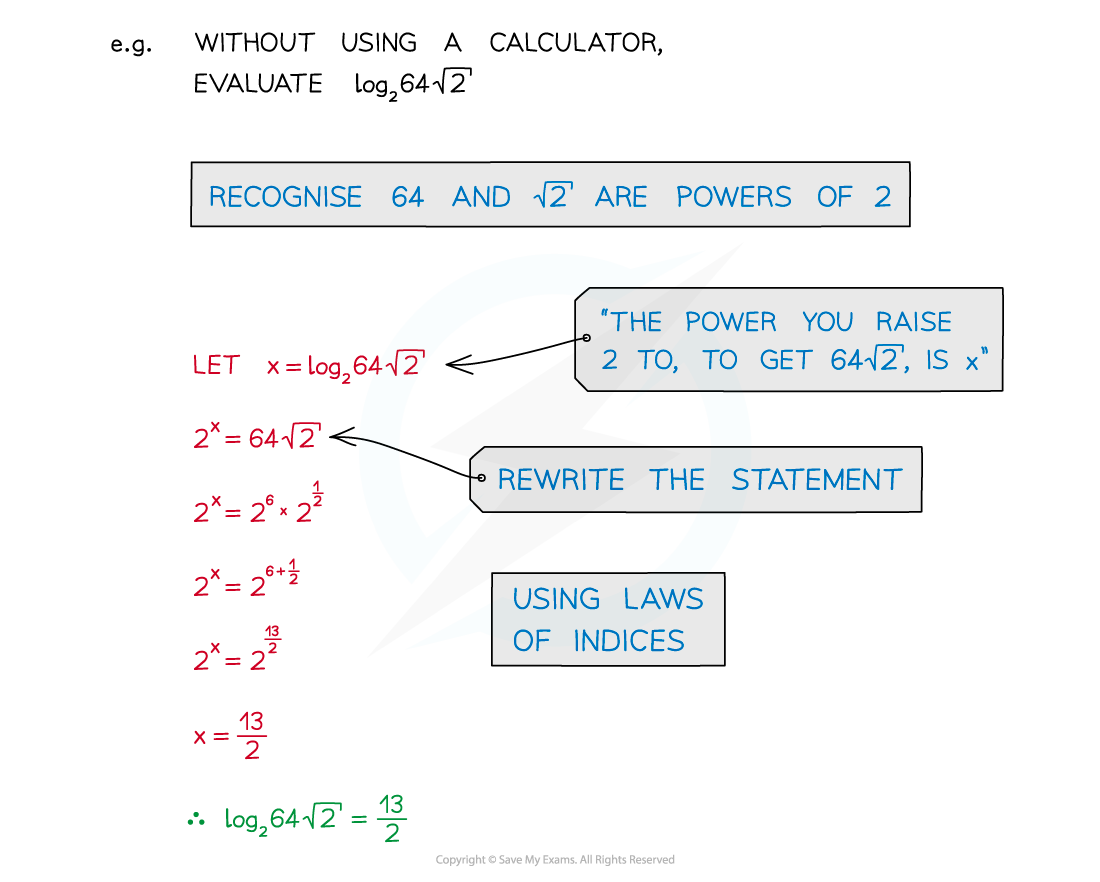
Working out a complicated logarithm
  • Recognition of common powers helps in simple cases

    • Powers of 2: 20 = 1, 21 = 2, 22 = 4, 23 = 8, 24 =16, …

    • Powers of 3: 30 = 1, 31 = 3, 32 = 9, 33 = 27, 34 = 81, …

    • The first few powers of 4, 5 and 10 should also be familiar

    For more awkward cases a calculator is needed 
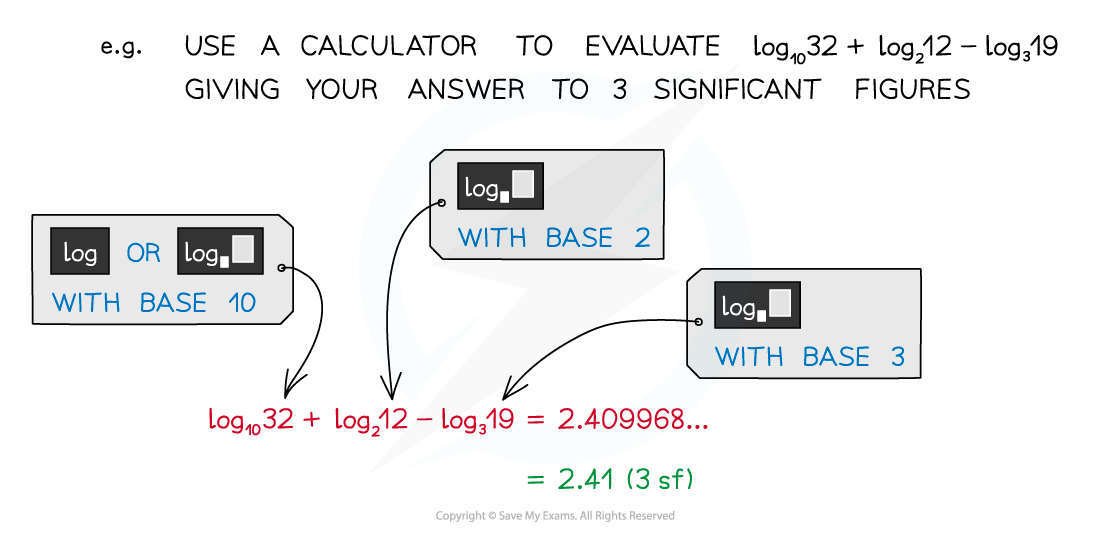
    Using a calculator to find logarithms
  • Calculators can have, possibly, three different logarithm buttons

logarithm button with a base


  • This button allows you to type in any number for the base

The button for ln
  • Natural logarithms (see “e”)

The button for log (base 10)
  • Shortcut for base 10 although SHIFT button needed 

  • Before calculators, logarithmic values had to be looked up in printed tables

What notation might I see with logarithms?
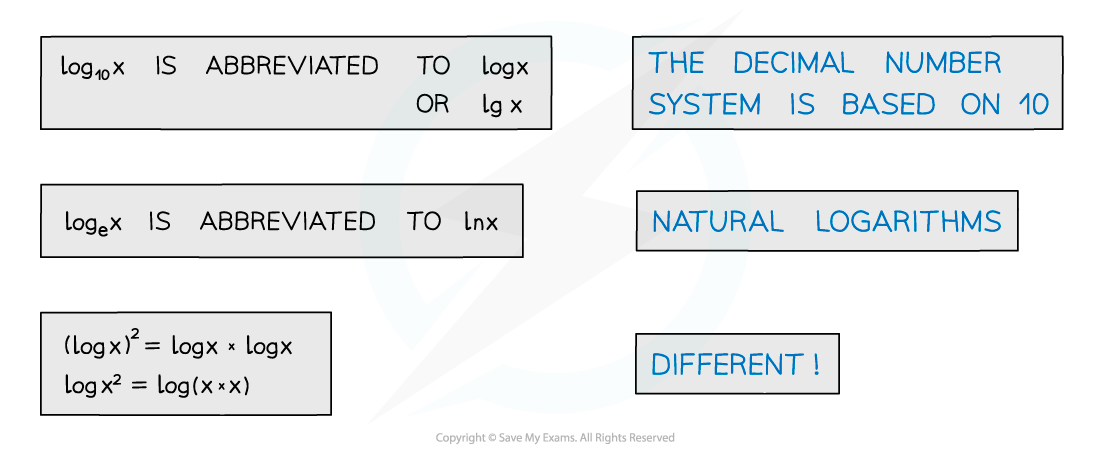
Abbreviations for common logarithms
  • 10 is a common base

    • log10 x is abbreviated to log x or lg x

  • The value e is another common base

    • loge x is abbreviated to ln x

  • (log x)2 ≠ log x2

ln x

ln x

What is ln? 

  • ln is a function that stands for natural logarithm

  • It is a logarithm where the base is the constant "e"

    • ln x≡logex{"language":"en","fontFamily":"Times New Roman","fontSize":"18"}

    • It is important to remember that ln is a function and not a number

  • The natural logarithm (ln x{"language":"en","fontFamily":"Times New Roman","fontSize":"18","autoformat":true}) and the exponential function (ex{"language":"en","fontFamily":"Times New Roman","fontSize":"18","autoformat":true}) are inverses of each other 

  • It is defined for all positive numbers (x > 0{"language":"en","fontFamily":"Times New Roman","fontSize":"18","autoformat":true})

    • ln x{"language":"en","fontFamily":"Times New Roman","fontSize":"18","autoformat":true} cannot be defined for negative numbers or x = 0{"language":"en","fontFamily":"Times New Roman","fontSize":"18","autoformat":true}

What are the properties of ln? 

  • Using the definition of a logarithm you can see

    • ln 1=0{"language":"en","fontFamily":"Times New Roman","fontSize":"18"}

    • ln e=1{"language":"en","fontFamily":"Times New Roman","fontSize":"18"}

    • ln ex=x{"language":"en","fontFamily":"Times New Roman","fontSize":"18"} 

    • ln x{"language":"en","fontFamily":"Times New Roman","fontSize":"18"} is only defined for positive x

How can I solve equations involving e & ln? 

  • The functions ex{"language":"en","fontFamily":"Times New Roman","fontSize":"18"} and ln x{"language":"en","fontFamily":"Times New Roman","fontSize":"18"} are inverses of each other

    • If ex=a{"language":"en","fontFamily":"Times New Roman","fontSize":"18","autoformat":true} then x=ln⁡ a{"language":"en","fontFamily":"Times New Roman","fontSize":"18","autoformat":true}

    • If ln⁡ x=a{"language":"en","fontFamily":"Times New Roman","fontSize":"18","autoformat":true} then x=ea{"language":"en","fontFamily":"Times New Roman","fontSize":"18","autoformat":true}

    • If ef(x)=g(x){"language":"en","fontFamily":"Times New Roman","fontSize":"18"} then f(x)=ln⁡ g(x){"language":"en","fontFamily":"Times New Roman","fontSize":"18"}

    • If ln⁡ f(x)=gx{"language":"en","fontFamily":"Times New Roman","fontSize":"18"} then fx=egx{"language":"en","fontFamily":"Times New Roman","fontSize":"18"}

  • If your equation involves "e" then try to get all the "e" terms on one side

    • If "e" terms are multiplied, you can add the powers

      • ex×ey=ex+y{"language":"en","fontFamily":"Times New Roman","fontSize":"18"} 

      • You can then apply ln to both sides of the equation

    • If "e" terms are added, try transforming the equation with a substitution

      • For example: If y=ex{"language":"en","fontFamily":"Times New Roman","fontSize":"18"} then e4x=y4{"language":"en","fontFamily":"Times New Roman","fontSize":"18"}

      • You can then solve the resulting equation (usually a quadratic)

      • Once you solve for y then solve for x using the substitution formula

  • If your equation involves "ln", try to combine all "ln" terms together

    • Use the laws of logarithms to combine terms into a single term

    • If you have ln⁡ fx=ln⁡ g(x){"language":"en","fontFamily":"Times New Roman","fontSize":"18"} then solve fx=g(x){"language":"en","fontFamily":"Times New Roman","fontSize":"18"}

    • If you have ln⁡ fx=k{"language":"en","fontFamily":"Times New Roman","fontSize":"18"} then solve fx=ek{"language":"en","fontFamily":"Times New Roman","fontSize":"18"}