Inverse Functions
Inverse Functions
Inverse functions
What is an inverse function?
An inverse function does the exact opposite of the function it came from
For example, if the function “doubles the number and adds 1” then its inverse is
“subtract 1 and halve the result”
It is the inverse operations in the reverse order
How do I write inverse functions?
An inverse function f-1 can be written as or
For example, if its inverse can be written as
or
How do I find an inverse function?
The easiest way to find an inverse function is to 'cheat' and swap the and variables
Note that this is a useful method but you MUST remember not to do this in any other circumstances in maths
STEP 1 Write the function in the form e.g.
STEP 2 Swap the 's and's to get e.g.
STEP 3 Rearrange the expression to make the subject again
STEP 4 Rewrite using the correct notation for an inverse function
either as f-1(x) = … or f-1 : x ↦ …
should not exist in the final answer
e.g.
How does a function relate to its inverse?
If then the input of 3 gives an output of 10
The inverse function undoes f(x)
An input of 10 into the inverse function gives an output of 3
If then
If you apply a function to x, then immediately apply its inverse function, you get x
Whatever happened to x gets undone
f and f-1 cancel each other out when applied together
If and you want to solve
Finding the inverse function in this case is tricky (impossible if you haven't studied logarithms)
instead, take f of both sides and use that cancel each other out:
What condition is needed for an inverse function to exist?
For the inverse function to exist, , the original function must be one-to-one
Substituting 1 input into must give 1 output only
Substituting this 1 output into must give back the original input only
At no point are more values allowed to be created!
Domain & Range of Inverse Functions
Domain & range of inverse functions
How do I find the domain and range of inverse functions?
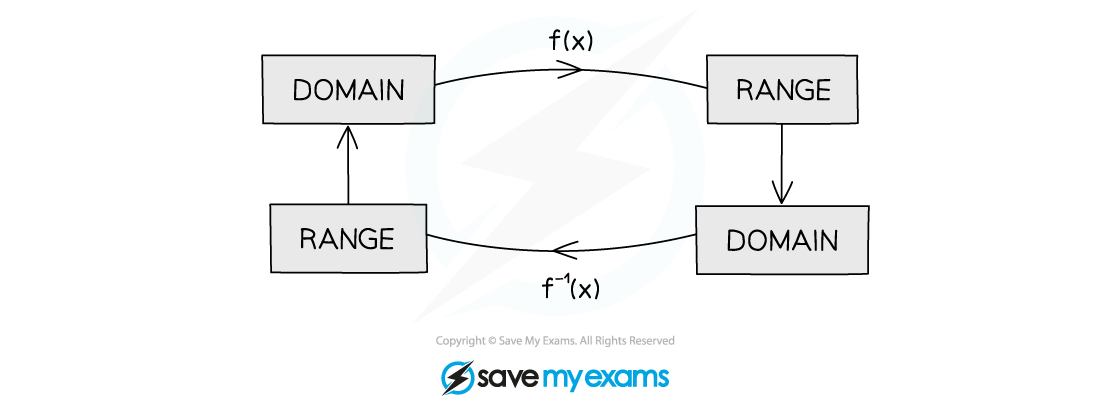
The range of a function will be the domain of its inverse function
The domain of a function will be the range of its inverse function
Graphs of Inverse Functions
Graphs of inverse functions
How are the graphs of a function and its inverse related?
The graph of an inverse function, , is a reflection of the graph of the function, , in the line
Key features of the graph of will be reflected, such as
and axes intercepts
turning points
asymptotes
How do I sketch the graph of an inverse function?
STEP 1
Sketch the line , and if need be, the graph of
STEP 2
Reflect the graph of in the line
Remember it is a sketch, but the graphs together should look like reflections
Consider points where the reflected graph will intersect the and axes
e.g. The point will be reflected to the point
Consider any asymptotes on the graph of - these will also be need reflecting
e.g. The asymptote (line) will be reflected to the line
Consider any restrictions on the domain and range of
e.g. If the domain is only sketch the graph for positive values of
STEP 3
Label key points on the sketch of and state the equations of any asymptotes
This process works the other way round - the graph of can be sketched from the graph of