Solving Cubic Equations
Solving Cubic Equationsvideo
Solving cubic equations
What is a cubic equation?
A cubic function is an polynomial of degree 3
i.e. the highest power of is 3
A cubic equation can be written in the form
Solving a cubic equation involves factorising the cubic function first.
How do I factorise a cubic function?
Factorising a cubic (function) combines the factor theorem with the method of polynomial division
The example below shows the steps for factorising a cubic

STEP 1
Use factor theorem.
Find a value such that .
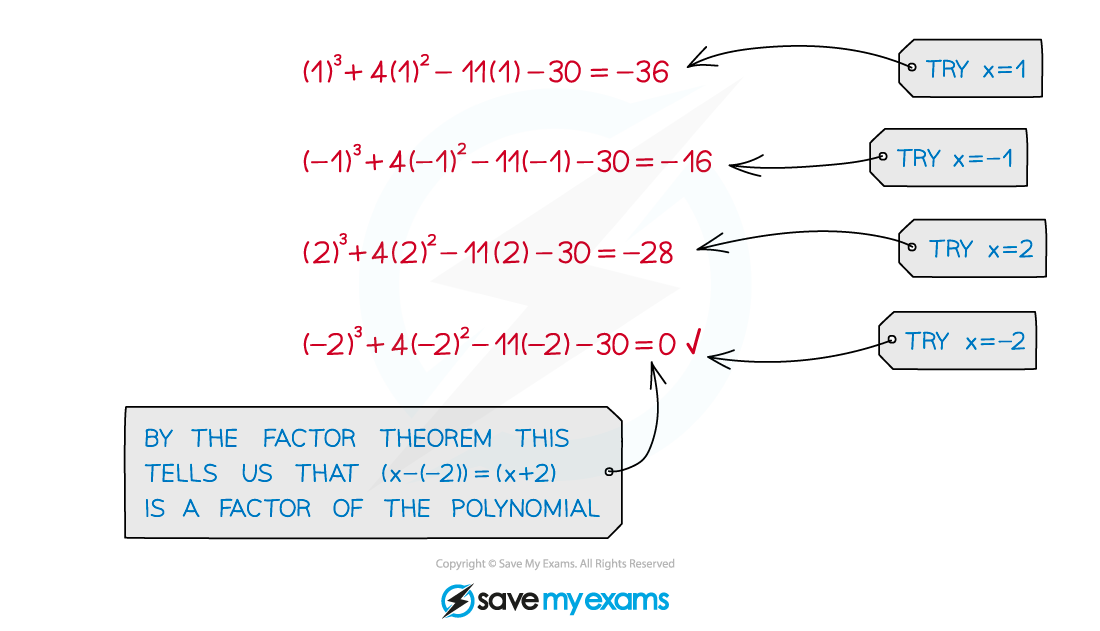
STEP 2
Use polynomial division.
Divide by .
(It is possible to do this step 'by inspection', see the worked example below)
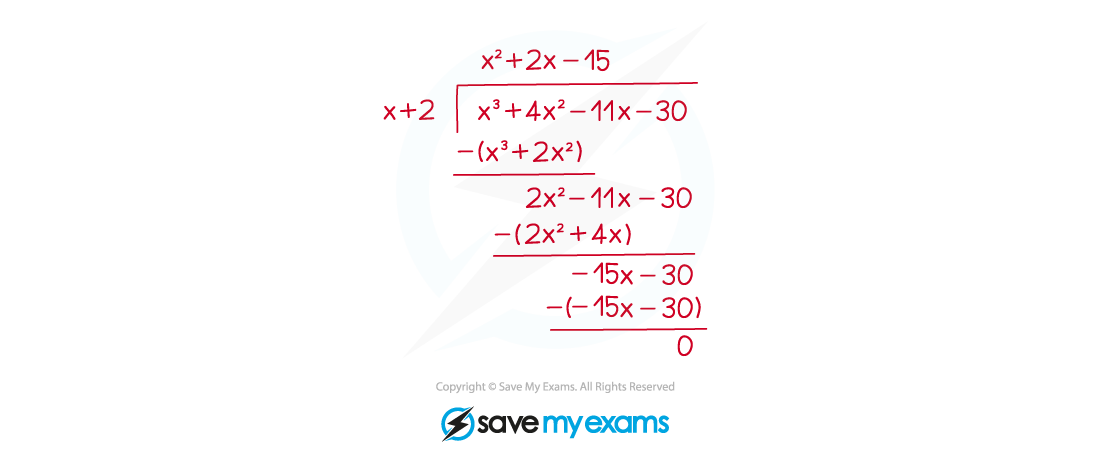
STEP 3
Use the result of your division to write .
STEP 4
If the quadratic can be factorised, do so.
can then be written as the product of three linear factors.
If the quadratic cannot be factorised, then the result from STEP 3 is the final factorisation.

How do I solve a cubic equation?
A cubic equation will have either 1, 2 or 3 (real) solutions
(The cubic function will have either 1, 2 or 3 (real) roots)
Once the cubic function is factorised using the four steps above, there is one more step to carry out
STEP 5 Find the solutions to the cubic equation by making each factor equal to zero
For each linear factor,
so is a solution
This is the factor theorem!
For a quadratic factor,
use either the quadratic formula or completing the square (as it won't factorise)
this will give two of the solutions to the cubic equation
if there are no solutions to the quadratic equation there are no solutions other than that from the linear factor
From the example above,
so the solutions to the cubic equation are
and
Cubic equations can have equal (repeated) solutions
e.g. has two (equal and real) roots, (repeated) and
e.g. has three (equal and real) roots,