StudyDeck

Discriminants

Exam code: 4037
Written by: Ashika|Reviewed by: Caroline Carroll|Updated 2 July 2026

Discriminants

Discriminants

What is a discriminant?

  • The discriminant is the part of the quadratic formula that is under the square root sign 

  • It is b2-4ac{"language":"en","fontFamily":"Times New Roman","fontSize":"18"}

    • The quadratic formula, in full, is

x=-b±b2-4ac2a{"language":"en","fontFamily":"Times New Roman","fontSize":"18","autoformat":true}

where the quadratic equation is written in the form

ax2+bx+c=0{"language":"en","fontFamily":"Times New Roman","fontSize":"18","autoformat":true}

  • It is sometimes denoted by the Greek letter Δ{"language":"en","fontFamily":"Times New Roman","fontSize":"18","autoformat":true} (capital delta)

Applications of Discriminant

Applications of discriminant

How does the value of the discriminant affect roots?

  • There are three options for the outcome of the discriminant:

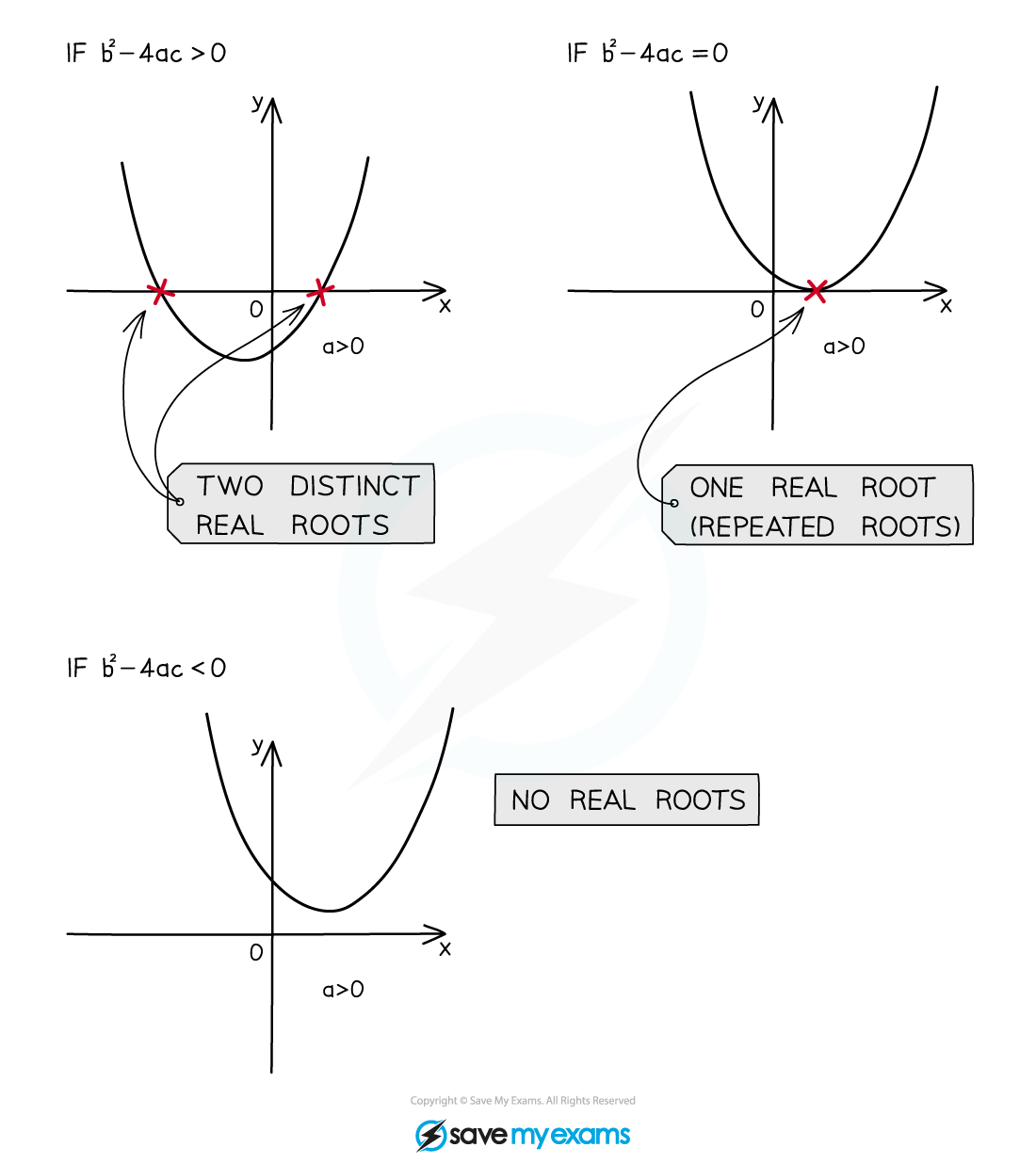
    • If b2-4ac >0{"language":"en","fontFamily":"Times New Roman","fontSize":"18"} the square root part of the quadratic formula can be calculated leading to two solutions (values of x{"language":"en","fontFamily":"Times New Roman","fontSize":"18","autoformat":true})

      • i.e. two different real roots

    • If  b2-4ac=0{"language":"en","fontFamily":"Times New Roman","fontSize":"18"} the square root part of the quadratic formula will be zero leading to one solution

      • i.e. one repeated root or two equal roots

    • If  b2-4ac <0{"language":"en","fontFamily":"Times New Roman","fontSize":"18"} the square root part of the quadratic formula cannot be calculated leading to no solutions

      • i.e. no (real) roots

How do I sketch quadratic graphs using the discriminant?

  • If b2-4ac >0{"language":"en","fontFamily":"Times New Roman","fontSize":"18"} the quadratic equation has two different real roots

    • The graph of the quadratic will intersect the x{"language":"en","fontFamily":"Times New Roman","fontSize":"18","autoformat":true}-axis twice (at the roots)

  • If  b2-4ac=0{"language":"en","fontFamily":"Times New Roman","fontSize":"18"} the quadratic equation has two equal roots (one root)

    • The graph of the quadratic will intersect (touch) the x{"language":"en","fontFamily":"Times New Roman","fontSize":"18","autoformat":true}-axis once (at the root)

  • If  b2-4ac <0{"language":"en","fontFamily":"Times New Roman","fontSize":"18"} the quadratic equation has no (real) roots

    • The graph of the quadratic will not intercept the x{"language":"en","fontFamily":"Times New Roman","fontSize":"18","autoformat":true}-axis

The discriminant determines how many roots a quadratic graph has

How do I use the discriminant to find the number of intersections between a line and a curve?

  • For the graphs of two functions, y=fx{"language":"en","fontFamily":"Times New Roman","fontSize":"18","autoformat":true} and y=gx{"language":"en","fontFamily":"Times New Roman","fontSize":"18","autoformat":true} where

    • fx{"language":"en","fontFamily":"Times New Roman","fontSize":"18","autoformat":true} is quadratic

    • gx{"language":"en","fontFamily":"Times New Roman","fontSize":"18","autoformat":true} is linear

the number of intersections between the graphs can be found using the discriminant.

  • STEP 1

    • Set fx=gx{"language":"en","fontFamily":"Times New Roman","fontSize":"18","autoformat":true}

  • STEP 2

    • Rearrange into the form hx=0{"language":"en","fontFamily":"Times New Roman","fontSize":"18","autoformat":true} such that hx{"language":"en","fontFamily":"Times New Roman","fontSize":"18","autoformat":true} is in the quadratic form ax2+bx+c=0{"language":"en","fontFamily":"Times New Roman","fontSize":"18","autoformat":true}

  • STEP 3

    • Find the discriminant and thus determine the number of intersections between the graphs of y=fx{"language":"en","fontFamily":"Times New Roman","fontSize":"18","autoformat":true}and y=gx{"language":"en","fontFamily":"Times New Roman","fontSize":"18","autoformat":true}

      • if b2-4ac>0{"language":"en","fontFamily":"Times New Roman","fontSize":"18","autoformat":true} (two real roots) the graphs intersect twice

      • if b2-4ac=0{"language":"en","fontFamily":"Times New Roman","fontSize":"18","autoformat":true} (equal roots) the graphs intersect once

      • this means the line (gx{"language":"en","fontFamily":"Times New Roman","fontSize":"18","autoformat":true}) is a tangent to the curve (fx{"language":"en","fontFamily":"Times New Roman","fontSize":"18","autoformat":true})

      • if b2-4ac<0{"language":"en","fontFamily":"Times New Roman","fontSize":"18","autoformat":true} (no real roots) the graphs do not intersect
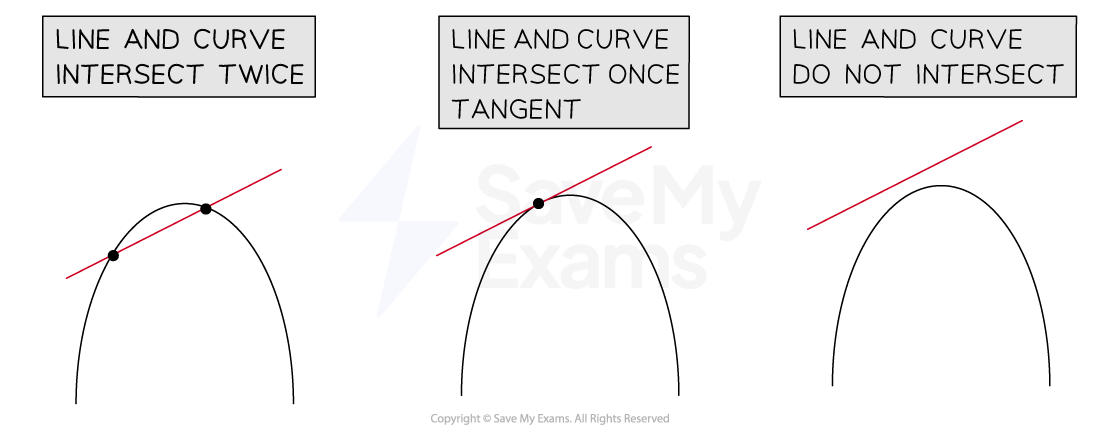
The possible intersections between a line and a quadratic