StudyDeck

Laws of Logarithms

Exam code: 4037
Written by: Ashika|Reviewed by: Caroline Carroll|Updated 2 July 2026

Laws of Logarithmsvideo

Laws of Logarithms

Laws of logarithms

What are the laws of logarithms?

  • Laws of logarithms allow you to simplify and manipulate expressions involving logarithms

    • The laws of logarithms are equivalent to the laws of indices

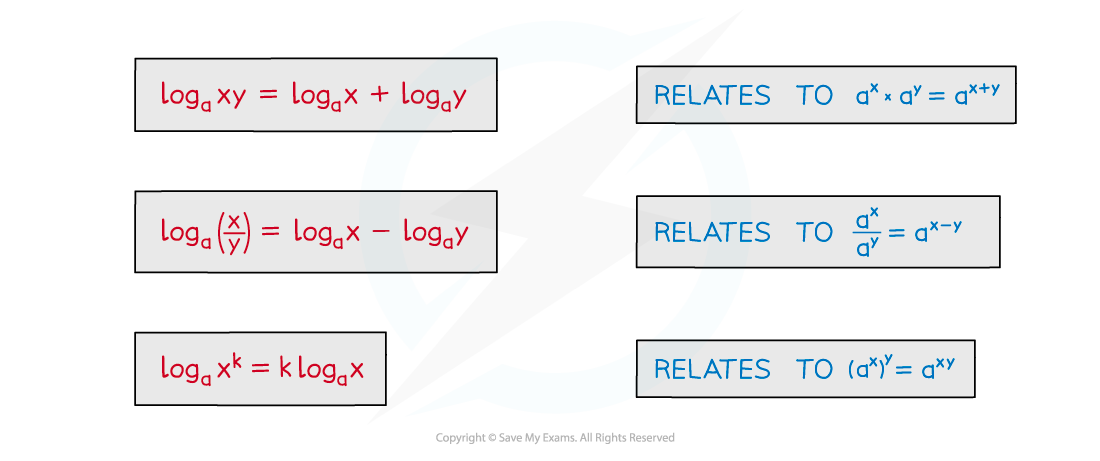
  • The laws you need to know are, given a, x, y > 0{"language":"en","fontFamily":"Times New Roman","fontSize":"18","autoformat":true}:

    • logaxy= logax+ logay{"language":"en","fontFamily":"Times New Roman","fontSize":"18"}

      • This relates to ax× ay=ax+y{"language":"en","fontFamily":"Times New Roman","fontSize":"18"}

    • logaxy= logax - logay{"language":"en","fontFamily":"Times New Roman","fontSize":"18"} 

      • This relates to ax÷ ay=ax-y{"language":"en","fontFamily":"Times New Roman","fontSize":"18"}

    • logaxm= mlogax{"language":"en","fontFamily":"Times New Roman","fontSize":"18"} 

      • This relates to (ax)y=axy{"language":"en","fontFamily":"Times New Roman","fontSize":"18"}

The laws of logarithms
  • There are also some particular results these lead to
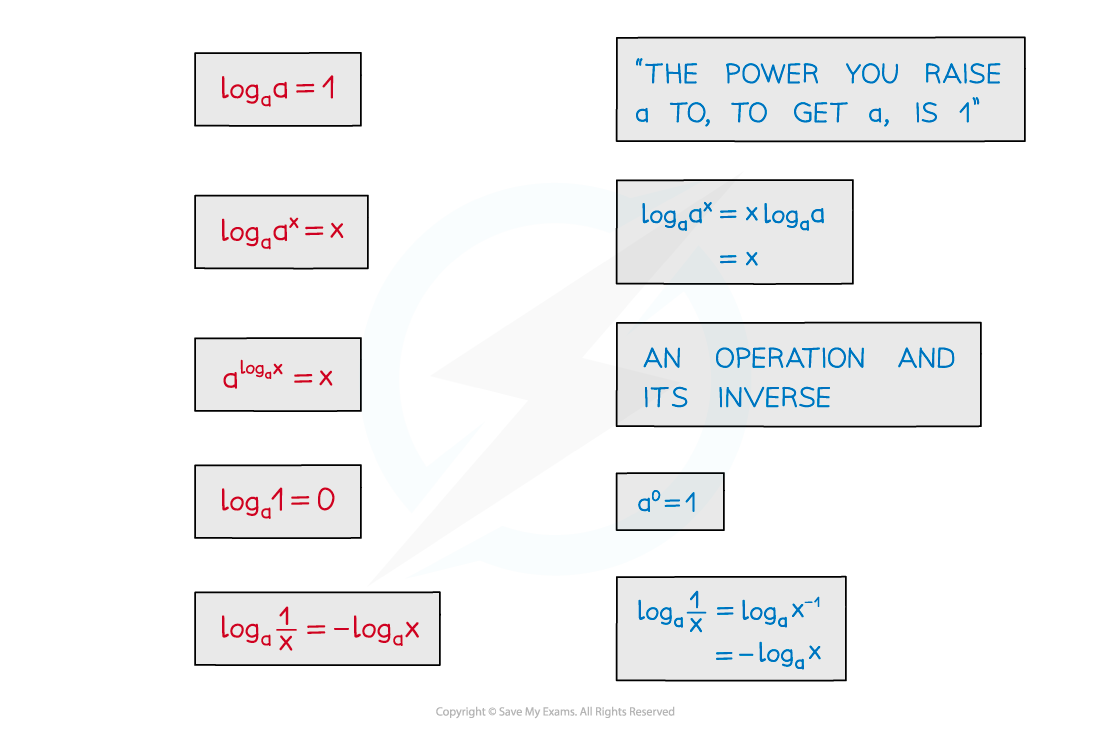
    • logaa=1{"language":"en","fontFamily":"Times New Roman","fontSize":"18"}

    • logaax=x{"language":"en","fontFamily":"Times New Roman","fontSize":"18"}

    • alogax=x{"language":"en","fontFamily":"Times New Roman","fontSize":"18"}

    • loga1=0{"language":"en","fontFamily":"Times New Roman","fontSize":"18"}

    • loga(1x)=-logax{"language":"en","fontFamily":"Times New Roman","fontSize":"18"}

Properties of logarithms
  • Beware…

    • …logax+y ≠ logax+logay{"language":"en","fontFamily":"Times New Roman","fontSize":"18"}

  • These results apply to ln x (logex){"language":"en","fontFamily":"Times New Roman","fontSize":"18"} too

    • Two particularly useful results are

      • ln ex = x{"language":"en","fontFamily":"Times New Roman","fontSize":"18"}

      • elnx = x{"language":"en","fontFamily":"Times New Roman","fontSize":"18"}

How do I use the laws of logarithms?

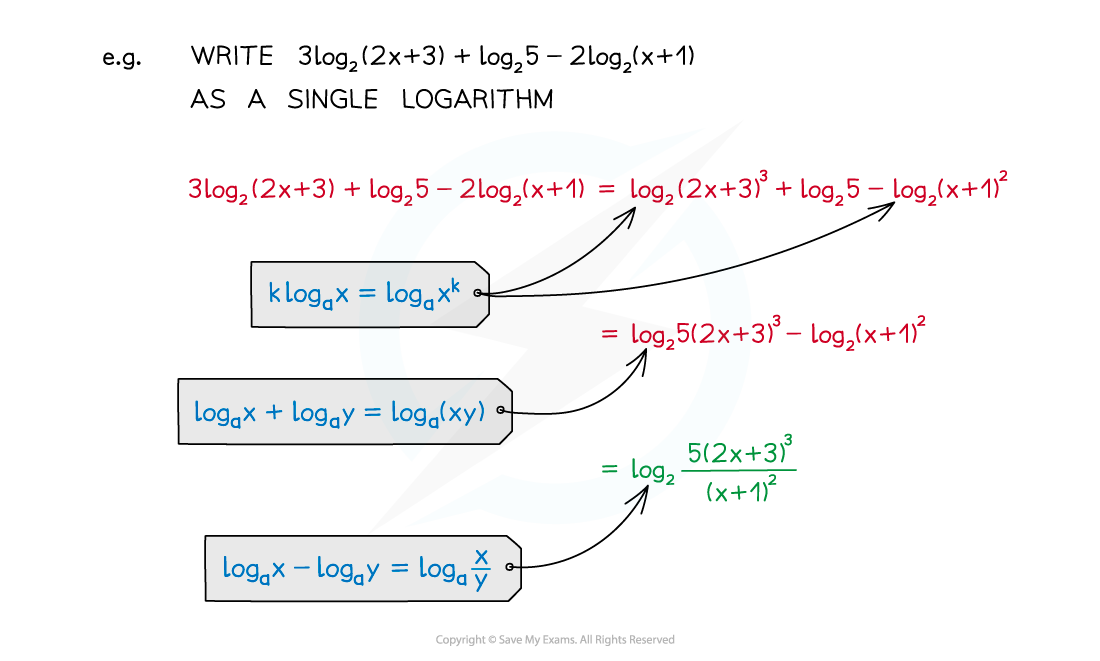
  • Laws of logarithms can be used to …

    • … simplify expressions

    • … solve logarithmic equations

    • … solve exponential equations

Simplifying an expression using the laws of logarithms

Change of Base

Change of base

How do I change the base of a logarithm?

  • The formula for changing the base of a logarithm is

logax= logbxlogba{"language":"en","fontFamily":"Times New Roman","fontSize":"18"}

  • The value you choose for b does not matter, however if you do not have a calculator, you can choose b such that the problem will be possible to solve

Why change the base of a logarithm?

  • The laws of logarithms can only be used if the logs have the same base

    • If a problem involves logarithms with different bases, you can change the base of the logarithm and then apply the laws of logarithms

  • Changing the base of a logarithm can be particularly useful if you need to evaluate a log problem without a calculator

    • Choose the base such that you would know how to solve the problem from the equivalent exponent

  • This formula had more use when calculators were less advanced

    • Some old calculators only had a button for logarithm of base 10

    • To calculate log57{"language":"en","fontFamily":"Times New Roman","fontSize":"18"}on these calculators you would have to enter

      • log10⁡7log10⁡5{"language":"en","fontFamily":"Times New Roman","fontSize":"18"}

  • The formula can be useful when evaluating a logarithm where the two numbers are powers of a common number

    • log48=log28log24=32{"language":"en","fontFamily":"Times New Roman","fontSize":"18"}

  • The formula can be useful when you are solving equations and two logarithms have different bases

    • For example, if you have log3k{"language":"en","fontFamily":"Times New Roman","fontSize":"18"} and log9n{"language":"en","fontFamily":"Times New Roman","fontSize":"18"} within the same equation

      • You can rewrite log9n{"language":"en","fontFamily":"Times New Roman","fontSize":"18"} as log3⁡nlog3⁡9 {"language":"en","fontFamily":"Times New Roman","fontSize":"18"} which simplifies to 12log3n{"language":"en","fontFamily":"Times New Roman","fontSize":"18"}

      • Or you can rewrite log3k{"language":"en","fontFamily":"Times New Roman","fontSize":"18"} as log9⁡klog9⁡3 {"language":"en","fontFamily":"Times New Roman","fontSize":"18"} which simplifies to 2log9k{"language":"en","fontFamily":"Times New Roman","fontSize":"18"}

  • The formula also allows you to derive and use a formula for switching the numbers:

loga⁡x=1logx⁡a{"language":"en","fontFamily":"Times New Roman","fontSize":"18"}

  • Using the fact that logxx=1{"language":"en","fontFamily":"Times New Roman","fontSize":"18"}