Features of Waves
Waves - Basic
Waves - Basic
Waves transfer energy and information
Waves are described as oscillations or vibrations about a fixed point
For example, ripples cause particles of water to oscillate up and down
Sound waves cause particles of air to vibrate back and forth
In all cases, waves transfer energy without transferring matter
For water waves, this means it is the wave and not the water (the matter) itself that travels
For sound waves, this means it is the wave and not the air molecules (the matter) itself that travels
Objects floating on water provide evidence that waves only transfer energy and not matter
Wave Motionvideo
Wave Motion
Wave vibrations can be shown on ropes (transverse) and springs (longitudinal)
Motion of Transverse and Longitudinal Waves
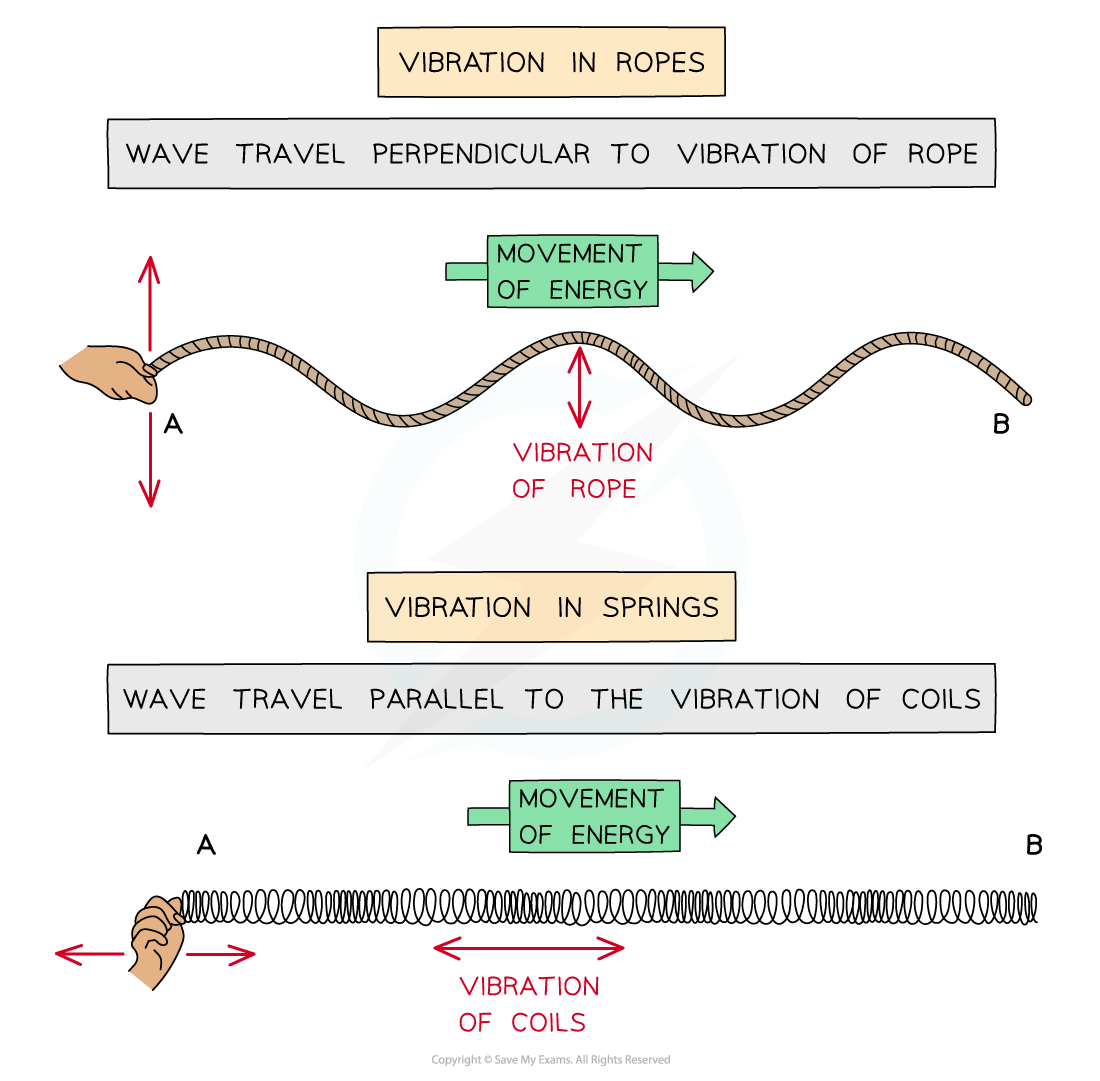
Waves can be shown through vibrations in ropes or springs
Demonstrating Wave Motion
Properties of waves, such as frequency, wavelength and wave speed, can be observed using water waves in a ripple tank
Ripple Tank
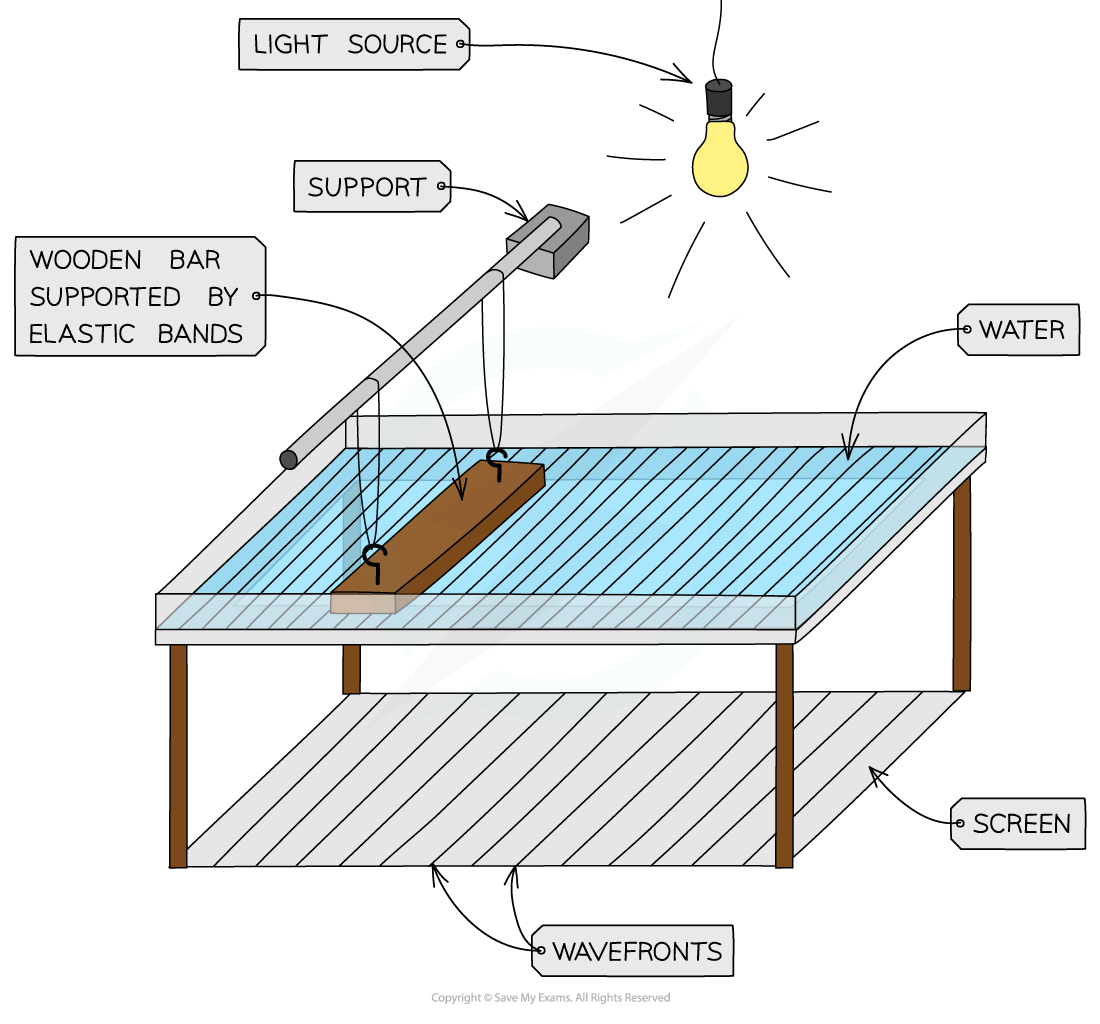
Wave motion of water waves may be demonstrated using a ripple tank
The wavelength of the waves can be determined by:
Using a ruler to measure the length of the screen
Dividing this distance by the number of wavefronts
The frequency can be determined by:
Timing how long it takes for a given number of waves to pass a particular point
Dividing the number of wavefronts by the time taken
The wave speed can then be determined by:
Using the equation wave speed = frequency × wavelength
Features of a Wave
Features of a Wave
When describing wave motion, there are several terms which are important to know, including:
Crest (Peak)
Trough
Amplitude
Wavelength
Frequency
Wave speed
Wavefront
Crests & Troughs
A crest, or a peak, is defined as:
The highest point on a wave above the equilibrium, or rest, position
A trough is defined as
The lowest point on a wave below the equilibrium, or rest, position
Crest and Trough of a Wave
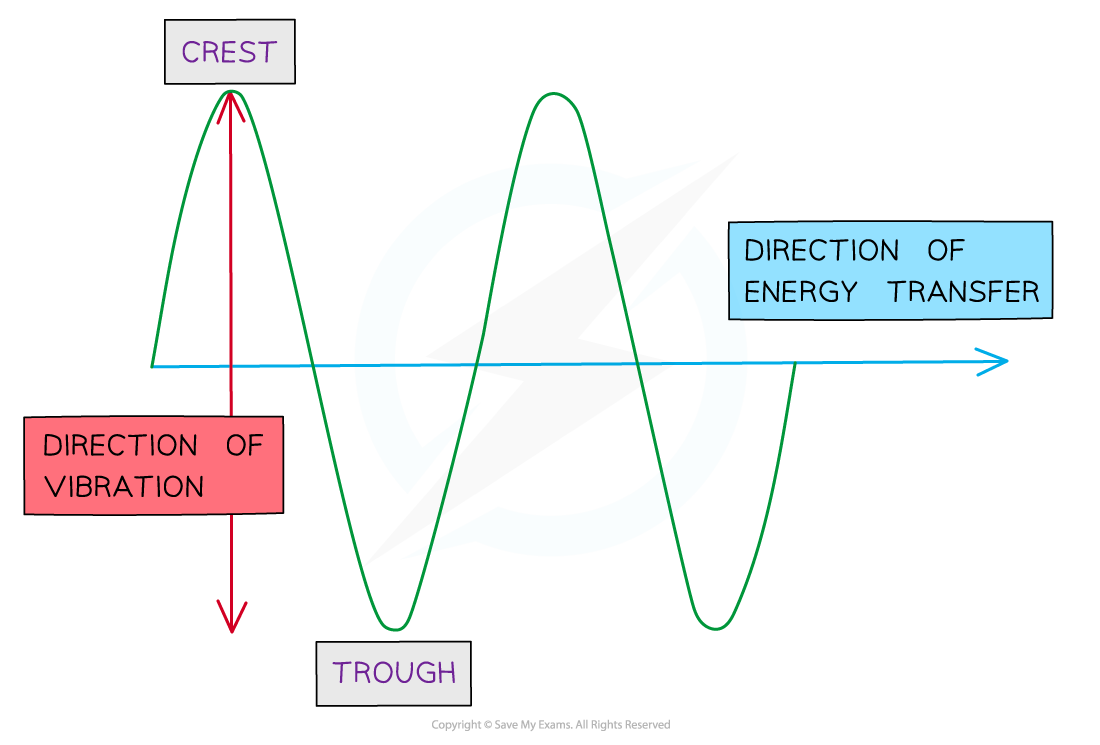
Diagram showing a crest and a trough on a transverse wave
Amplitude
Amplitude is defined as:
The distance from the undisturbed position to the peak or trough of a wave
It is given the symbol A and is measured in metres (m)
Amplitude is the maximum or minimum displacement from the undisturbed position
Wavelength
Wavelength is defined as:
The distance from one point on the wave to the same point on the next wave
In a transverse wave:
The wavelength can be measured from one peak to the next peak
In a longitudinal wave
The wavelength can be measured from the centre of one compression to the centre of the next
The wavelength is given the symbol λ (lambda) and is measured in metres (m)
The distance along a wave is typically put on the x-axis of a wave diagram
Wavelength and Amplitude
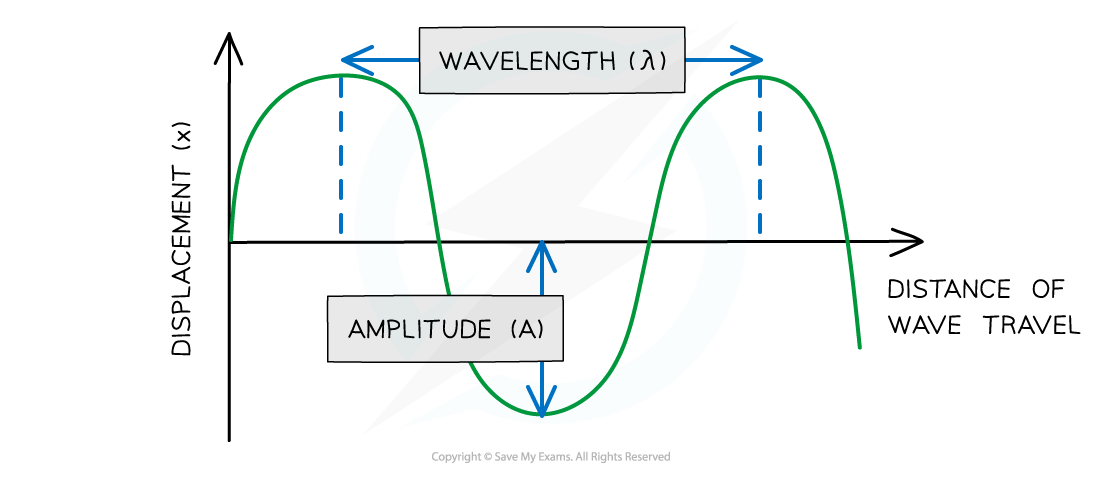
Diagram showing the amplitude and wavelength of a wave
Frequency
Frequency is defined as:
The number of waves passing a point in a second
Frequency is given the symbol f and is measured in Hertz (Hz)
Wave Speed
Wave speed is the speed at which energy is transferred through a medium
Wave speed is defined as:
The distance travelled by a wave each second
Wave speed is given the symbol, ν, and is measured in metres per second (m/s), it can be calculated using:
wave speed = frequency × wavelength
Wavefronts
Wavefronts are a useful way of picturing waves from above: each wavefront is used to represent a single wave
The image below illustrates how wavefronts are visualised:
The arrow shows the direction the wave is moving and is sometimes called a ray
The space between each wavefront represents the wavelength
When the wavefronts are close together, this represents a wave with a short wavelength
When the wavefronts are far apart, this represents a wave with a long wavelength
Wavefronts
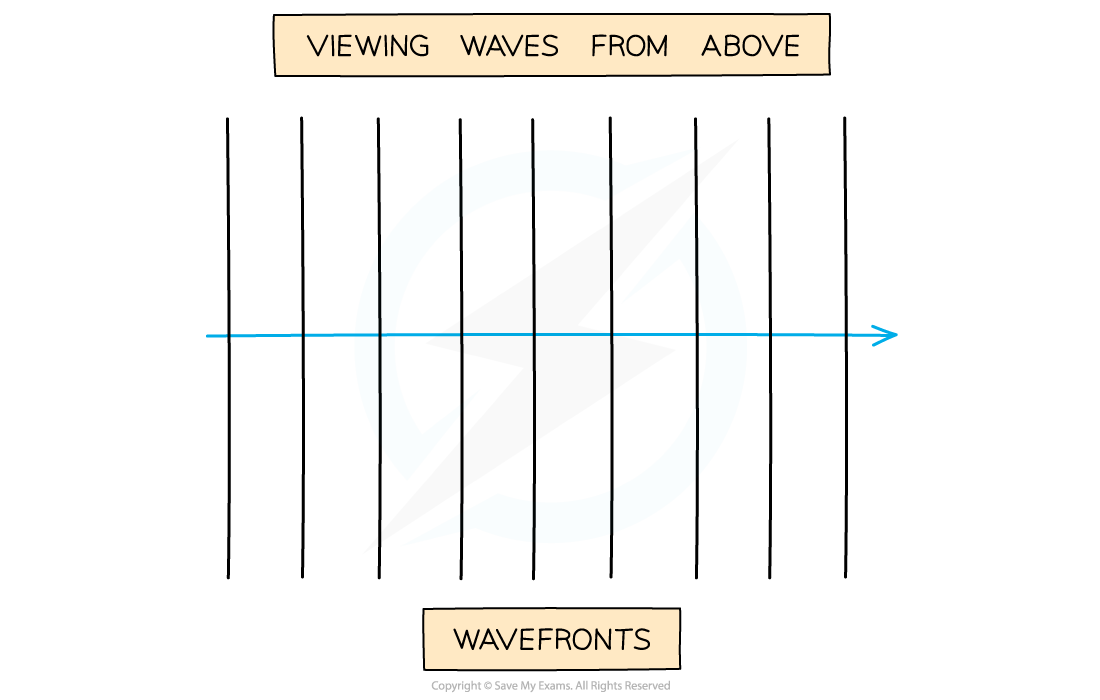
Diagram showing a wave moving to the right, drawn as a series of wavefronts