Total Internal Reflection
Total Internal Reflectionvideo
Total Internal Reflection
Sometimes, when light is moving from a denser medium towards a less dense one, instead of being refracted, all of the light is reflected
This phenomenon is called total internal reflection
Total internal reflection (TIR) occurs when:
The angle of incidence is greater than the critical angle and the incident material is denser than the second material
Therefore, the two conditions for total internal reflection are:
The angle of incidence > the critical angle
The incident material is denser than the second material
Critical Angle and TIR
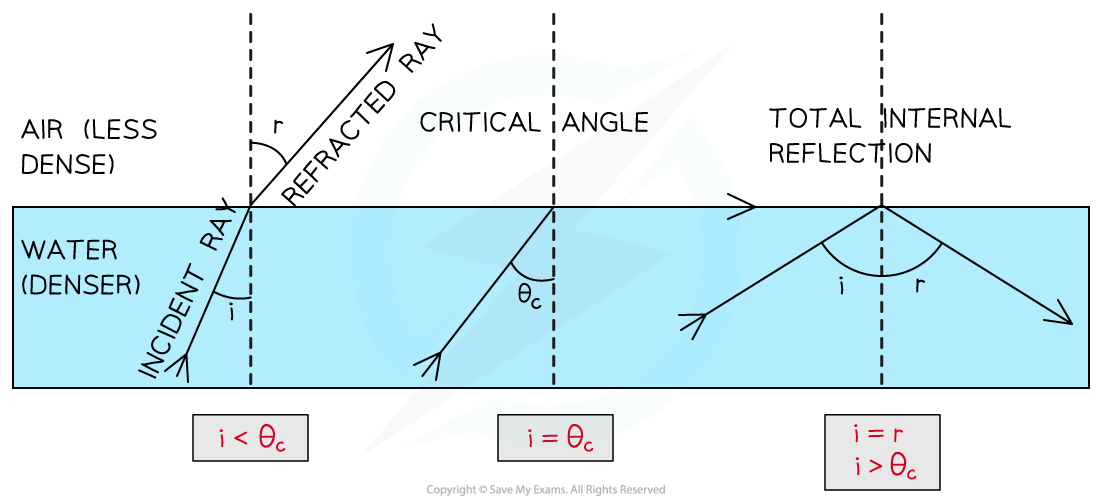
TIR occurs when the angle of incidence is greater than the angle of reflection
Total internal reflection is utilised in:
Optical fibres e.g. endoscopes
Prisms e.g. periscopes
Prisms
Prisms are used in a variety of optical instruments, including:
Periscopes
Binoculars
Telescopes
Cameras
They are also used in safety reflectors for bicycles and cars, as well as posts marking the side or edge of roads
A periscope is a device that can be used to see over tall objects
It consists of two right-angled prisms
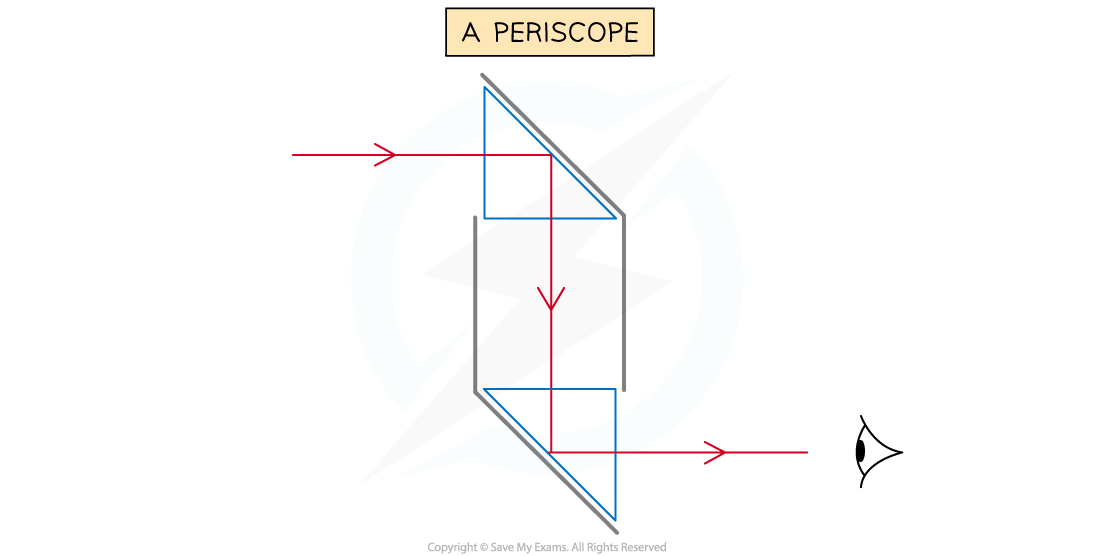
Reflection of light through a periscope
The light totally internally reflects in both prisms
Internal Reflection in Prisms
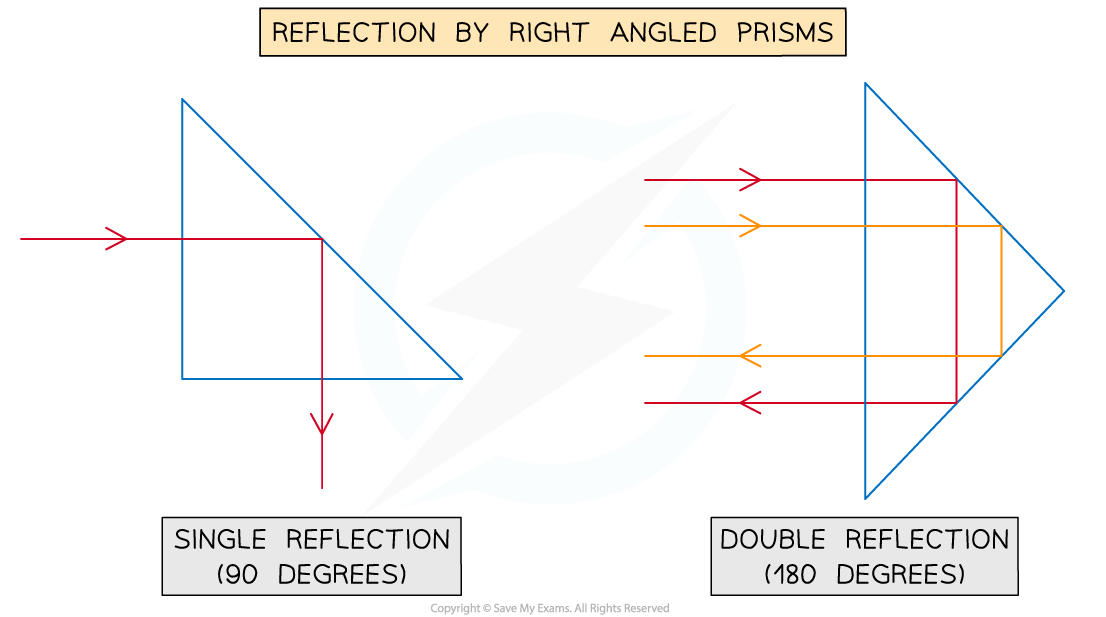
Single and double reflection through right-angled prisms
Refractive Index & Critical Angle Equation
Refractive Index & Critical Angle Equation
The critical angle, c, of a material is related to its refractive index, n
The relationship between the two quantities is given by the equation:
This can also be rearranged to calculate the refractive index, n:
This equation shows that:
The larger the refractive index of a material, the smaller the critical angle
Light rays inside a material with a high refractive index are more likely to be totally internally reflected
Optical Fibres
Optical Fibres
Total internal reflection is used to reflect light along optical fibres, meaning they can be used for
Communications
Endoscopes
Decorative lamps
Light travelling down an optical fibre is totally internally reflected each time it hits the edge of the fibre
This means information can be transmitted over long distances with minimal loss
Total Internal Reflection in an Optical Fibre
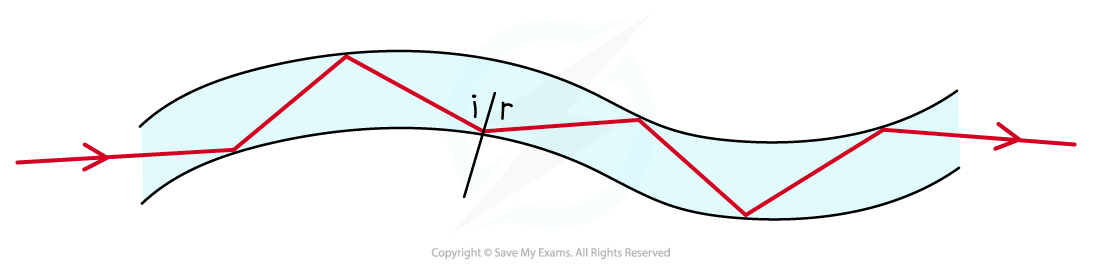
Optical fibres utilise total internal reflection for communications
Optical fibres are also used in medicine in order to see within the human body
Optical Fibres in Medicine
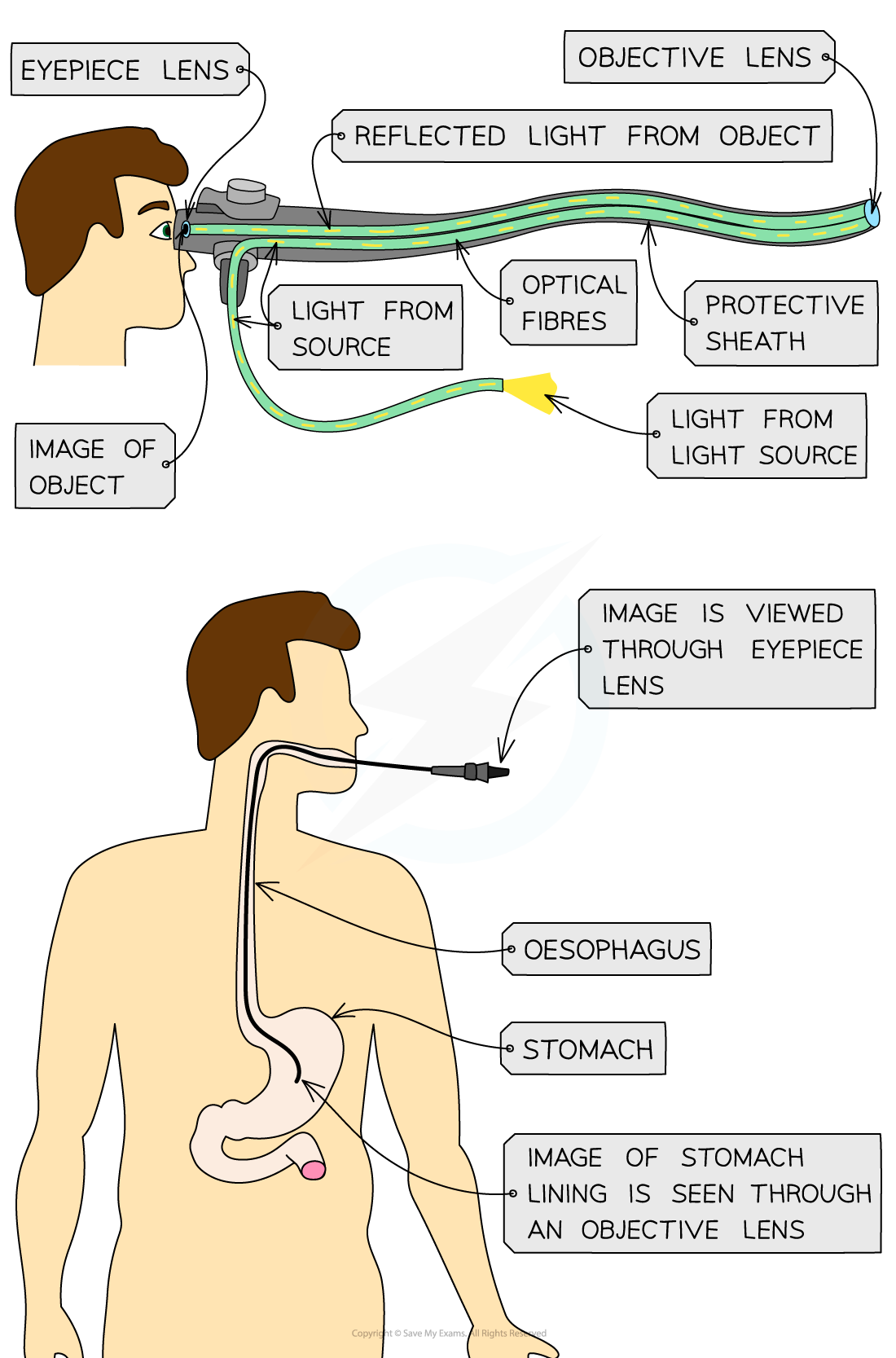
Endoscopes utilise total internal reflection to see inside a patient's body