Snell's Law
Refractive Index & Snell's Lawvideo
Refractive Index & Snell's Law
Refractive Index
The refractive index is a number which is related to the speed of light in the material (which is always less than the speed of light in a vacuum):
The refractive index is a number that is always larger than 1 and is different for different materials
Objects which are more optically dense have a higher refractive index, eg. n is about 2.4 for diamond
Objects which are less optically dense have a lower refractive index, eg. n is about 1.5 for glass
Since refractive index is a ratio, it has no units
Snell's Law
When light enters a denser medium (such as glass) it slows down and bends towards the normal
How much the light bends depends on the density of the material
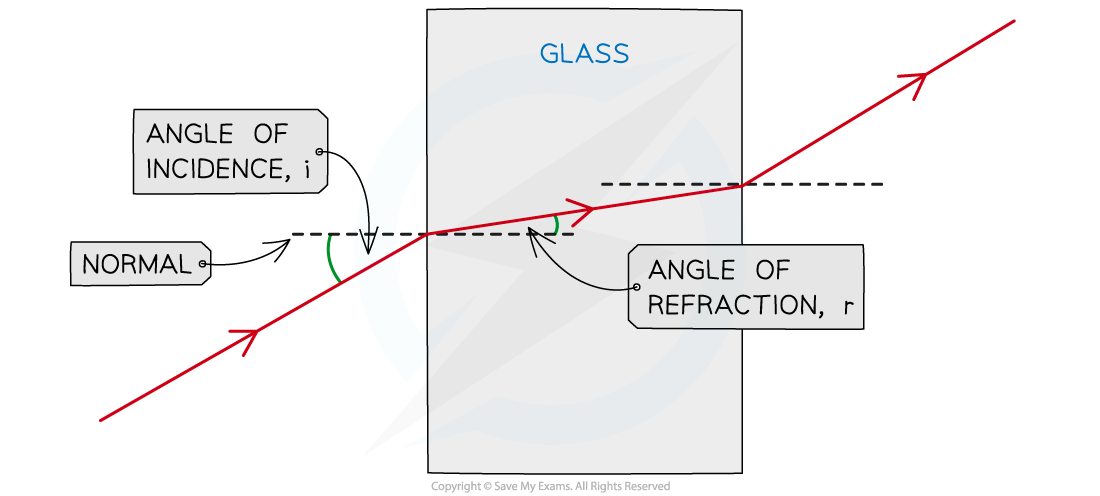
Angle of incidence i and angle of refraction r through a glass block
If light travels from a less dense to a more dense medium (e.g. air to glass), r < i (bends towards the normal)
If light travels from a more dense to a less dense medium (e.g. glass to air), r > i (bends away from the normal)
The angles of incidence and refraction are related by an equation known as Snell's Law:
Where:
n = the refractive index of the material
i = angle of incidence of the light (°)
r = angle of refraction of the light (°)
'Sin' is the trigonometric function 'sine' which is on a scientific calculator