Dangers of Electromagnetic Waves
Dangers of Electromagnetic Wavesvideo
Dangers of Electromagnetic Waves
As the frequency of electromagnetic (EM) waves increases, so does the energy
Beyond the visible part of the spectrum, the energy becomes large enough to ionise atoms
As a result of this, the danger associated with EM waves increases along with the frequency
The shorter the wavelength, the more ionising the radiation
Although the intensity of a wave also plays a very important role
Ionising Region of Electromagnetic Spectrum
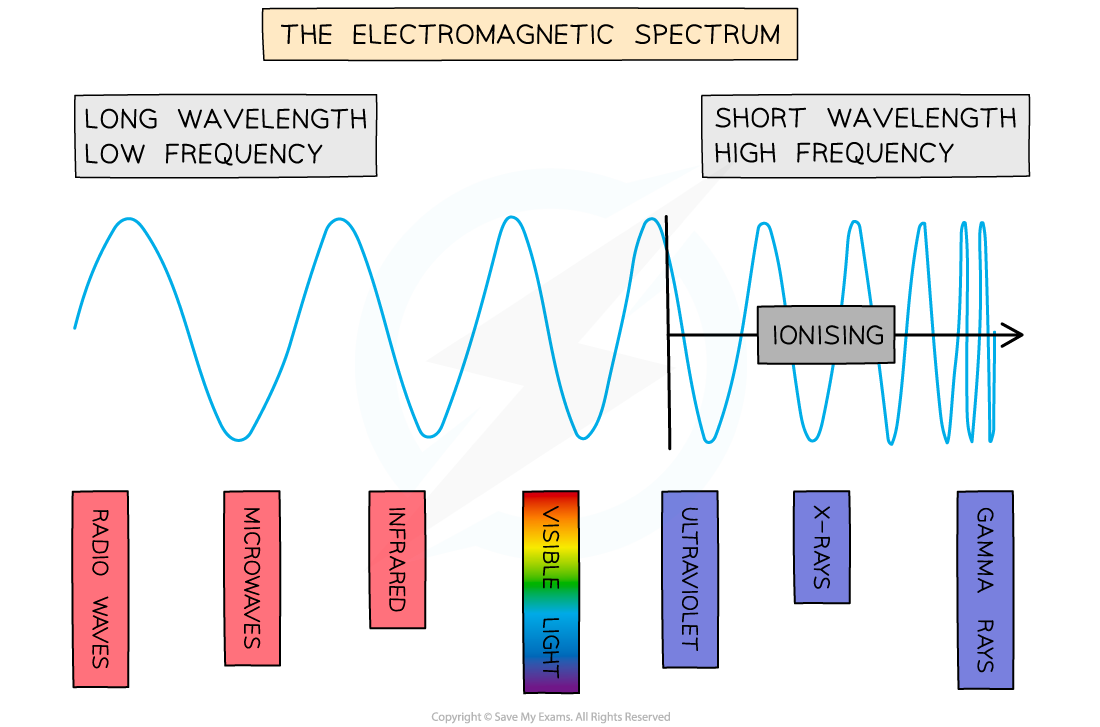
Ultraviolet, X-rays and gamma rays can all ionise atoms
Because of ionisation, ultraviolet waves, X-rays and gamma rays can have hazardous effects on human body tissue
The effects depend on the type of radiation and the size of the dose
They can damage cells and cause mutations, making them cancerous
In general, electromagnetic waves become more dangerous the shorter their wavelength
For example, radio waves have no known harmful effects whilst gamma rays can cause cancer and are regarded as extremely dangerous
The main risks associated with electromagnetic waves are summarised in the table below:
Dangers of EM Waves Table
Wave | Danger |
|---|---|
Radio |
|
Microwave |
|
Infrared |
|
Visible light |
|
Ultraviolet |
|
X-rays |
|
Gamma rays |
|