Dispersion of Light
Dispersion of Light
Dispersion of Light
White light is a mixture of all the colours of the spectrum
Each colour has a different wavelength (and frequency), making up a very narrow part of the electromagnetic spectrum
White light may be separated into all its colours by passing it through a prism
This is done by refraction
Violet light is refracted the most, whilst red light is refracted the least
This splits up the colours to form a spectrum
This process is similar to how a rainbow is created
Dispersion of White Light through a Prism
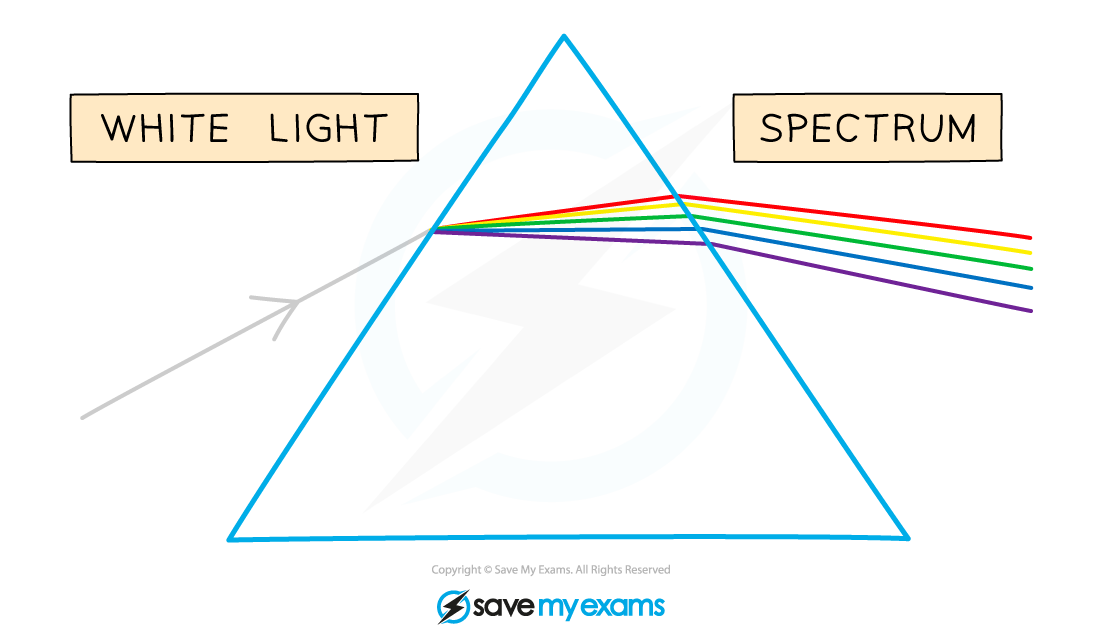
White light may be separated into all its colours by passing it through a prism
The Visible Spectrum of Light
The Visible Spectrum of Light
Visible light is defined as the range of wavelengths which are visible to humans
Visible light is the only part of the spectrum detectable by the human eye
However, it only takes up 0.0035% of the whole electromagnetic spectrum
In the natural world, many animals, such as birds, bees and certain fish, are able to perceive beyond visible light and can see infra-red and UV wavelengths of light
The different colours of waves correspond to different wavelengths:
Red has the longest wavelength (and the lowest frequency and energy)
Violet has the shortest wavelength (and the highest frequency and energy)
The Spectrum of Colours of Visible Light
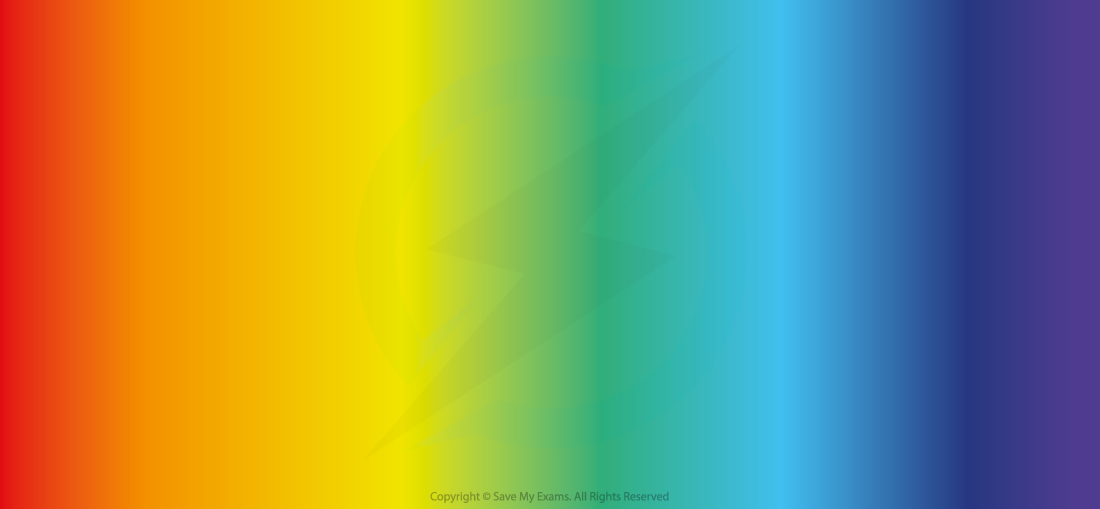

The colours of the visible spectrum: red has the longest wavelength; violet has the shortest