Electromagnetic Waves
Electromagnetic Waves
Electromagnetic Waves
The electromagnetic spectrum is arranged in a specific order based on the wavelengths or frequencies
The main groupings of the continuous electromagnetic (EM) spectrum in order of increasing frequency and decreasing wavelength are:
Radio waves
Microwaves
Infrared
Visible (red, orange, yellow, green, blue, indigo, violet)
Ultraviolet
X-rays
Gamma rays
This order is shown in the diagram below from longest wavelength (lowest frequency) to shortest wavelength (highest frequency)
The Spectrum of Electromagnetic Waves
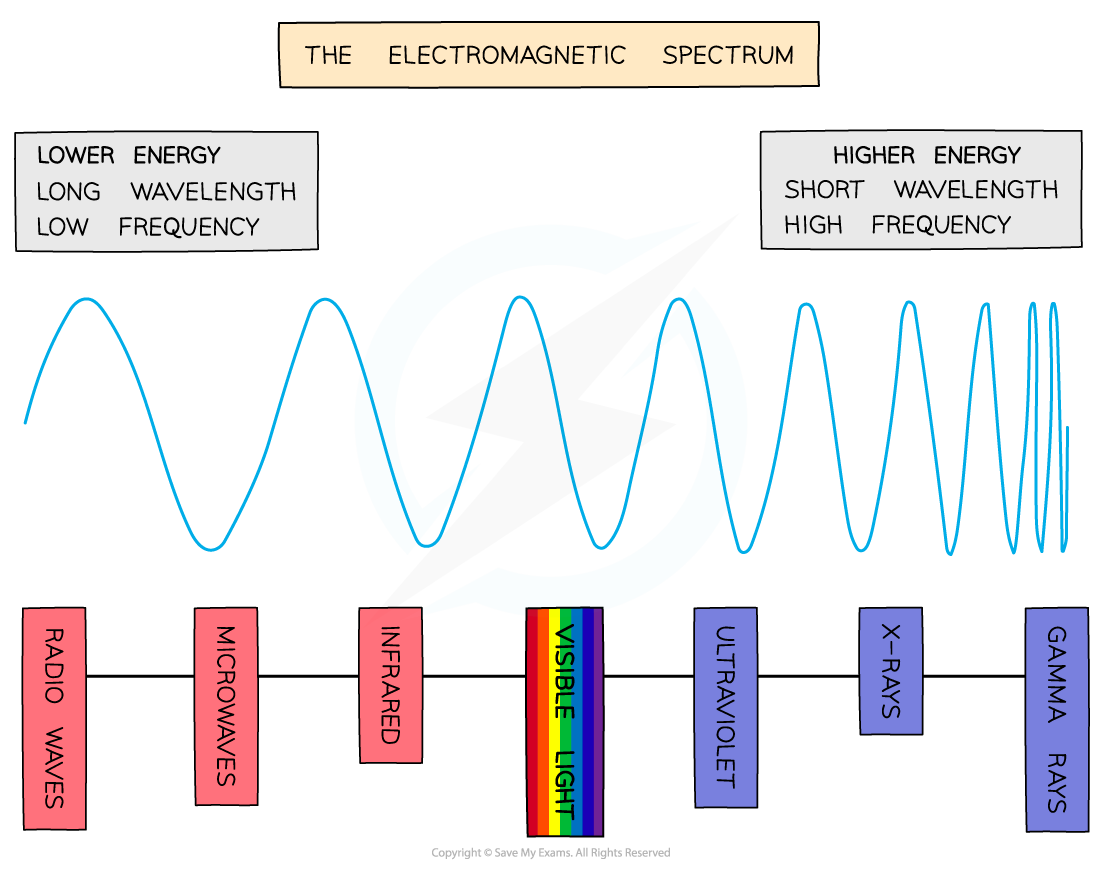
Visible light is just one small part of a much bigger spectrum: The electromagnetic spectrum
The higher the frequency, the higher the energy of the radiation
Radiation with higher energy is:
Highly ionising
Harmful to cells and tissues causing cancer (e.g. UV, X-rays, Gamma rays)
Radiation with lower energy is:
Useful for communications
Less harmful to humans
Properties of Electromagnetic Waves
Electromagnetic waves are defined as:
Transverse waves that transfer energy from the source of the waves to an absorber
All electromagnetic waves share the following properties:
They are all transverse
They can all travel through a vacuum
They all travel at the same speed in a vacuum
The 7 types of electromagnetic waves together form a continuous spectrum
The Speed of Electromagnetic Waves
The Speed of Electromagnetic Waves
The speed of electromagnetic waves in a vacuum is
3.0 × 10⁸ m/s
This is approximately the same speed as electromagnetic waves in air