Characteristics of a Mixed Economic System
Characteristics of a Mixed Economic System
Characteristics of a Mixed Economic System
Any economic system needs to decide how to answer the three fundamental economic questions (see: 2.2.1 The (Free) Market System)
What to produce? More weapons for the military or more schools to educate the children?
Who to produce for? Only those who can afford to pay for it? Or for everyone in society?
How to produce it? Should more labour be used or should the economy focus on using technology instead?
A mixed economic system is a blend of a market and planned economy
Individuals, firms and the government own factors of production and distribute goods/services
In reality, almost every country in the world operates as a mixed economic system
Some countries have more government intervention than others e.g. China has more intervention than the USA
The higher the level of government intervention, the more the economy will lean towards operating like a planned economy
Governments intervention is necessary for several reasons
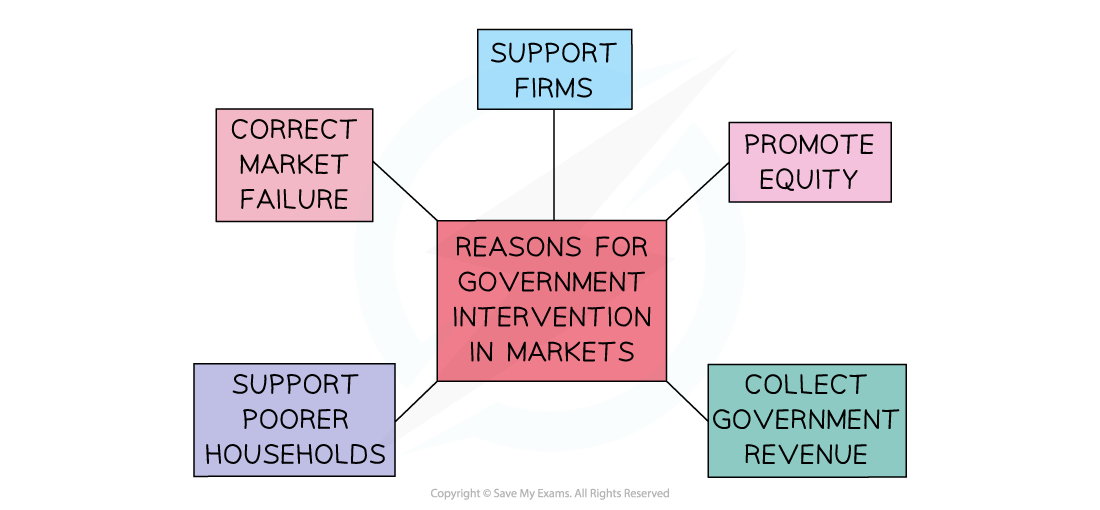
To correct market failure: in many markets there is a less than optimal allocation of resources from society's point of view
In maximising their self-interest, firms and individuals will not self-correct this misallocation of resources and there is a role for the government
Governments often achieve this by influencing the level of production or consumption
Earn government revenue: governments need money to provide essential services, public and merit goods
Revenue is raised through intervention such as taxation, privatisation, sale of licenses (e.g. 5G licenses), and the sale of goods/services
Promote equity: to reduce the opportunity gap between the rich and poor
Support firms: in a global economy, governments choose to support key industries so as to help them remain competitive
Support poorer households: poverty has multiple impacts on both the individual and the economy
Intervention seeks to redistribute income (tax the rich and give to the poor) so as to reduce the impact of poverty
As we have seen in 2.10.3 Government Intervention to Address Market Failure, four of the most commonly used methods to intervene in markets are indirect taxation, subsidies, maximum prices, and minimum prices
Additional methods of intervention include regulation, nationalisation, privatisation, and the State provision of public goods