Calculation & Determinants of PES
Introducing price elasticity of supply
Introducing price elasticity of supply
The law of supply states that when there is an increase in price (ceteris paribus), producers will increase the quantity supplied and vice versa
Economists are interested in how much the quantity supplied will increase
Price elasticity of supply (PES) reveals how responsive the change in quantity supplied is to a change in price
The responsiveness is different for different types of products
Calculation of PES
PES can be calculated using the following formula:
To calculate a % change, use the following formula:
Drawing and interpreting PES values
Drawing and interpreting PES values
The results of the price elasticity of supply calculation tell us how responsive producers are to a change in price
1. Price elastic supply
The value of PES: 1 → ∞
The quantity supplied changes more than proportionally to price

Producers are very responsive to price changes
For example, a clothing factory in Bangladesh quickly increases T-shirt production when prices rise
2. Price inelastic supply
The value of PES: 0 → 1
The percentage change in quantity supplied is less than proportional to the percentage change in price

Producers are relatively unresponsive to price changes
For example, banana growers in Ecuador cannot increase output quickly due to growing time
3. Perfectly elastic supply
The value of PES: ∞
The quantity supplied will fall to zero with any percentage change in price (highly theoretical elasticity)

Producers will only sell at one price, and any change in price causes supply to drop to zero
For example, on international markets, a wheat exporter in Brazil may only sell at the global price
4. Perfectly inelastic supply
The value of PES: 0
The quantity supplied does not change at all, no matter the price

For example, a stadium in Argentina with 50,000 seats can't supply more tickets, even if price rises
5. Unitary elasticity of supply
The value of PES: 1
The percentage change in quantity supplied is exactly equal to the percentage change in price

Any supply curve that starts at the origin has unitary elasticity
S1, S2 and S3 all have a PES value equal to 1
The %∆ in P = %∆ in QS
For example, a shoe manufacturer in Vietnam increases supply by 10% when price rises 10%
The determinants of PES
The determinants of PES
Some products are more responsive to changes in price than others
This responsiveness is known as Price Elasticity of Supply (PES)
The factors that affect how responsive supply is, are called the determinants of PES
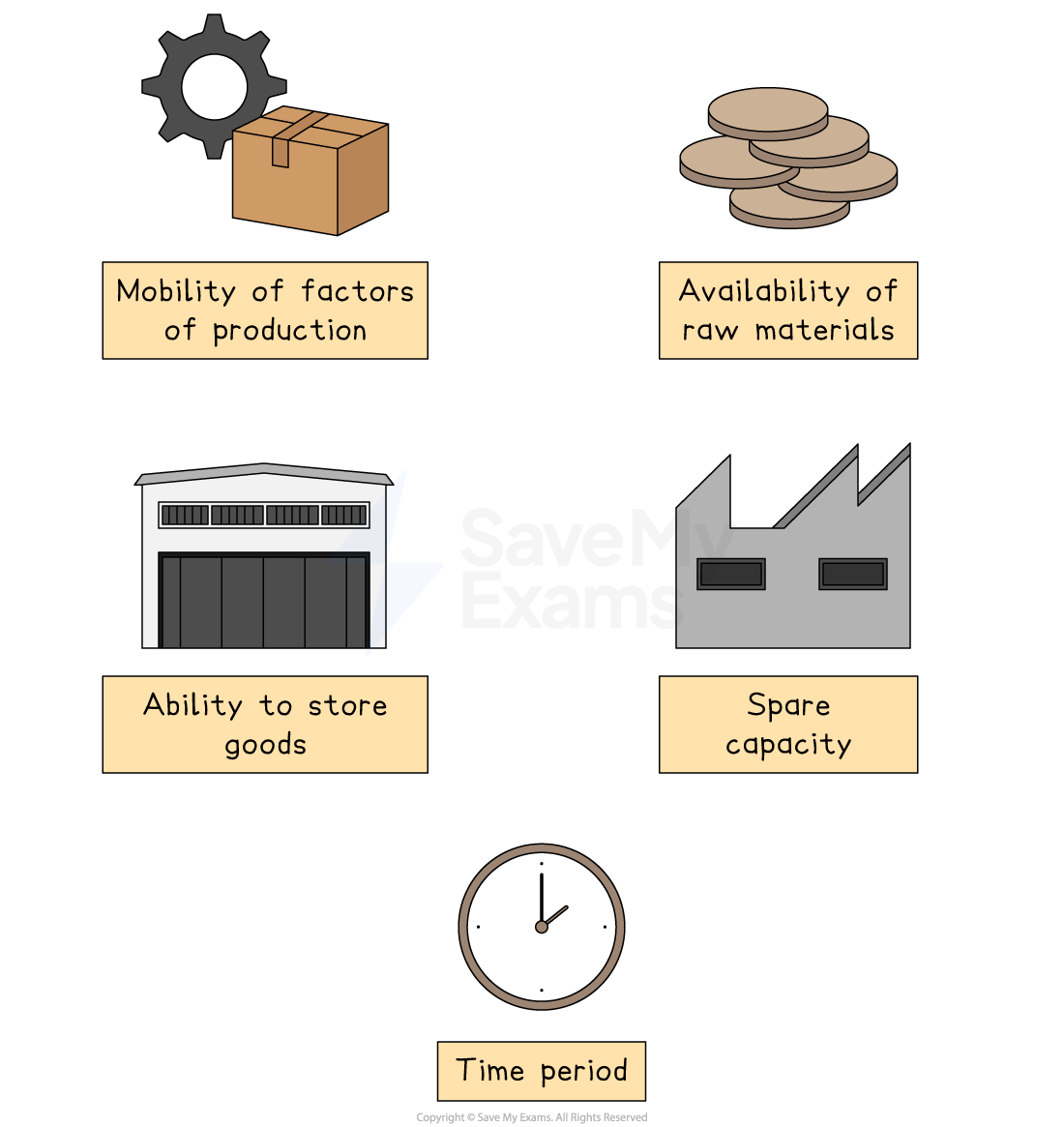
1. Mobility of the factors of production
If producers can quickly switch resources (e.g., labour, capital) between products, then PES will be higher (elastic)
If resources are specialised or fixed, then supply is less responsive (inelastic)
For example, if the price of hiking boots rises, a shoe manufacturer who can easily shift workers and machinery from making trainers to boots will have elastic supply
2. Availability of raw materials
If raw materials are easily available, producers can respond quickly to price changes → elastic supply
If materials are scarce or hard to obtain, supply cannot increase easily → inelastic supply
For example, a chocolate producer with limited access to cocoa beans may find it harder to increase supply when prices rise.
3. Ability to store stock
If goods can be stored easily, producers can build up inventory and release more when prices rise → elastic supply
If goods cannot be stored (e.g., fresh flowers), supply will be more inelastic
For example, producers of tinned food can respond quickly to price increases because the products can be stored for long periods
4. Spare capacity
If a firm has unused capacity (idle machines, underused staff), it can increase output quickly when prices rise → elastic supply
If operating at full capacity, it cannot easily raise production → inelastic supply
For example, a car factory with extra machinery and space can respond rapidly to rising demand
5. Time period
In the short run, supply is usually more inelastic because firms need time to adjust production
In the long run, supply becomes more elastic as firms can invest in more resources and change production processes
For example, avocado farmers cannot instantly grow more avocados when prices rise — but over time, they can plant more trees and expand supply