PED, Consumer Expenditure and Firms’ Revenue
PED and total revenue
PED and total revenue
Revenue is the amount of money a firm receives from selling its goods or services
Total revenue = price x quantity
Also referred to as consumer expenditure from the buyer’s perspective
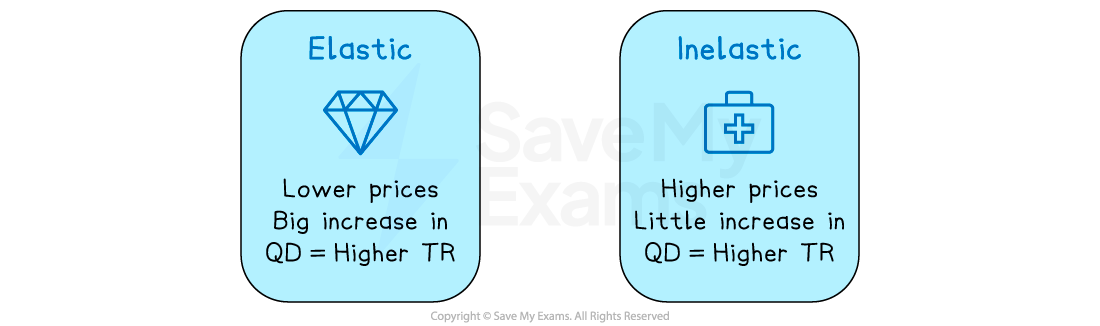
The total revenue rule states that in order to maximise revenue, firms should increase the price of products that are inelastic in demand, and decrease prices on products that are elastic in demand
Illustrating the gains using a demand curve
Lowering price for elastic demand
This can be illustrated using a demand curve
The demand curve is very elastic in this market

When a good or service is price elastic in demand, there is a greater than proportional increase in the quantity demanded to a decrease in price
Total revenue is higher once the price has been decreased from P1 to P2
(P2 x Q2) > (P1 x Q1)
Raising price for inelastic demand
The demand curve is very inelastic in this market

The demand curve is very inelastic in this market
When a good/service is price inelastic in demand, there is a smaller than proportional decrease in the quantity demanded to an increase in price
Total revenue is higher once the price has been increased
(P2 x Q2) > (P1 x Q1)