Causes & Consequences of Market Failure
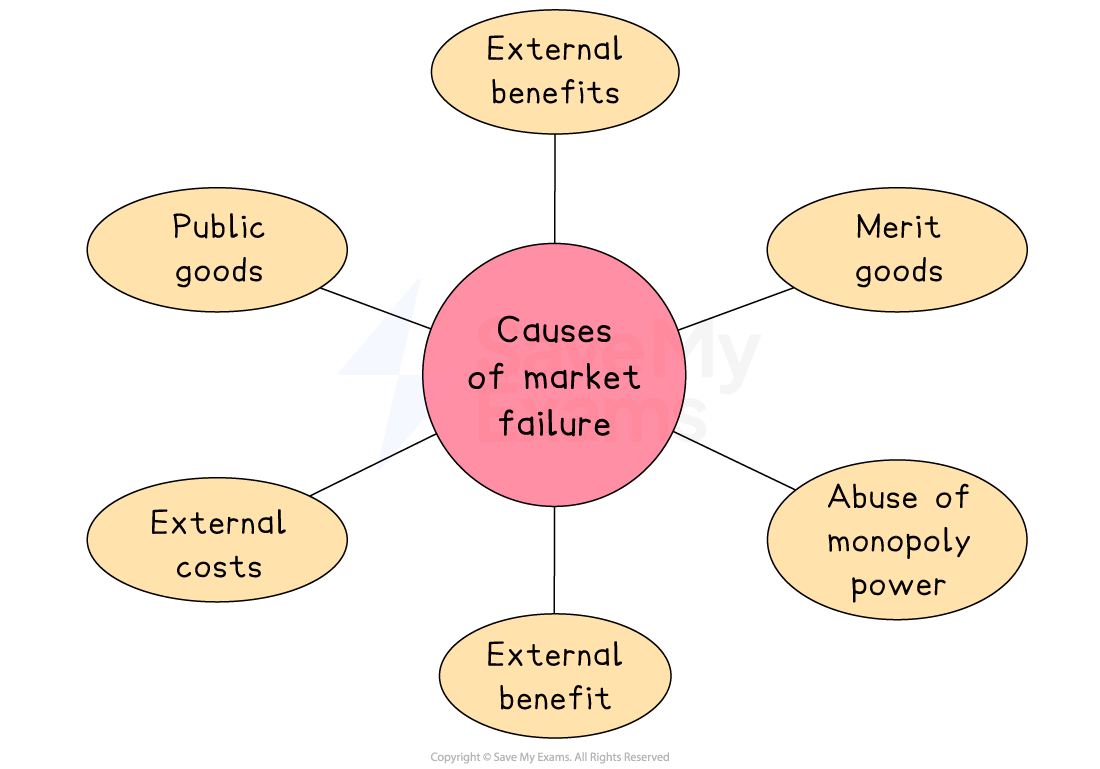
Causes of market failure
Causes of market failure
Market Failure occurs when free market activity results in a less than optimum allocation of resources from the point of view of society
Causes of market failure
Demerit goods
These are goods that are over-consumed because individuals underestimate how harmful they are to themselves
The focus is on the individual’s misjudgement of private harm
These goods are often addictive
For example, gambling, alcohol, drugs, sugary foods and drinks
Consequences | |
|---|---|
|
Merit goods
These are goods that are beneficial to society but consumers under-consume them as they do not fully recognise the private benefits
Consumers make poor decisions due to lack of information or short-term thinking
For example. vaccinations, education, electric cars
Consequences | |
|---|---|
|
Public goods
Public goods are beneficial to society but would be underprovided by a free market
Public goods are goods that are:
Non-excludable: you can't stop someone from using them
Non-rivalrous: one person’s use doesn’t reduce availability for others
Due to the above two factors, there is little opportunity for sellers to make profits from providing these goods and services
Examples include national defence, parks, libraries and lighthouses
Consequences | |
|---|---|
|
Abuse of monopoly power
The development of monopoly markets is a natural outcome of a market system
Firms seek to eliminate competition by buying out competitors and increasing their ownership of factors of production
With less competition, firms can raise prices, reduce the choice available to consumers, or limit the supply
Consequences | |
|---|---|
|
External costs and benefits
Externalities occur when there is an external cost or external benefit on a third party not involved in the economic transaction
The price mechanism in a free market ignores these externalities
If these external costs/benefits were acknowledged, then the price and output in the market would be different
Consequences | |
|---|---|
|
Summarising some key differences
Summarising some key differences
The difference between merit goods and external benefits
Many merit goods also create external benefits, so they are common causes of market failure. But they are not identical:
Merit goods | External benefits (positive externalities) | |
|---|---|---|
Definition |
|
|
Cause of market failure |
|
|
Key issue |
|
|
May include |
|
|
Do they always overlap? |
|
|
The difference between demerit goods and external costs
Many demerit goods also create external costs, so they are common causes of market failure. But they are not identical:
Demerit goods | External costs (negative externalities) | |
|---|---|---|
Focus |
|
|
Cause of market failure |
|
|
May include |
|
|
Do they always overlap? |
|
|