StudyDeck

Understanding the Market Economic System

Exam code: 2281
Written by: Ashika|Reviewed by: Caroline Carroll|Updated 2 July 2026

What is a market economic system?

What is a market economic system?

  • A market economy is an economy that has no government intervention in the allocation of resources and distribution of goods or services

    • This is also called a free market economy

    • There is no purely free market economy in the world but some countries have less government intervention than others

  • An economy can be considered to be a market, mixed or planned economy

    • The type of economy is determined by how the three economic questions are answered (for more on this, read 1.1 Resource Allocation Decisions)

    • This ultimately determines the amount of government intervention in an economy 
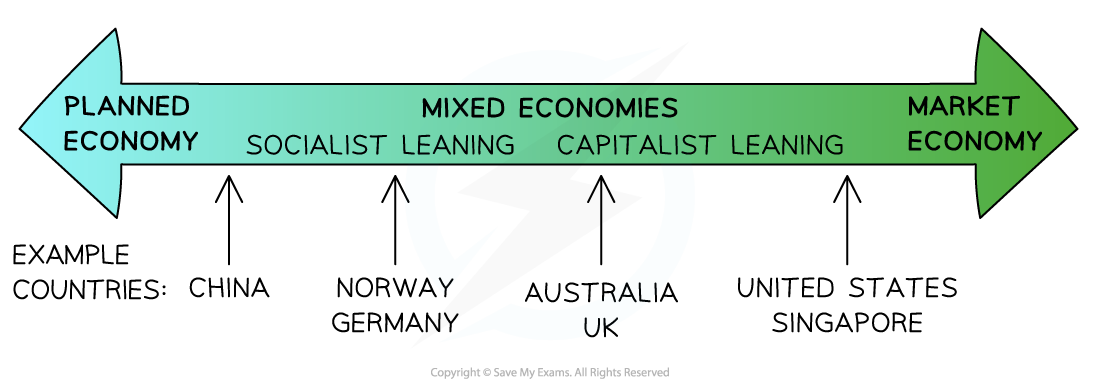
Economic spectrum with planned to market economies; examples are China, Norway, Germany, Australia, UK, USA, Singapore under respective categories.
The spectrum of economic systems and where certain economies fall based on the degree of government intervention
  • North Korea is a planned economy

  • The United States, Japan and Singapore are mixed economies but have less government intervention than Norway, Germany or China

Characteristics of a market system

Characteristic

Explanation

Property ownership

  • Individuals have the right to purchase the factors of production

Freedom of choice

  • Individuals are free to start their own business

  • Firms are free to decide what they are going to produce, how, and for whom

  • Workers are free to decide who they are going to work for

  • Consumers decided what goods/services best meet their wants/needs

Self-interest is maximised

  • Entrepreneurs maximise profits

  • Workers maximise wages

  • Consumers maximise their well-being/satisfaction

Limited government intervention

  • A pure market economy has no government intervention

  • Most free market economies have a low level of intervention, usually in the form of taxation, provision of defence, healthcare and education

Price mechanism allocates resources

  • Changes in prices allocate scarce resources

  • Rising prices indicate a shortage of resources and falling prices indicate a surplus of resources

Advantages and disadvantages of a market economic system

Advantages and disadvantages of a market economic system

  • In a market economy, decisions about what to produce, how to produce it, and for whom are made by individuals and private firms, based on supply, demand, and price signals — not by the government

  • This system encourages competition, efficiency and innovation, but it can also lead to inequality and market failures

Evaluating market economies

Advantages

Disadvantages

  • The profit incentive motivates people to work or develop entrepreneurial ideas

  • Greater variety of goods/services

  • Competition leads to better quality of goods/services

  • Competition leads to lower prices of goods/services

  • Competition encourages innovation and product development

  • Profits, income and wealth are unlimited resulting in better standards of living for some

  • More efficient use of scarce resources

  • Wealth gets concentrated in the hands of the few, as they are able to keep buying up the scarce factors of production

  • This increases inequality such that the gap between the rich and the poor continues to grow

  • Sometimes product quality falls as firms lower quality standards in order to increase profits

  • Workers get exploited

  • Resource depletion and environmental degradation are often ignored

  • Monopolies develop as firms increase market power through mergers and acquisitions

  • This leads to exploitation of consumers and supply chains