Understanding Money
The meaning of money
The meaning of money
Prior to the creation of money, individuals and firms had to accept other goods or services as payment, or be self-sufficient by producing everything required
Lacking self-sufficiency or driven by the desire for a wider range of goods and services, bartering became the norm but it too had problems
As individuals and firms trade with each other in order to acquire goods or raw materials, they require a means of exchange that is acceptable and easy to use
Modern currency fulfils this purpose
The forms of money
Cash – coins and banknotes used for everyday transactions
Bank deposits – money held in bank accounts, accessible via cheques, debit cards, or online transfers
Electronic money – digital payments, mobile banking, and online currencies
Near money – assets that can be quickly converted into cash (e.g. savings accounts)
The functions of money
The functions of money
In order to be effective, modern currency has to fulfill four uses (functions)
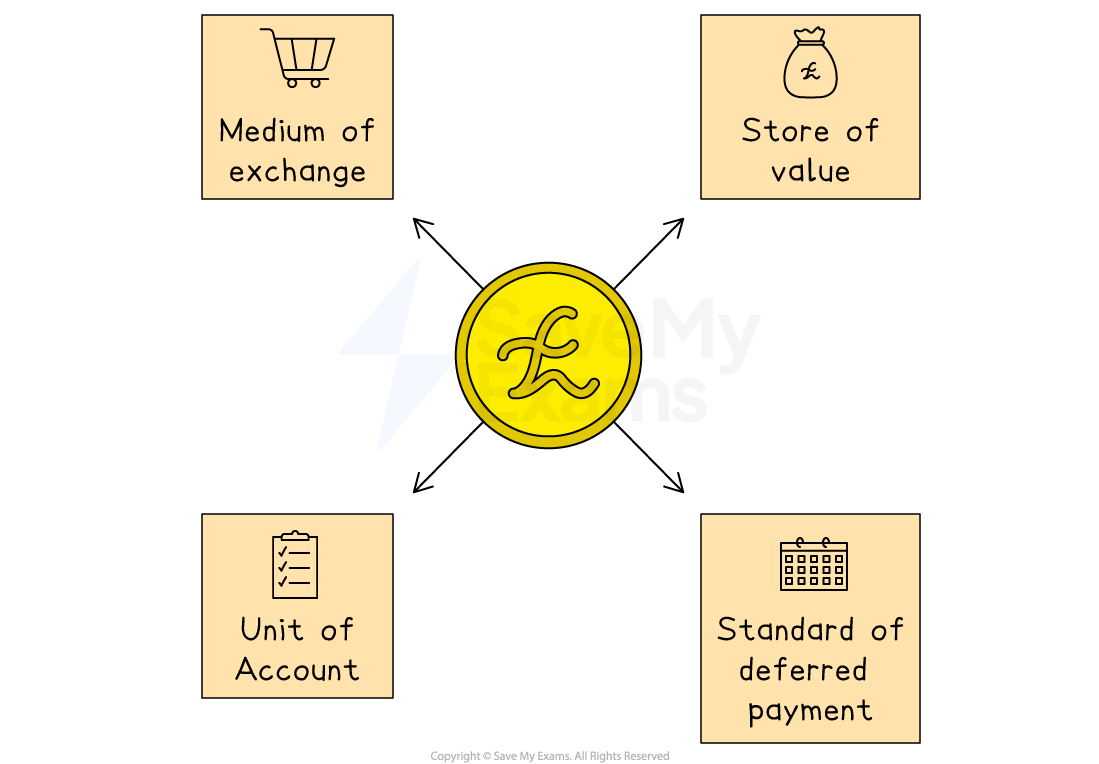
The four functions of money
1. A medium of exchange
Without money, it becomes necessary for buyers and sellers to barter (exchange goods)
Bartering is problematic as it requires two people to want each other's goods (double co-incidence of wants)
Money easily facilitates the exchange of goods, as no double co-incidence of wants is necessary
2. A measure of value (unit of account)
Money provides a means of giving a value to different goods and services
Knowing the price of a good in terms of money allows both consumers and producers to make decisions in their best interests
Without this measure it is difficult for buyers and sellers to arrange an agreeable exchange
3. A store of value
Money holds its value over time (of course inflation means that is not always true!)
This means that money can be saved
It remains valuable in exchange over long periods of time
4. A method of deferred payment
Money is an acceptable way to arrange terms of credit (loans) and to settle any future debts
This allows producers and consumers to acquire goods in the present and pay for them in the future
The characteristics of money
The characteristics of money
Many items were used for centuries as a form of money, such as gold, silver, shells, beer and tobacco
However, each one of these items had some characteristics that made them less than ideal for exchange in certain circumstances
Good money has a number of essential characteristics – and modern currency fulfils them all
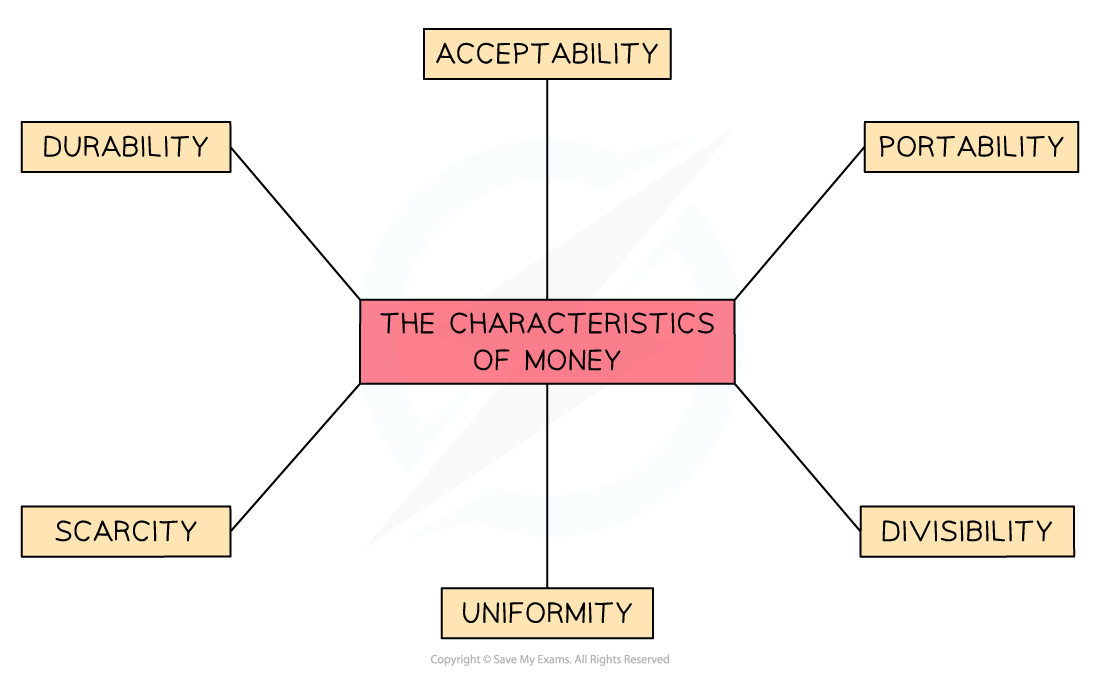
Divisibility
To be a valued medium of exchange, currency must be divisible. €50 notes can be exchanged for €10 euro notes or €1 coins
Acceptability
The currency must be valued and widely accepted by society as a valid way to pay for goods/services
Durability
The currency must be robust, not easily defaced or destroyed and last for a long period of time
Scarcity
The supply of the currency should be such that it remains desirable and retains its value in the market. Oversupply would decrease its worth
Uniformity
In order to be a valid measure of value, each denomination must be exactly the same, e.g., every $50 note must be exactly the same
Portability
Good currency is easy to carry or conceal