StudyDeck

Economies & Diseconomies of scale

Exam code: 2281
Written by: Ashika|Reviewed by: Caroline Carroll|Updated 2 July 2026

An introduction to economies and diseconomies of scale

An introduction to economies and diseconomies of scale

  • Economies of scale occur when an increase in the scale of output results in a lower cost per unit

  • As a firm grows, it is able to increases its scale of output generating efficiencies that lower its average costs (AC) of production

    • Economies of scale help large firms to lower their costs of production beyond what small firms are able to achieve 

  • Diseconomies of scale occur when an increase in the scale of output results in a higher cost per unit

  • As a firm continues increasing its scale of output, it will reach a point where its average costs (AC) will start to increase

    • The reasons for the increase in the average costs are called diseconomies of scale
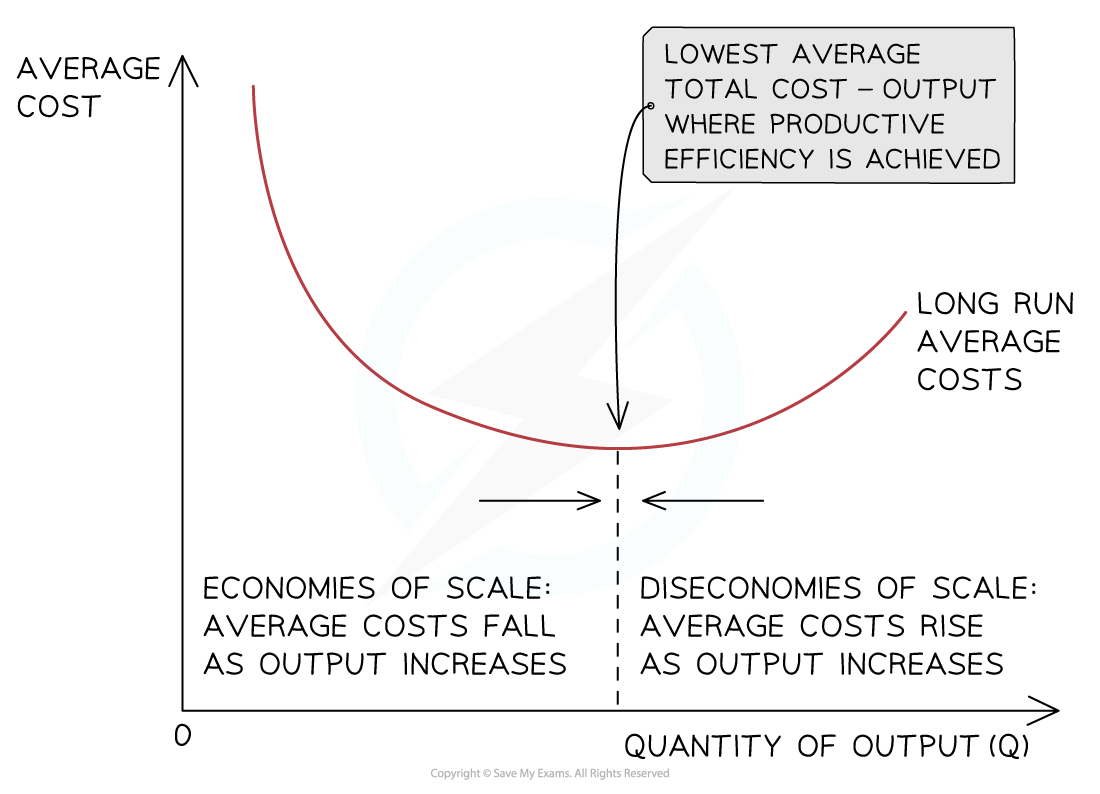
Graph showing long run average costs curve. Economies of scale reduce costs with increased output; diseconomies increase costs. Efficiency at low average cost.
 Economies of scale occur when average costs decrease with increasing output and diseconomies of scale occur when average costs increase with increasing output

Diagram analysis

  • With relatively low levels of output, the firm's average costs are high

  • As the firm increases its output, it begins to benefit from economies of scale which lower the average cost per unit

  • At some level of output, a firm will not be able to reduce costs any further

    • This point is called productive efficiency

  • Beyond this level of output, the average cost will begin to rise as a result of diseconomies of scale

Causes of internal economies of scale

Causes of internal economies of scale

  • Internal economies of scale occur as a result of the growth in the scale of production within the firm

Type of economy

Explanation

Financial economies

  • Large firms can borrow money at lower interest rates, as they are seen as less risky by lenders

  • They also have access to a wider range of finance sources

Managerial economies

  • As firms grow, they can hire specialist managers for different departments, leading to more efficient decision-making and improved productivity

Marketing economies

  • Larger firms can spread the cost of marketing (e.g. advertising, promotion) over a greater output, reducing the cost per unit sold

Purchasing economies

  • Bigger firms buy inputs (e.g. raw materials) in bulk, allowing them to negotiate lower prices and better terms with suppliers

Technical economies

  • Large-scale production allows firms to invest in more advanced equipment or use production techniques that smaller firms cannot afford, improving efficiency

Risk-bearing economies

  • Large firms can spread risk by operating in different markets or producing a range of products, so failure in one area has less impact overall

Causes of diseconomies of scale

Causes of diseconomies of scale

  • As a firm continues to increase its scale of output in the long-run, at some point its average costs will start to increase

  • The reasons for the increase are called diseconomies of scale

Causes of diseconomies of scale

Type of diseconomy

Explanation

Management diseconomies

  • Occur when managers work more in their own interest than in the interest of the firm, e.g. managers become territorial and obstructive thus reducing efficiency and increasing the average costs

Communication diseconomies

  • Occur when a firm with multiple layers of management and perhaps in multiple geographic locations struggles to communicate quickly and efficiently, leading to slow responses and increased average costs

Geographical diseconomies

  • Occur when a firm has widespread bases of operations and this leads to logistical and communication challenges which can raise the average costs

Cultural diseconomies
 

  • Occur when a firm expands into foreign markets in which workers have very different cultural work or productivity norms, which can raise the average costs

Causes of external economies of scale

Causes of external economies of scale

  • External economies of scale occur when there is an increase in the size of the industry in which the firm operates

    • The firm is able to benefit from lower average total costs generated by factors outside of the firm

Sources of external economies of scale

Type of external economy

Explanation

Geographic cluster

  • As an industry grows, ancillary firms move closer to major manufacturers to cut costs and generate more business

  • This lowers the average total cost

    • For example, car manufacturers in Sunderland rely on the service of over 2,500 ancillary firms

Transport links

  • Improved transport links develop around growing industries in order to help get people to work and to improve the transport logistics

  • This lowers the average total costs

    • For example, Bangalore is know as India's Silicon Valley and transportation projects have been successful in transforming the movement of people and goods

Skilled labour

  • An increase in skilled labour can lower the cost of skilled labour, thereby lowering the average total cost

  • The larger the geographic cluster, the larger the pool of skilled labour

Favourable legislation
 

  • Governments may pass laws that help to lower business costs

  • This often generates significant reductions in average total costs, as governments support certain industries in order to achieve their wider objectives