Different Types of Firms
Criteria for classifying firms
Criteria for classifying firms
A firm is a business organisation which sells or produces a good/service
All firms require factors of production as inputs
They add value to these inputs in producing a good/service
They sell the good/service, ideally at a price higher than their cost of production
It is useful to classify firms into categories so that we can make comparisons between them
These categories are
The sector of the economy in which they operate
Publicly (government) or privately owned
Their relative size
1. The economic sector
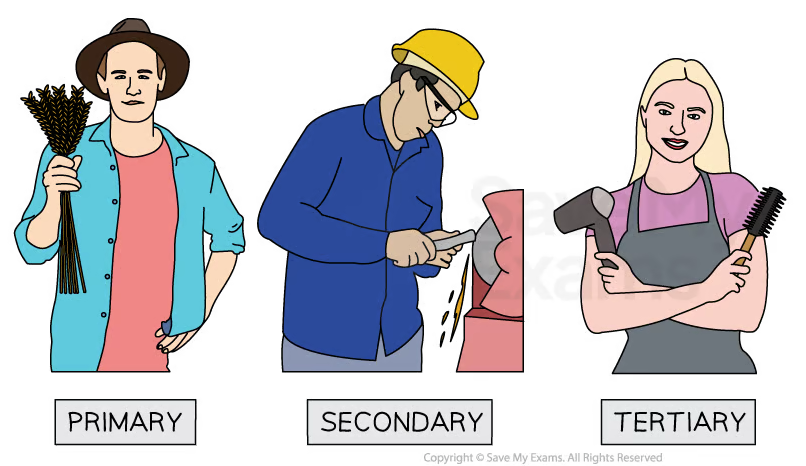
Firms can be classified according to which economic sector they operate in
The primary sector includes firms involved in the production or extraction of raw materials
E.g. fishing, farming, mining
Tata Steel is a large firm in the primary sector
The secondary sector includes firms that process raw materials in order to manufacture goods
E.g. car manufacturing
Kelloggs is a large firm in the secondary sector
The tertiary sector includes firms which provide services
E.g. car sales, banking, travel bookings
Expedia is a large booking firm in the travel industry
Economies usually measure what proportion of firms are active in each sector
Two useful metrics are
The % of workers employed in each sector
E.g. In 2019, 84% of workers in Singapore worked in the tertiary sector
The % of gross domestic product (GDP) which each sector generates
E.g. In 2021, 38% of the GDP in Ethiopia was generated from primary sector activity
Many firms have operations in multiple economic sectors
For example Tata operates in all three
2. Public or private sector
Public sector firms are owned and controlled by the government
Private sector firms are owned and controlled by other firms and private individuals (entrepreneurs and shareholders)
Privatisation occurs when government-owned firms are sold to the private sector
Many government-owned firms have been partially privatised
The government retains a share in them so they can influence decision-making and receive a share of the profits
For example, the shares of Singapore Airlines are 55% government-owned and 45% privately owned
Public Sector Firms | Private Sector Firms |
|---|---|
|
|