Wage Determination
Influences on the demand for labour
Influences on the demand for labour
The labour market is composed of sellers of labour (households) and buyers of labour (firms)
Workers supply their labour and firms demand labour
The demand for labour is a derived demand
This means that it depends on the demand for goods and services
If demand for goods and services increases, then the demand for labour will increase – and vice versa
Factors that influence the demand for labour
1. The price of the product being produced
If the selling price of the product increases, then the firm will be incentivised to supply more, and the firm's demand for labour will increase
2. The demand for the final product
As demand for labour is a derived demand, when an economy is booming, then demand for most goods and services will be high – and the demand for labour will be high
Conversely, when an economy is in a recession demand for most goods and services will be lower - and the demand for labour will be lower
3. The ability to substitute capital (machinery) for labour
Firms will constantly evaluate if it will be possible and more cost-effective to switch production from using labour to capital (machinery)
If it is more cost-effective, then demand for labour will fall
4. The productivity of labour
If the productivity of labour increases (possibly through training), this will lower average costs, and firms will likely demand more labour
Influences on the supply of labour
Influences on the supply of labour
Households supply labour in a market economy
There are numerous factors that influence the amount of labour supplied to a particular industry

Training period
Long training periods (and their cost) act as a barrier to entry and exclude many households from offering labour in certain markets
Wages in other occupations
Comparative wage rates in substitute labour markets strongly influence the supply of labour
For example, it is getting harder to recruit economics teachers as businesses in the private sector offers higher wages for their skills
Changes in migration policy
Policies that increase the net migration rate increase the supply of labour to certain industries
For example, in 2022, 36% of Singapore's labour force were migrants
Income tax levels
Beyond a certain level, income taxes become a disincentive to households offering their labour
The assumption is that as income tax increases, labour supply decreases - and vice versa
Working conditions
The working conditions and non-wage benefits can act as strong incentive in certain industries
For example, tech companies are well known for their laid-back work environment and wide range of benefits. e.g. on-site childcare and restaurants
Trade union power
Trade unions can increase the supply of labour to certain industries as workers consider the benefits of belonging to the union,
For example, higher wages and a safer working environment
Level of welfare benefit
The higher the level of welfare benefits, the lower the incentive for low-skilled labour to offer their labour – and vice versa
Social trends
Social trends include any major changes within society and can influence the supply of labour to certain industries
For example. working from home during Covid resulted in significant changes to the labour market and not all workers returned to work when economies opened up again
Trade unions and their relative bargaining power
Trade unions and their relative bargaining power
A trade union is an organisation formed by workers to protect and promote their common interests, particularly regarding pay, working conditions, and employment rights
Trade unions negotiate with employers on behalf of all of their members (collective bargaining) on wages, working hours, and benefits
Their bargaining power can influence wage levels above what might be set by market forces alone
Factors affecting a trade union’s bargaining power
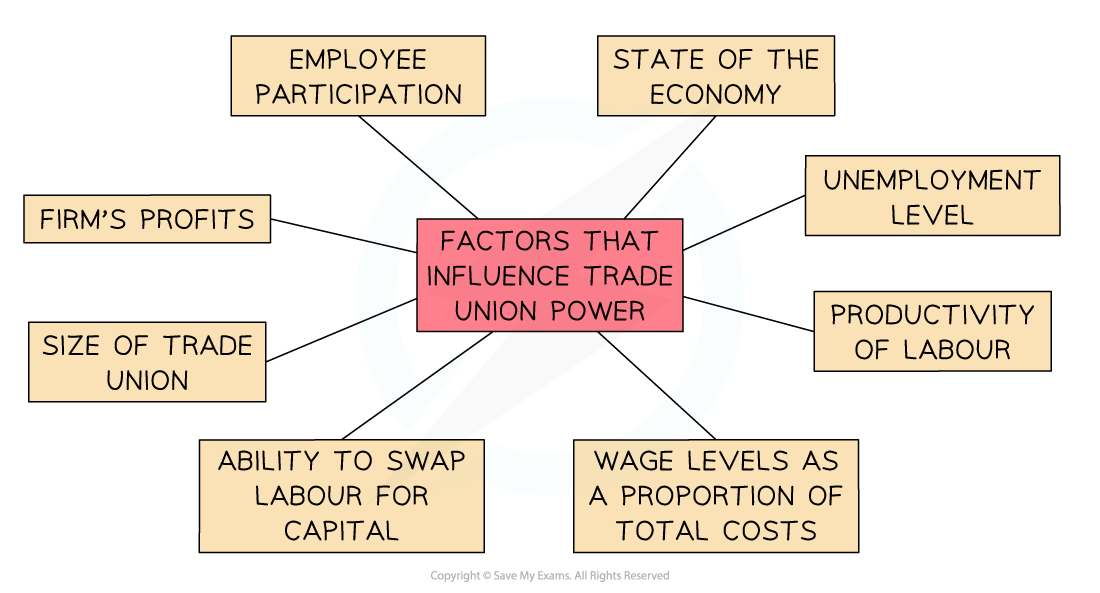
Membership size (employee participation)
Large, well-organised unions can exert more influence
Wage levels as proportion of total costs
The lower the percentage of total costs that a firms's wages represent, the higher the bargaining power
Swapping labour for capital
The nearer the replacement cost of capital for labour to meeting the increased costs demanded by the union, the weaker the bargaining power
Legal framework
Labour laws may support or restrict union activities (e.g., right to strike, limits on picketing)
Firm's profits
Firms making higher profits may be more able (and willing) to agree to wage increases
State of the economy
In a strong economy with low unemployment, unions have more leverage; in a recession, less
Skill level of members
Unions that represent highly skilled, specialised workers tend to have more bargaining power because their labour is harder to replace.