The Role of Trade Unions
The Work of Trade Unions
The Work of Trade Unions
Workers pay a monthly fee to join a trade union
The fee is called a subscription
Their membership ends when they stop paying this fee
Benefits of union membership include
Collective bargaining
Job-specific training
Legal representation in disputes
Discounts on a wide range of goods/services
When collective bargaining fails and discussions break down, trade unions have several methods of forcing employers/governments to continue engaging with them
These methods are collectively referred to as industrial action and include
Strikes
Overtime bans
Work to rule
Go-slows
The Focus of Trade Union Efforts
1. Collective bargaining on wages, working conditions and contractual terms | |
|---|---|
|
|
|
|
|
|
2. Protecting the employment of their workers | |
|---|---|
|
|
|
|
3. Influencing government policy | |
|---|---|
|
|
|
|
Factors Influencing the Strength of Trade Unions
Factors Influencing the Strength of Trade Unions
The higher the percentage of workers from a firm that belong to a trade union, the greater the collective bargaining power of that union with the employer
The higher the percentage of workers from an economy that belong to trade unions, the greater the collective bargaining power of the unions with the government
There are numerous other factors which influence the collective bargaining power of specific unions at different periods of time
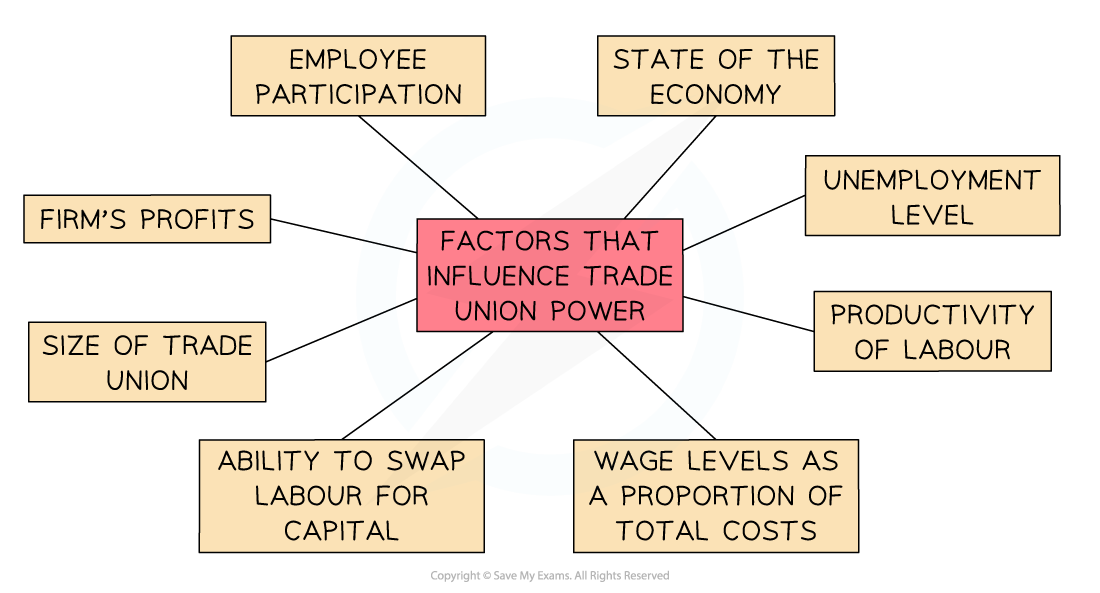
The unemployment level - the higher the unemployment level the weaker the bargaining power as firms can more easily replace existing workers
Wage levels as proportion of total costs - the lower the percentage of total costs that a firms's wages represent, the higher the bargaining power
Swapping labour for capital - the nearer the replacement cost of capital for labour to meeting the increased costs demanded by the union, the weaker the bargaining power
The level of profits - higher profits strengthen the unions demands for higher wages
State of the economy - less bargaining power in a recession and more when the economy is booming
Overall size of the trade union - the larger the union the stronger their bargaining power
The productivity of labour - if the workers are extremely productive, generating high levels of output from low levels of input, they are more valuable to the firm and the union has stronger bargaining power