Magnets
Magnetsvideo
Magnets
Magnetic and Non-magnetic Materials

Magnetic materials are attracted to a magnet; non-magnetic materials are not
Very few metals in the Periodic Table are magnetic. These include:
Iron
Cobalt
Nickel
Steel is an alloy which contains iron, so it is also magnetic
Magnetic materials (which are not magnets) will always be attracted to the magnet, regardless of which pole is held close to it
Magnetism in Magnetic Materials

Magnetic materials are attracted to both poles of a magnet
To test whether a material is a magnet it should be brought close to a known magnet
If it can be repelled by the known magnet then the material itself is a magnet
If it can only be attracted and not repelled then it is a magnetic material
Types of Magnets
There are two types of magnets
Permanent magnets
Induced magnets
Permanent Magnets
Permanent magnets are made out of permanent magnetic materials, for example steel
A permanent magnet will produce its own magnetic field
It will not lose its magnetism
Temporary (Induced) Magnets
When a magnetic material is placed in a magnetic field, the material can temporarily be turned into a magnet
This is called induced magnetism
Some objects such as paperclips or needles (which are made from steel) can be magnetised and will remain magnetic for a while
Other objects, such as electromagnets or transformers (which are made from iron) will be demagnetised as soon as the cause of the induced magnetism is removed
When magnetism is induced on a material:
One end of the material will become a north pole
The other end will become a south pole
Magnetic materials will always be attracted to a permanent magnet
This means that the end of the material closest to the magnet will have the opposite pole to magnets pole closest to the material
Magnetic Induction in Magnetic Materials
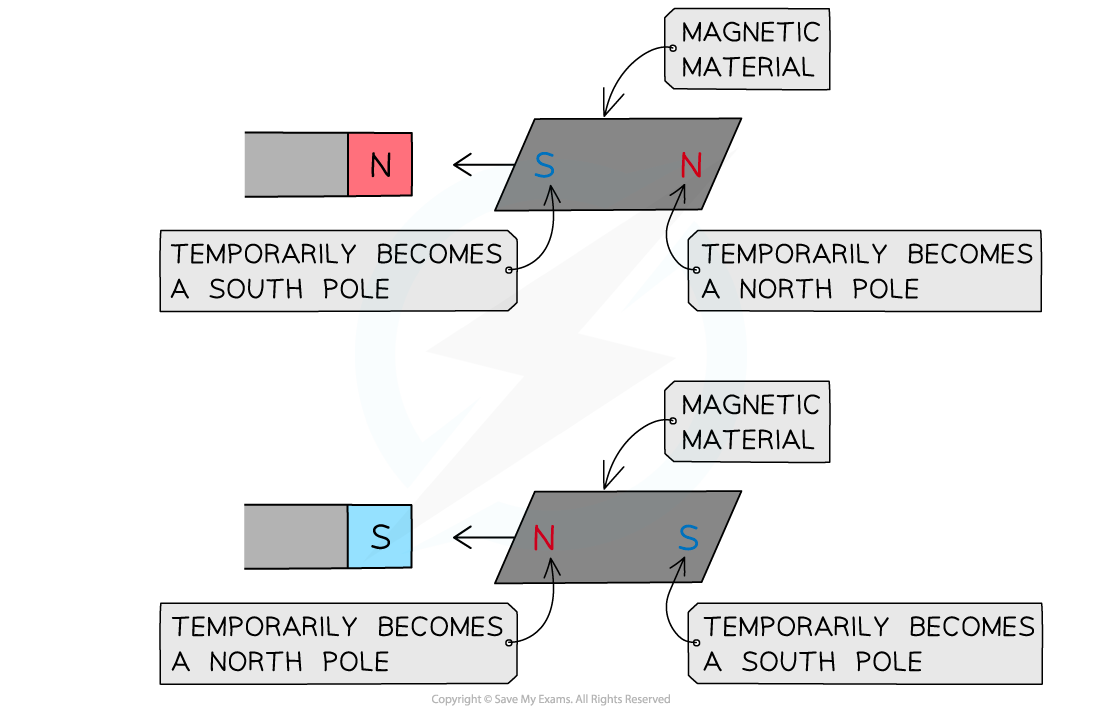
Magnetic poles are induced in a magnetic material; the induced pole is always the opposite pole to the pole of the permanent magnet
When the magnetic material is removed from the magnetic field it will lose most/all of its magnetism quickly