Electromagnetic Induction
Induced EMF & Lenz's Law
Induced EMF & Lenz's Law
An EMF will be induced in a conductor if there is relative movement between the conductor and the magnetic field
It will also be induced if the conductor is stationary in a changing magnetic field
For an electrical conductor moving in a fixed magnetic field
The conductor (e.g wire) cuts through the fields lines
This induces an EMF in the wire
Current-Carrying Wire Moving Through a Magnetic Field
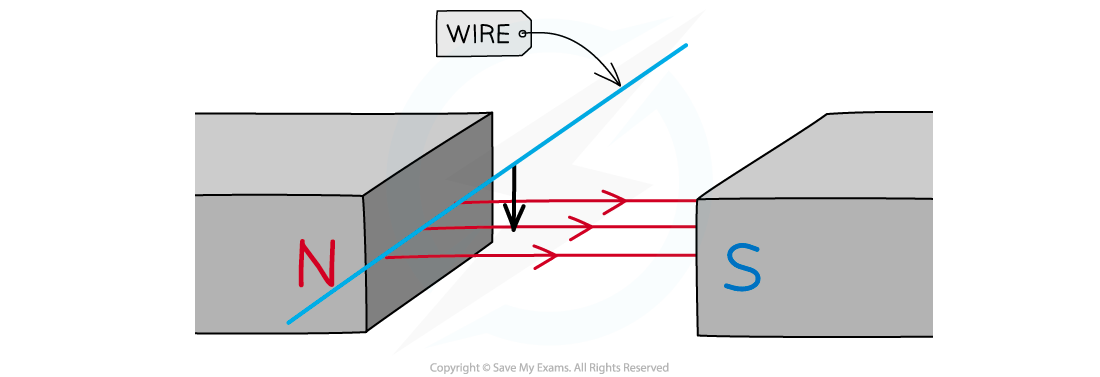
Moving an electrical conductor in a magnetic field to induce an EMF
Bar Magnet Moving Through a Solenoid
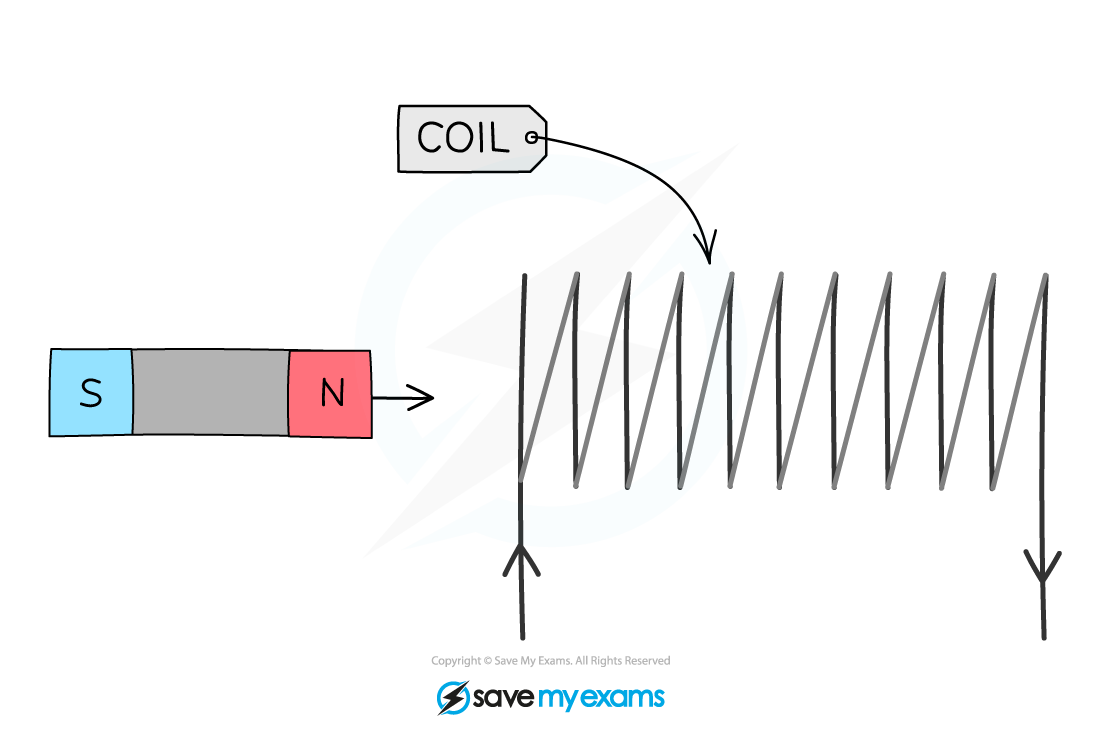
When the magnet enters the coil, the field lines cut through the turns, inducing an EMF
For a fixed conductor in a changing magnetic filed
As the magnet moved through the conductor (e.g. a coil), the field lines cut through the turns on the conductor (each individual wire)
This induces an EMF in the coil
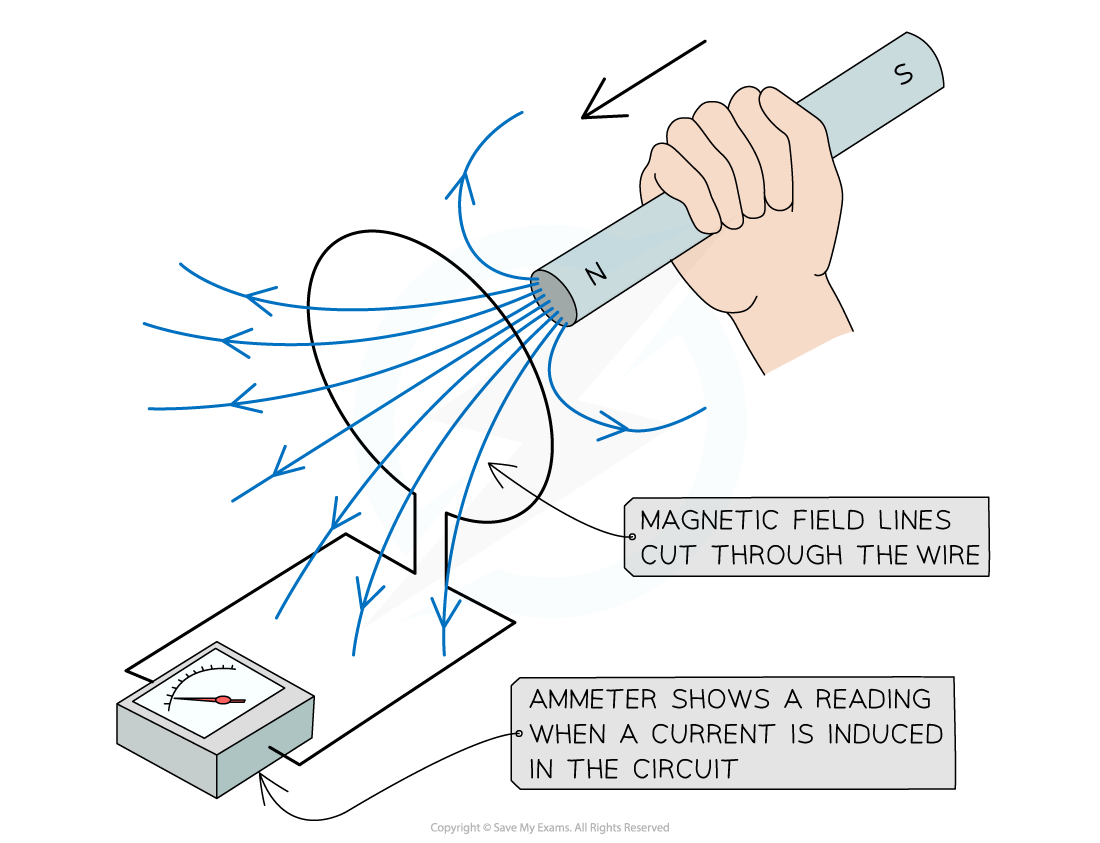
A magnet moved towards a wire creates a changing magnetic field and induces a current in the wire
A sensitive voltmeter can be used to measure the size of the induced EMF
If the conductor is part of a complete circuit then a current is induced in the conductor
This can be detected by an ammeter
Lenz's Law
Lenz Law states:
The direction of an induced potential difference always opposes the change that produces it
This means that any magnetic field created by the potential difference will act so that it tries to stop the wire or magnet from moving
Demonstrating Lenz's Law
If a magnet is pushed north end first into a coil of wire then the end of the coil closest to the magnet will become a north pole
Explanation
Due to the generator effect, a potential difference will be induced in the coil
The induced potential difference always opposes the change that produces it
The coil will apply a force to oppose the magnet being pushed into the coil
Therefore, the end of the coil closest to the magnet will become a north pole
This means it will repel the north pole of the magnet
Bar Magnet Approaching a Solenoid
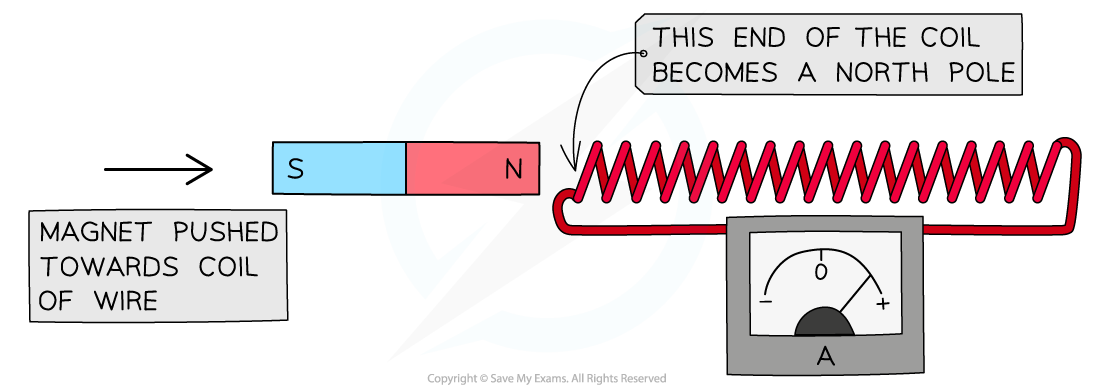
Magnet being pushed into a coil of wire inducing a current in the wire
If a magnet is now pulled away from the coil of wire then the end of the coil closest to the magnet will become a south pole
Explanation:
Due to the generator effect, a potential difference will be induced in the coil
The induced potential difference always opposes the change that produces it
The coil will apply a force to oppose the magnet being pulled away from the coil
Therefore, the end of the coil closest to the magnet will become a south pole
This means it will attract the north pole of the magnet
Bar Magnet Leaving Solenoid
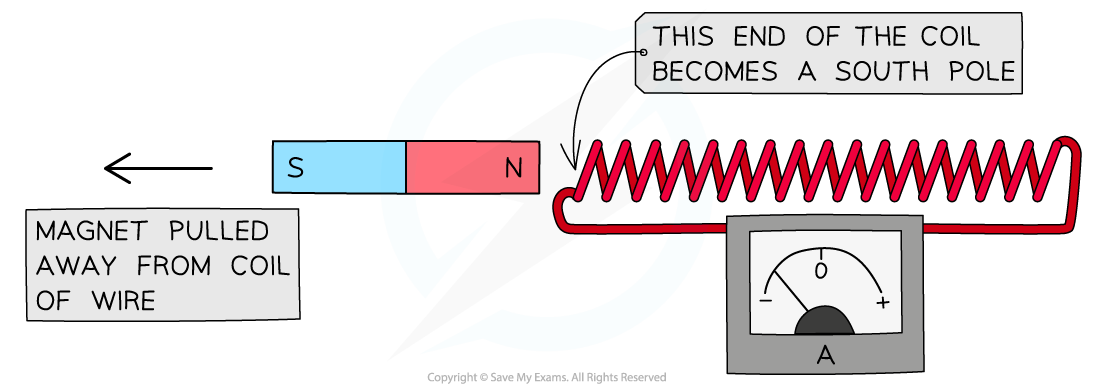
Magnet being pulled away from a coil of wire due to force of attraction
Right-Hand Dynamo Rule
Right-Hand Dynamo Rule
When moving a wire through a magnetic field, the direction of the induced EMF can be worked out by using the Right-Hand Dynamo rule
Right-Hand Dynamo Rule

The Right-Hand Dynamo rule can be used to deduce the direction of the induced EMF
To use the rule:
First Finger = Field:
Start by pointing the first finger (on the right hand) in the direction of the field
ThuMb = Motion:
Next, point the thumb in the direction that the wire is moving in
SeCond = Current:
The Second finger will now be pointing in the direction of the current (or, strictly speaking, the EMF)
The direction of the induced EMF always opposes the change that produces it
This means that any magnetic field created by the EMF will act so that it tries to stop the wire or magnet from moving