Electric Motors
The DC Motor
The DC Motor
The motor effect can be used to create a simple d.c electric motor
The simple d.c. motor consists of a coil of wire (which is free to rotate) positioned in a uniform magnetic field:
Structure of a Simple D.C. Motor
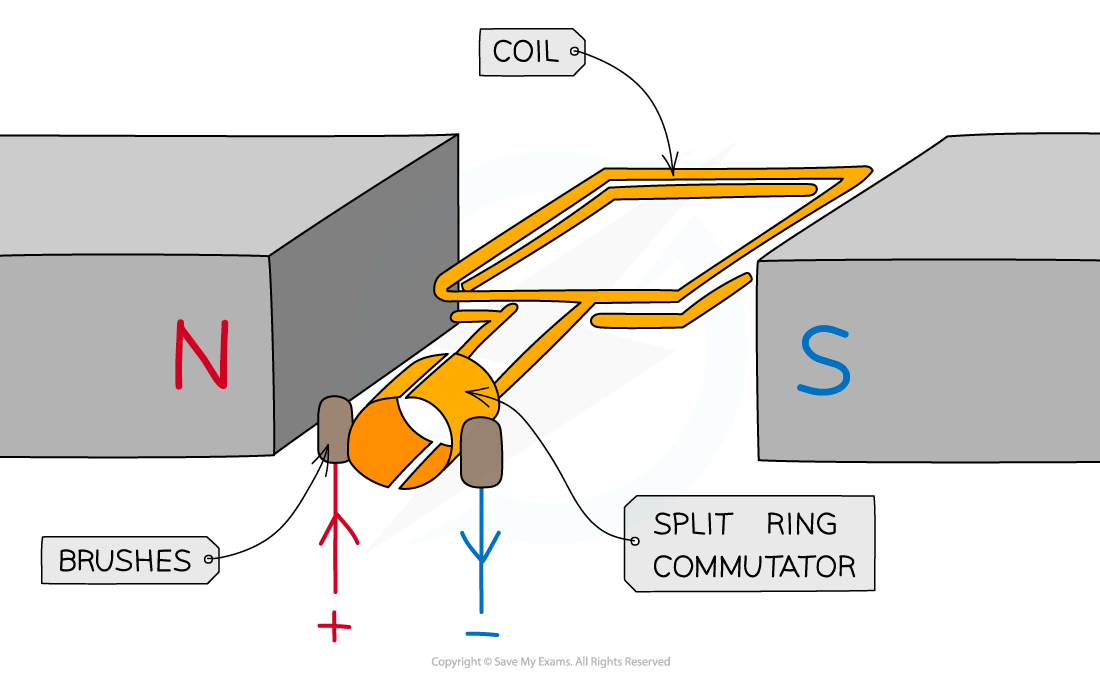
A simple D.C. electric motor consists of a coil that rotates in a magnetic field, a split ring commutator and brushes
This causes the coil to rotate since it experiences a turning effect
The turning effect is increased by increasing:
The number of turns on the coil
The current
The strength of the magnetic field
Operation of a DC Motor
Operation of a DC Motor
When the current is flowing in the coil at 90o to the direction of the magnetic field:
The current creates a magnetic field around the coil
The magnetic field produced around the coil interacts with the field produced by the magnets
This results in a force being exerted on the coil
The direction of the force can be determined using Fleming's left-hand rule
As current will flow in opposite directions on each side of the coil, the force produced from the magnetic field will push one side of the coil up and the other side of the coil down
This will cause the coil to rotate, and it will continue to rotate until it is in the vertical position
In the vertical position momentum keeps the coil turning until the magnetic force takes over again
The split ring commutator swaps the contacts of the coil
This reverses the direction in which the current is flowing every half turn
This keeps the current leaving the motor in the same direction (d.c)
Reversing the direction of the current will also reverse the direction in which the forces are acting
As a result, the coil will continue to rotate
Force on Coil in a D.C. Motor
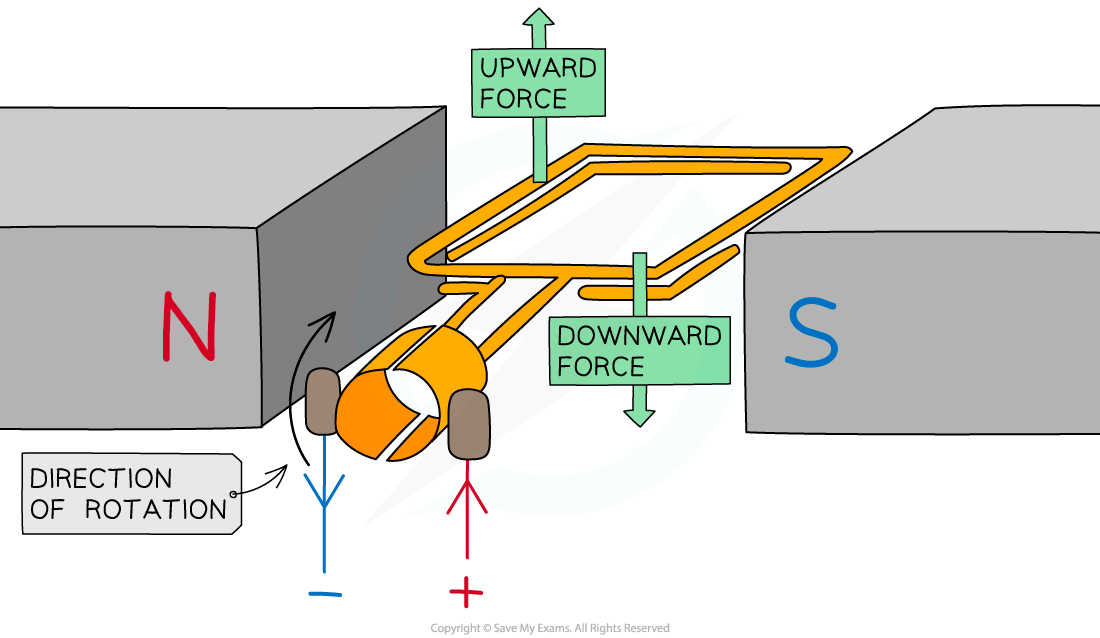
Forces on coil after commutator has reversed the direction of the current
The split-ring commutator reverses the direction of the current in the coil every half turn
This will keep the coil rotating continuously as long as the current is flowing
Factors Affecting the D.C Motor
The speed at which the coil rotates can be increased by:
Increasing the current
Use a stronger magnet
The direction of rotation of coil in the d.c motor can be changed by:
Reversing the direction of the current
Reversing the direction of the magnetic field by reversing the poles of the magnet
The force supplied by the motor can be increased by:
Increasing the current in the coil
Increasing the strength of the magnetic field
Adding more turns to the coil