Transformer Calculations
Transformer Calculations
Transformer Calculations
The output potential difference (voltage) of a transformer depends on:
The number of turns on the primary and secondary coils
The input potential difference (voltage)
It can be calculated using the equation:
This equation can be written using symbols as follows:
Where
Vp = potential difference (voltage) across the primary coil in volts (V)
Vs = potential difference (voltage) across the secondary coil in volts (V)
np = number of turns on primary coil
ns = number of turns on secondary coil
The equation above can be flipped upside down to give:
The equations above show that:
The ratio of the potential differences across the primary and secondary coils of a transformer is equal to the ratio of the number of turns on each coil
High-Voltage Transmission
High-Voltage Transmission
Transformers have a number of roles:
They are used to increase the potential difference of electricity before it is transmitted across the national grid
They are used to lower the high voltage electricity used in power lines to the lower voltages used in houses
They are used in adapters to lower mains voltage to the lower voltages used by many electronic devices
Advantages of High Voltage Transmission
When electricity is transmitted over large distances, the current in the wires heats them, resulting in energy loss
To transmit the same amount of power as the input power the potential difference at which the electricity is transmitted should be increased
This will result in a smaller current being transmitted through the power lines
This is because P = IV, so if V increases, I must decrease to transmit the same power
A smaller current flowing through the power lines results in less heat being produced in the wire
This will reduce the energy loss in the power lines
Model of High-Voltage Transmission
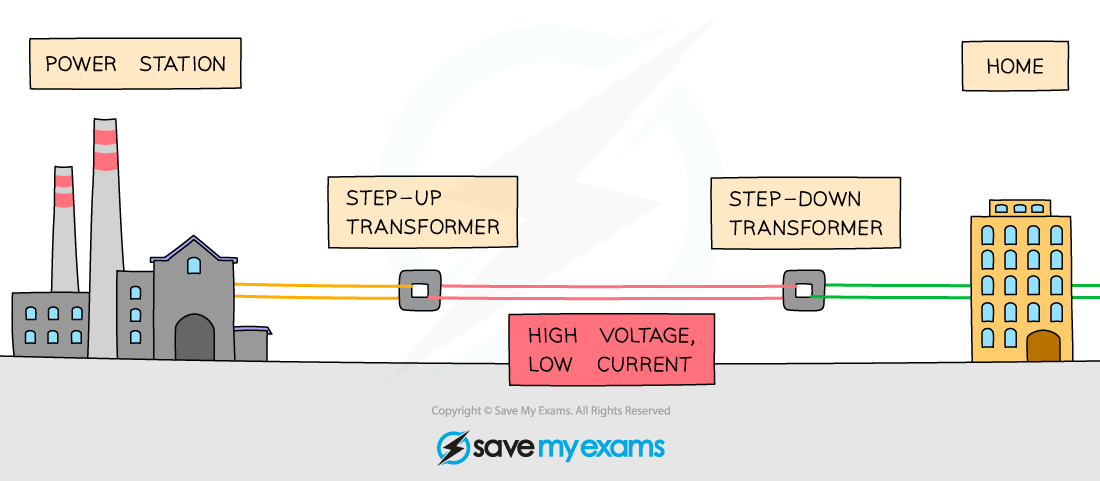
Electricity is transmitted at high voltage, reducing the current and hence power loss in the cables