Electrical Power
Electrical Power Equation
Electrical Power Equation
In mechanics, power P is defined as the rate of doing work
The potential difference is the work done per unit charge
Current is the rate of flow of charge
Therefore, the electrical power is defined as the rate of change of work done:
Where:
P = power in watts (W)
E = energy in joules (J)
t = time in seconds (s)
W = work done in (J)
The work done is the energy transferred so the power is the energy transferred per second in an electrical component
The power dissipated (produced) by an electrical device can also be written as
Where:
P = power in watts (W)
I = current in amps (A)
V = potential difference in volts (V)
Using Ohm's Law V = IR to rearrange for either V or I and substituting into the power equation, means power can be written in terms of resistance R
Where:
P = power in watts (W)
I = current in amps (A)
R = resistance in ohms (Ω)
V = potential difference in volts (V)
This means for a given resistor if the current or voltage doubles the power will be four times as great.
Which equation to use will depend on whether the value of current or voltage has been given in the question
Rearranging the energy and power equation, the energy can be written as:
Where:
E = energy transferred in joules (J)
V = potential difference in volts (V)
I = current in amps (A)
t = time in seconds (s)
Measuring Energy Usage
Measuring Energy Usage
The Kilowatt Hour (kWh)
Energy usage in homes and businesses is calculated and compared using the kilowatt hour
The kilowatt hour is defined as:
A unit of energy equivalent to one kilowatt of power expended for one hour
Appliances are given power ratings, which tell consumers:
The amount of energy transferred (by electrical work) to the device every second
Power Rating for a Kettle
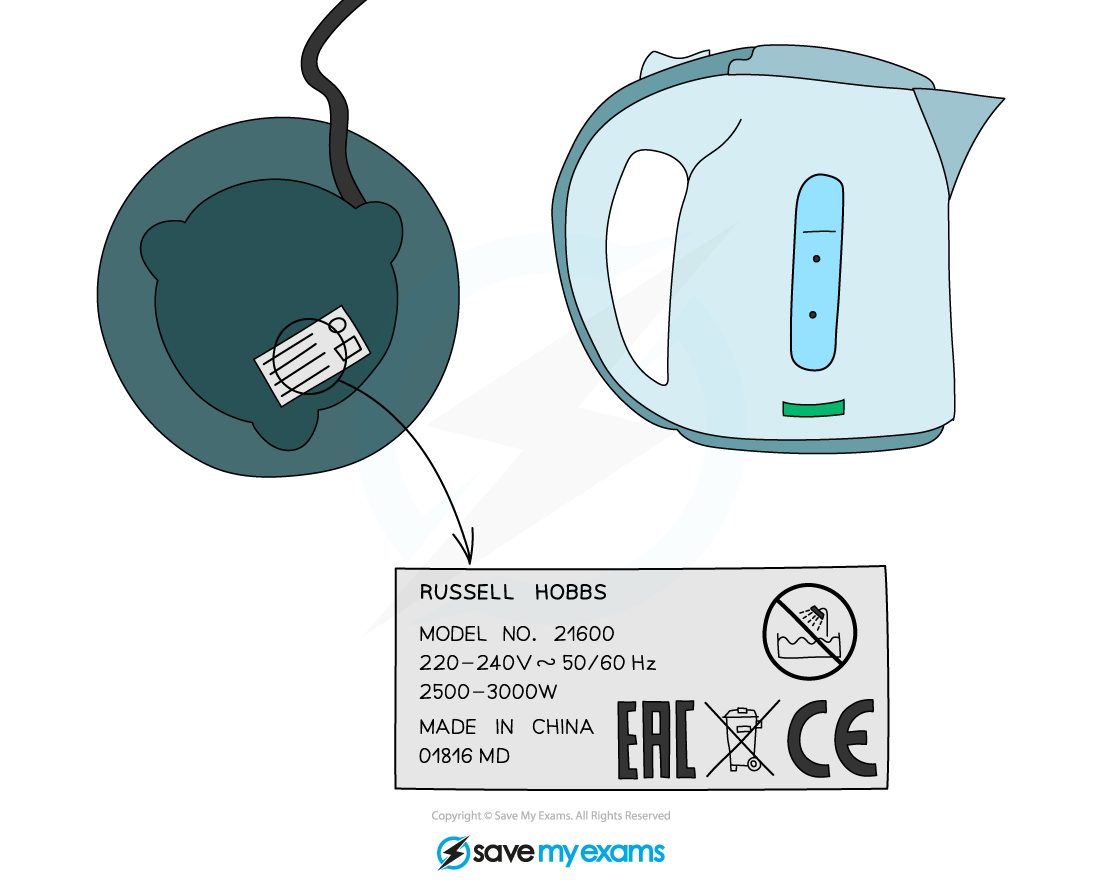
This kettle uses between 2500 and 3000 W of electrical energy
This energy is commonly measured in kilowatt-hour (kW h), which is then used to calculate the cost of energy used
Calculating with kWh
The kilowatt hour can also be defined using an equation:
Where
E = energy (kWh)
P = power (kW)
t = time (h)
This equation is unusual because S.I. unit are not used, both energy and power are × 103, and time is in hours, not seconds
Since the usual unit of energy is joules (J), this is the 1 W in 1 s
Therefore:
Since 1 kW = 1000 W and 1 h = 3600 s
To convert between Joules and kW h:
The kW h is a large unit of energy, and mostly used for energy in homes, businesses, factories and so on