Resistance
Ohm's Lawvideo
Ohm's Law
Resistance is the opposition to current
For a given potential difference, the higher the resistance, the lower the current
Therefore resistors are used in circuits to control the current
The unit of resistance is the ohm, represented by the Greek symbol omega Ω
Ohm's Law
The definition of resistance can be given using the equation
Where
R = resistance (ohms, Ω)
V = potential difference (volts, V)
I = current (amperes, A)
Ohm's Law can be stated in words:
Current is directly proportional to potential difference as long as the temperature remains constant
Equation Triangle for Ohm's Law
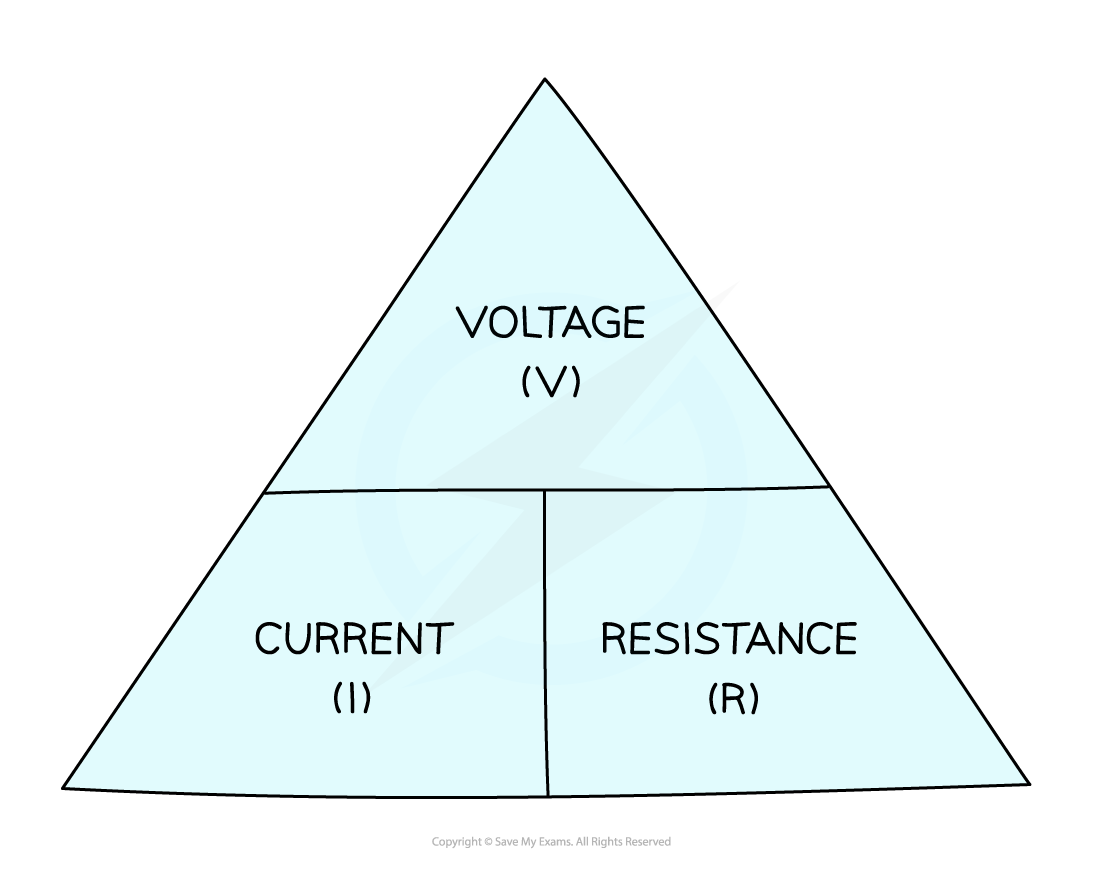
Use the formula triangle to help you rearrange the equation until you feel confident to do it unaided
Consequences of Ohm's Law
Resistors are used in circuits to control either
The current in branches of the circuit (through certain components)
The potential difference across certain components
This is due to the consequences of Ohm's Law
The current in an electrical conductor decreases as its resistance increases (for a constant p.d.)
The p.d. across an electrical conductor increases as its resistance increases (for a constant current)
Determining Resistance
Determining Resistance
Determining Resistance
To find the resistance of a component, we can set up a circuit like the one shown below
Circuit Set-up for Determining Resistance
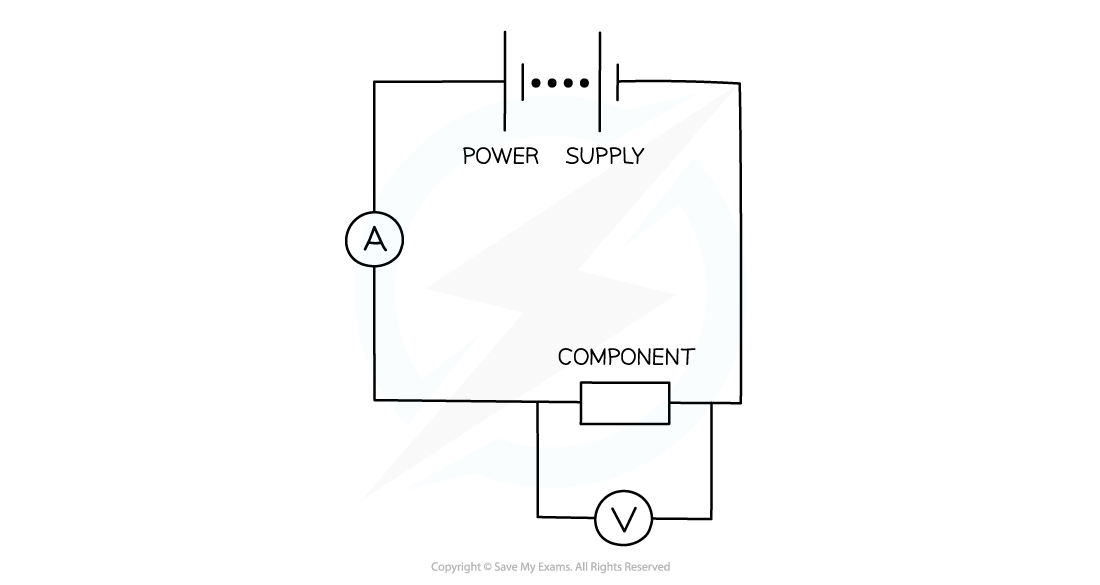
A circuit to determine the resistance of a component includes a power supply, an ammeter connected in series, and a voltmeter connected in parallel to the component being measured
The power supply should be set to a low voltage to avoid heating the component, typically 1-2 V
Measurements of the potential difference and current should then be taken from the voltmeter and ammeter respectively
Finally, these readings should be substituted into the resistance equation