Investigating Conductors & Insulators
Conductors, Insulators & Electrons
Conductors, Insulators & Electrons
The key difference between conductors and insulators is that:
Conductors allow charge carriers to freely move
Insulators do not allow charge carriers to move
The reasons for this are to do with their internal structure
Conductors
A conductor is a material that allows charge (usually electrons) to flow through it easily
Examples of conductors are:
Silver
Copper
Aluminium
Steel
Conductors tend to be metals
Relative Conductivity of Different Materials

Different materials have different properties of conductivity
On the atomic scale, conductors are made up of positively charged metal ions with their outermost electrons delocalised
This means the electrons are free to move
Metals conduct electricity very well because:
Current is the rate of flow of charged particles
So, the more easily electrons are able to flow, the better the conductor
Metallic Bonding and Delocalised Electrons
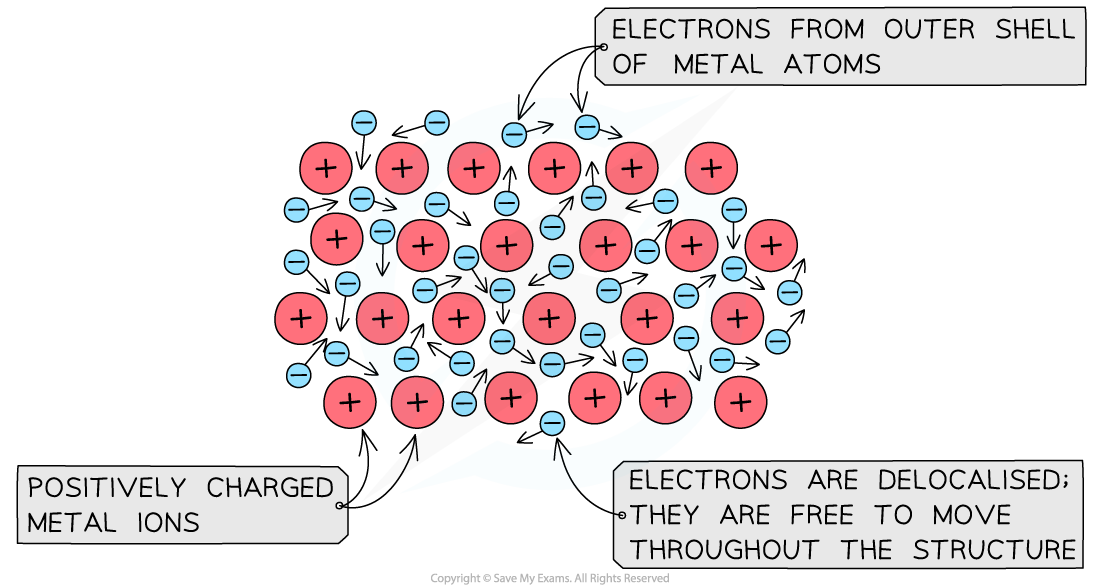
The lattice structure of a conductor with positive metal ions and delocalised electrons
Insulators
An insulator is a material that has no free charges, hence does not allow the flow of charge through them very easily
Examples of insulators are:
Rubber
Plastic
Glass
Wood
Some non-metals, such as wood, allow some charge to pass through them
Although they are not very good at conducting, they do conduct a little in the form of static electricity
For example, two insulators can build up charge on their surfaces. If those surfaces touch, this would allow that charge to be conducted away
Investigating Electrical Conductors & Insulators
Investigating Electrical Conductors & Insulators
The Gold-leaf Electroscope (GLE)
To distinguish between conductors and insulators a Gold-leaf electroscope (GLE) can be used
Gold-Leaf Electroscope
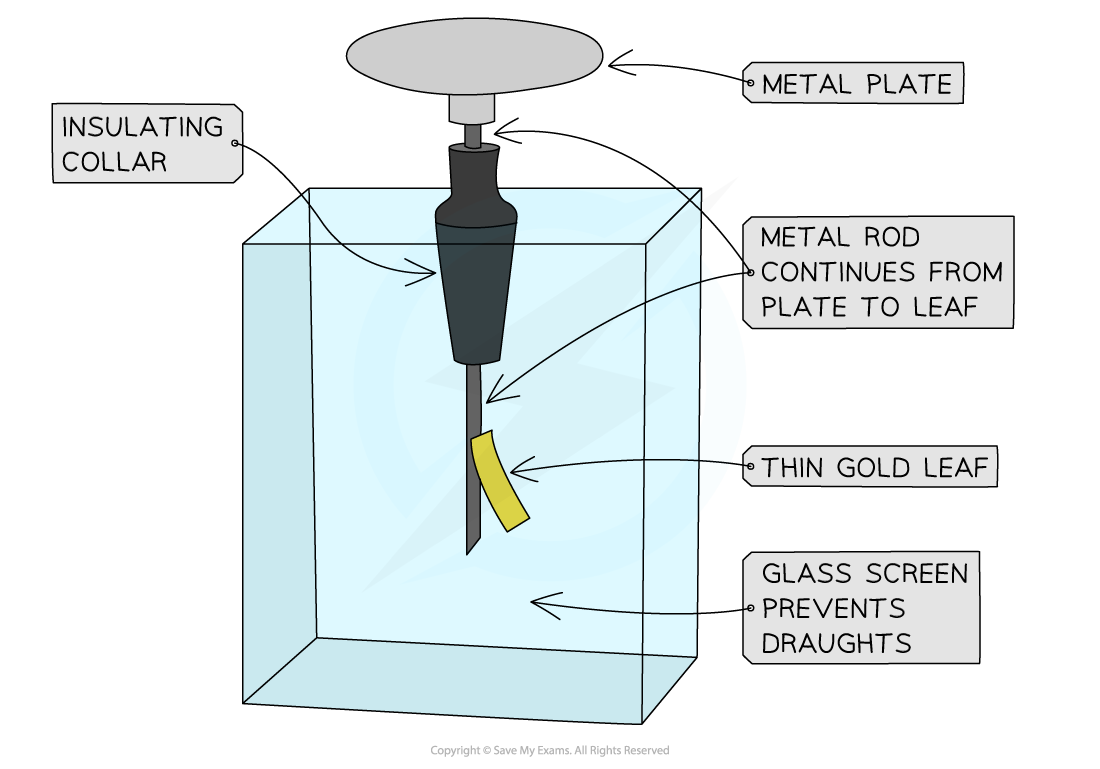
The gold-leaf electroscope is a device used to demonstrate charge
The GLE consists of
A metal plate attached to one end of a metal rod
At the other end of the rod a very thin leaf of gold foil is attached
The rod is held by an insulating collar inside a box with glass sides, allowing the gold leaf to both be seen and protected from draughts
When the GLE is charged, the plate, rod and gold leaf have the same charge (either positive or negative)
Since the rod and leaf have the same charge, they repel, and the leaf sticks out to the side
When the rod and leaf are discharged (are neutral) the leaf hangs down
To Test Electrical Conductors and insulators
Charge the plate of the GLE so that the gold leaf stands clear of the rod
Carefully touch the plate of the GLE with the items being tested, for example:
Metals, such as: wire, paperclip, scissor blades
Non-metals, such as: paper, fingers, glass, graphite
Plastics, such as: plastic ruler, the handles of the scissors, finger in a plastic sandwich bag
Comparisons, such as: wet cloth, dry cloth; finger and finger in a plastic sandwich bag
Record the observations each time
Leaf falls: material is a good conductor
Leaf remains in place: object is a poor conductor (good insulator)
Leaf falls slowly: material is a poor conductor
Alternative method
An electronic charge detector can be used in place of the Gold-leaf Electroscope
Expected Results
Overall, metals are very good conductors whilst non-metals tend to be good insulators
Conductors & Insulators Summary Table
Conductors | Insulators |
|---|---|
Metals | Plastics |
Graphite | Glass |
| Most other non-metals |