Magnetic Effect of a Current
Magnetic Field Around Wires & Solenoids
Magnetic Field Around Wires & Solenoids
When a current flows through a conducting wire a magnetic field is produced around the wire
A conducting wire is any wire that has current flowing through it
The shape and direction of the magnetic field can be investigated using plotting compasses
The compasses would produce a magnetic field lines pattern that would like look the following
Magnetic Field Around a Current-Carrying Wire
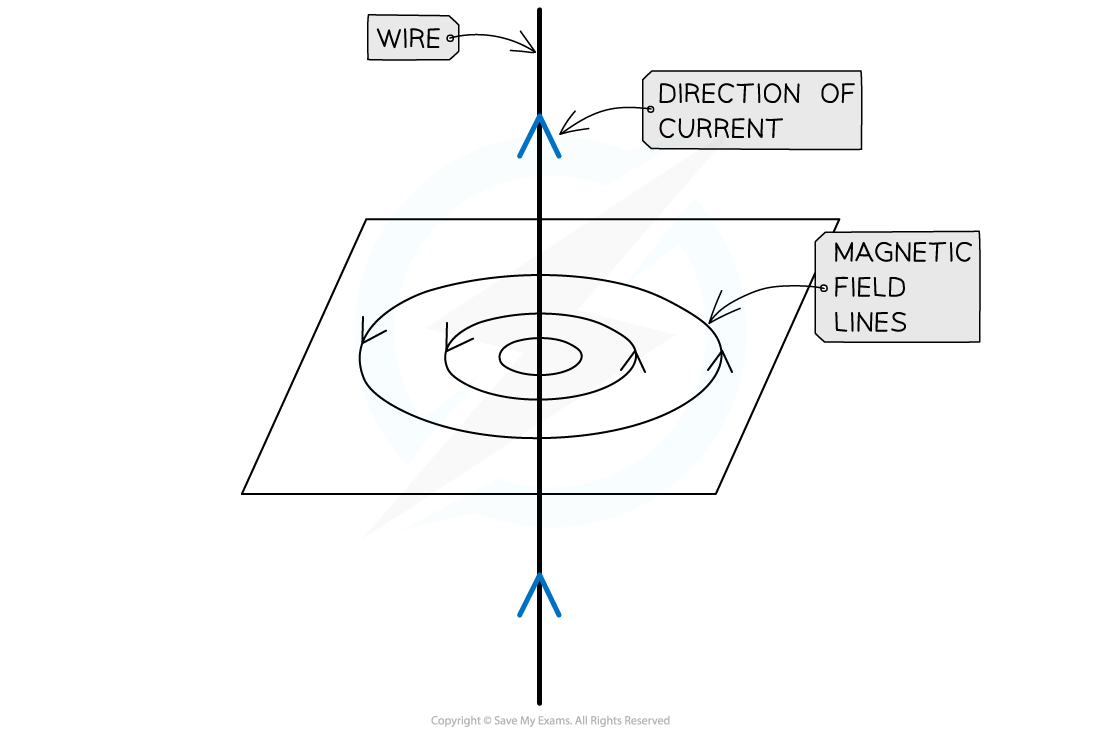
The magnetic field pattern around a current-carrying wire is a series of concentric circles
The magnetic field is made up of concentric circles
A circular field pattern indicates that the magnetic field around a current-carrying wire has no poles
As the distance from the wire increases the circles get further apart
This shows that the magnetic field is strongest closest to the wire and gets weaker as the distance from the wire increases
The right-hand thumb rule can be used to work out the direction of the magnetic field
Right-Hand Thumb Rule
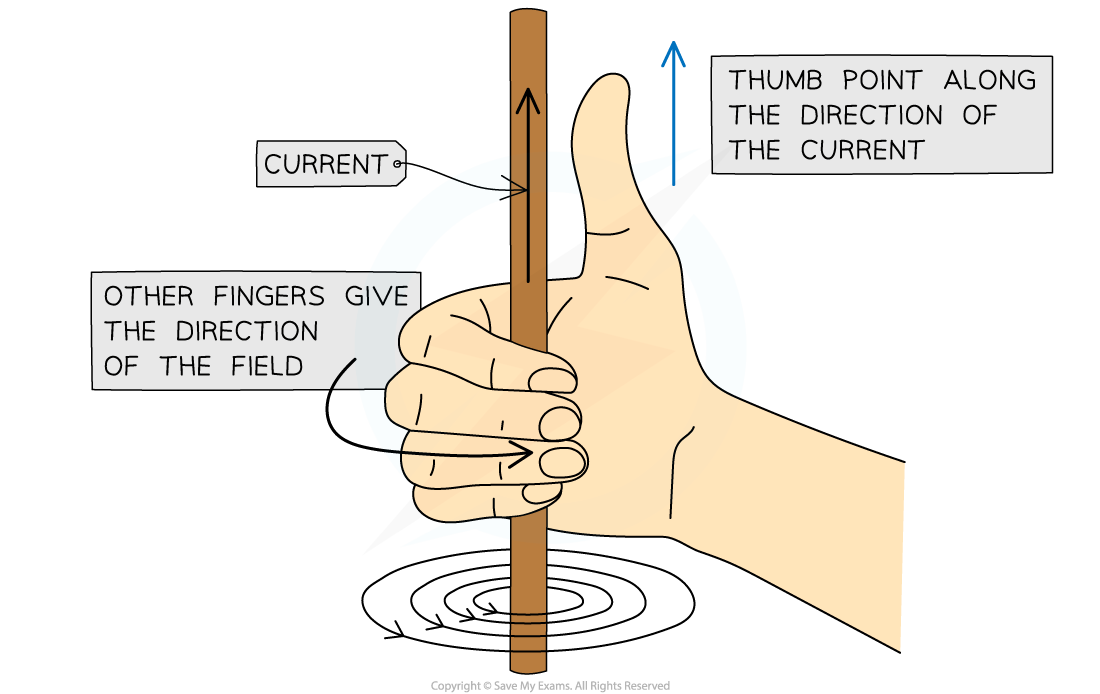
The right-hand thumb rule shows the direction of current flow through a wire and the direction of the magnetic field around the wire
Reversing the direction in which the current flows through the wire will reverse the direction of the magnetic field
Different Views of Magnetic Field Lines Around a Current-Carrying Wire
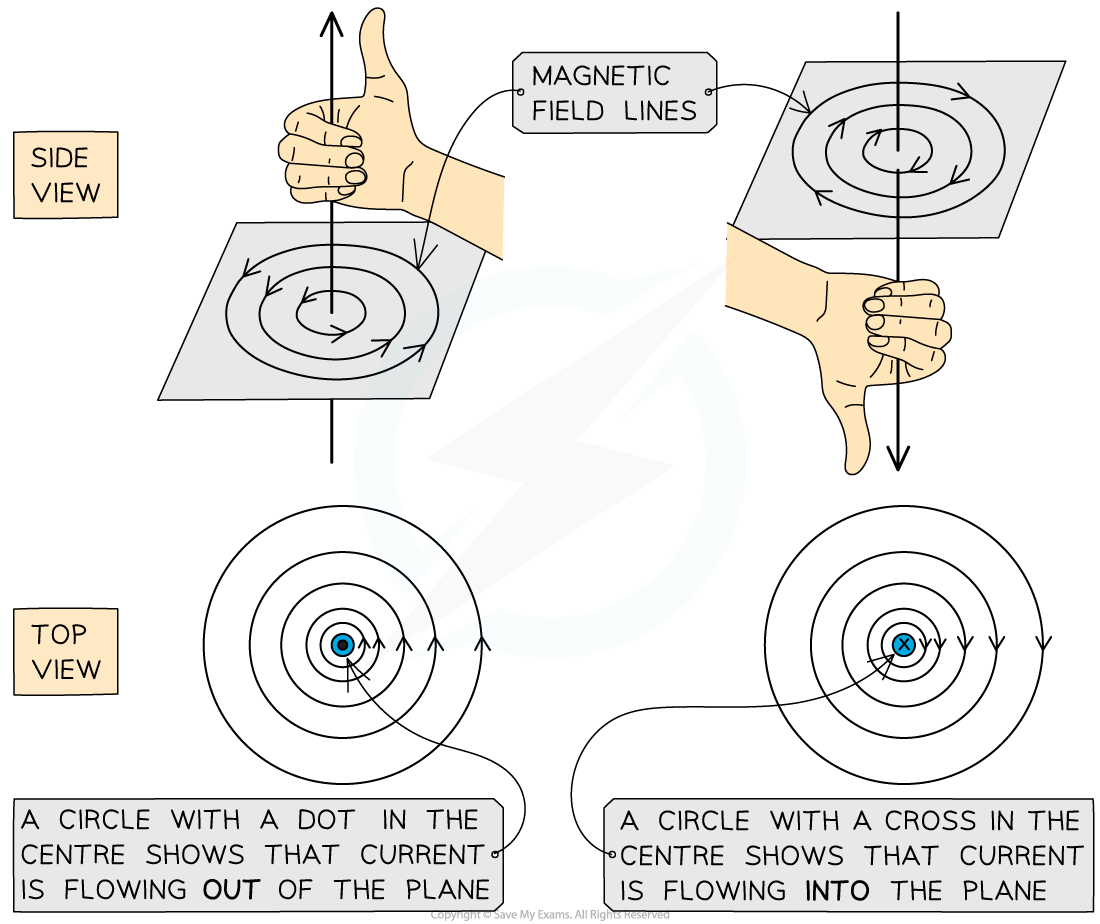
Side and top view of the current flowing through a wire and the magnetic field produced
If there is no current flowing through the conductor there will be no magnetic field
Increasing the amount of current flowing through the wire will increase the strength of the magnetic field
This means the field lines will become closer together
Magnetic Field Around a Solenoid
When a wire is looped into a coil, the magnetic field lines circle around each part of the coil, passing through the centre of it
Field Lines Around Loops of Wire

Diagram showing the magnetic field around a flat circular coil
To increase the strength of the magnetic field around the wire it should be coiled to form a solenoid
The magnetic field around the solenoid is similar to that of a bar magnet
Magnetic Field Produced by a Solenoid
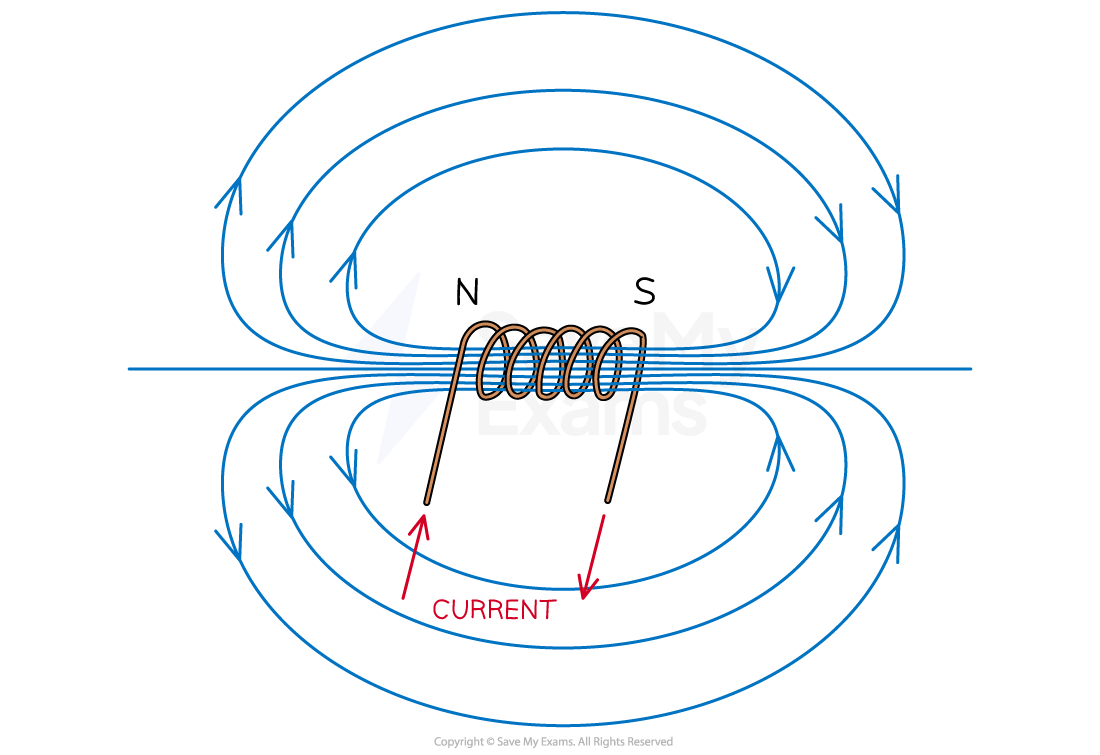
The magnetic field inside the solenoid is strong and uniform
One end of the solenoid behaves like the north pole of a magnet; the other side behaves like the south pole
To work out the polarity of each end of the solenoid it needs to be viewed from the end
If the current is travelling around in a clockwise direction then it is the south pole
If the current is travelling around in an anticlockwise direction then it is the north pole
If the current changes direction then the north and south poles will be reversed
If there is no current flowing through the wire then there will be no magnetic field produced around or through the solenoid
Poles of a Solenoid
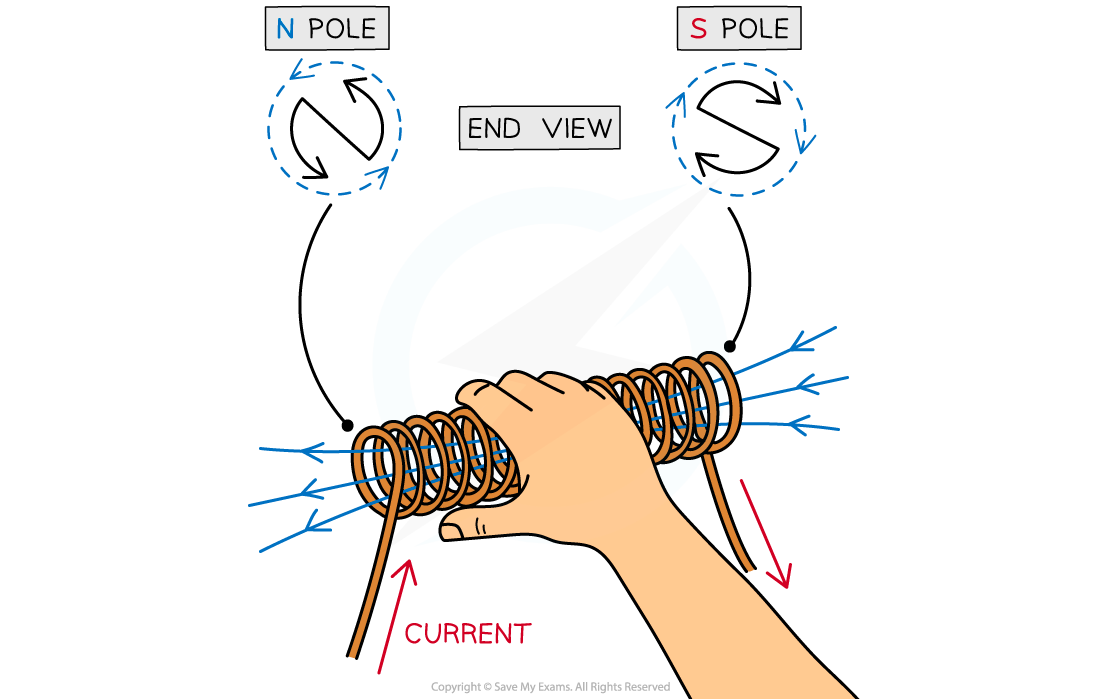
If the current is travelling in a clockwise direction around the end of the solenoid, the induced pole is a south pole and vice versa
A solenoid can be used as an electromagnet by adding a soft iron core
The iron core will become an induced magnet when current is flowing through the coils
The magnetic field produced from the solenoid and the iron core will create a much stronger magnet overall
The magnetic field produced by the electromagnet can be switched on and off
When the current is flowing there will be a magnetic field produced around the electromagnet
When the current is switched off there will be no magnetic field produced around the electromagnet
Structure of Electromagnet
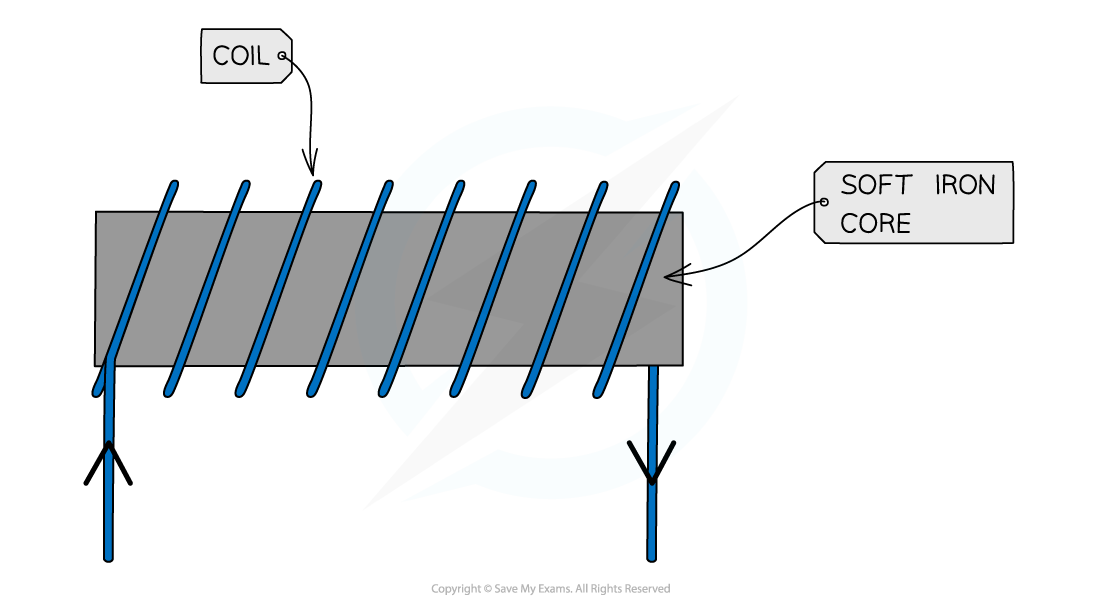
An electromagnet consists of a solenoid wrapped around a soft iron core
Changing the direction of the current also changes the direction of the magnetic field produced by the iron core
Factors Affecting Magnetic Field Strength
The strength of the magnetic field produced around a solenoid can be increased by:
Increasing the size of the current which is flowing through the wire
Increasing the number of coils
Adding an iron core through the centre of the coils
The strength of an electromagnet can be changed by:
Increasing the current will increase the magnetic field produced around the electromagnet
Decreasing the current will decrease the magnetic field produced around the electromagnet
Applications of the Magnetic Effect
Applications of the Magnetic Effect
Electromagnets are used in a wide variety of applications, including:
Relay circuits (utilised in electric bells, electronic locks, scrapyard cranes etc)
Loudspeakers & headphones
Relay Circuits
Electromagnets are commonly used in relay circuits
Relays are switches that open and close via the action of an electromagnet
A relay circuit consists of:
An electrical circuit containing an electromagnet
A second circuit with a switch which is near to the electromagnet in the first circuit
Relay Circuits
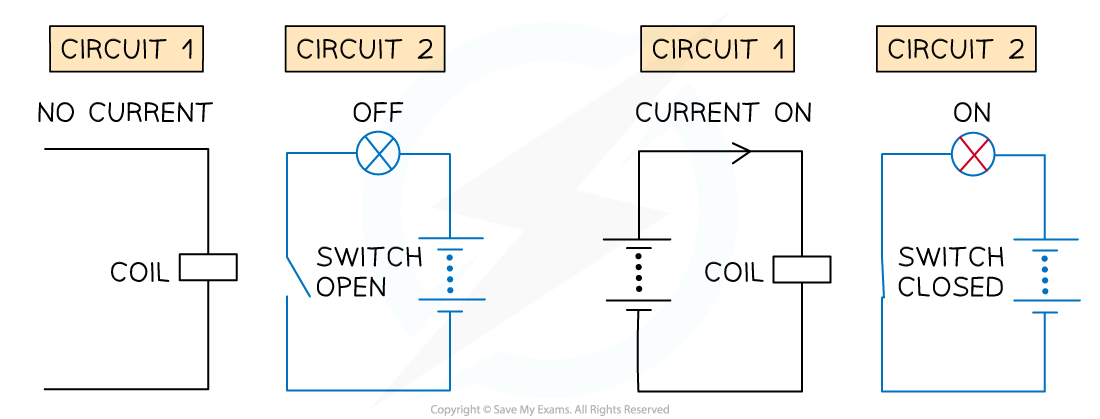
When a current passes through the coil in Circuit 1, it attracts the switch in Circuit 2, closing it enables a current to flow in Circuit 2
When a current flows through Circuit 1, a magnetic field is induced around the coil
The magnetic field attracts the switch, causing it to pivot and close the contacts in Circuit 2
This allows a current to flow in Circuit 2
When no current flows through Circuit 1, the magnetic force stops
The electromagnet stops attracting the switch
The current in Circuit 2 stops flowing
Scrapyard cranes utilise relay circuits to function:
When the electromagnet is switched on it will attract magnetic materials
When the electromagnet is switched off it will drop the magnetic materials
Electric bells also utilise relay circuits to function
Electric Bell
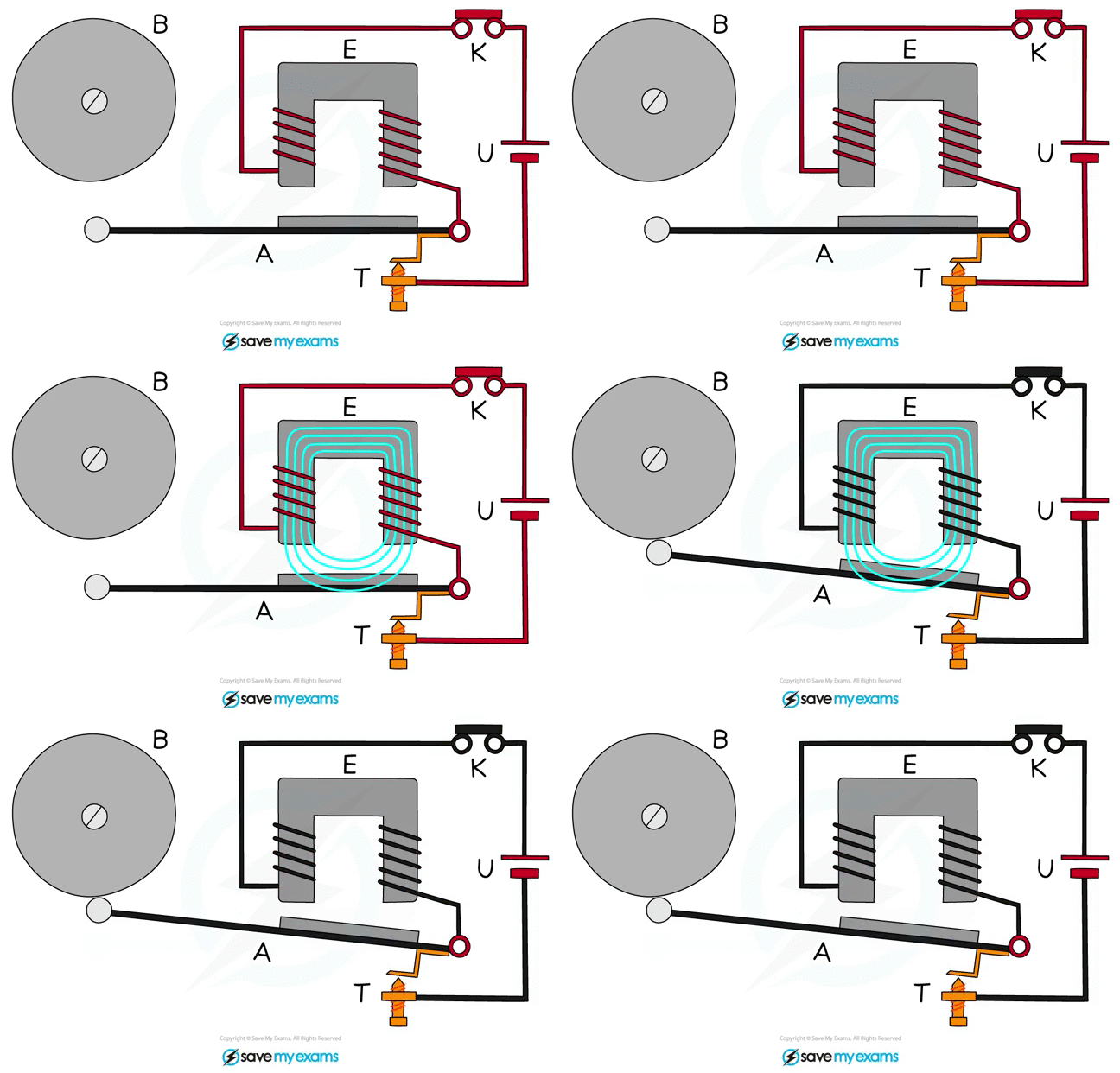
Animation: Electric bells utilise relay circuits. As the current alternates, the metal arm strikes the bell and drops repeatedly to produce the ringing effect
When the button K is pressed:
A current passes through the electromagnet E creating a magnetic field
This attracted the iron armature A, causing the hammer to strike the bell B
The movement of the armature breaks the circuit at T
This stops the current, destroying the magnetic field and so the armature returns to its previous position
This re-establishes the circuit, and the whole process starts again
Loudspeakers & Headphones
Loudspeakers and headphones convert electrical signals into sound
They work due to the motor effect
A loudspeaker consists of a coil of wire which is wrapped around one pole of a permanent magnet
Loud Speaker
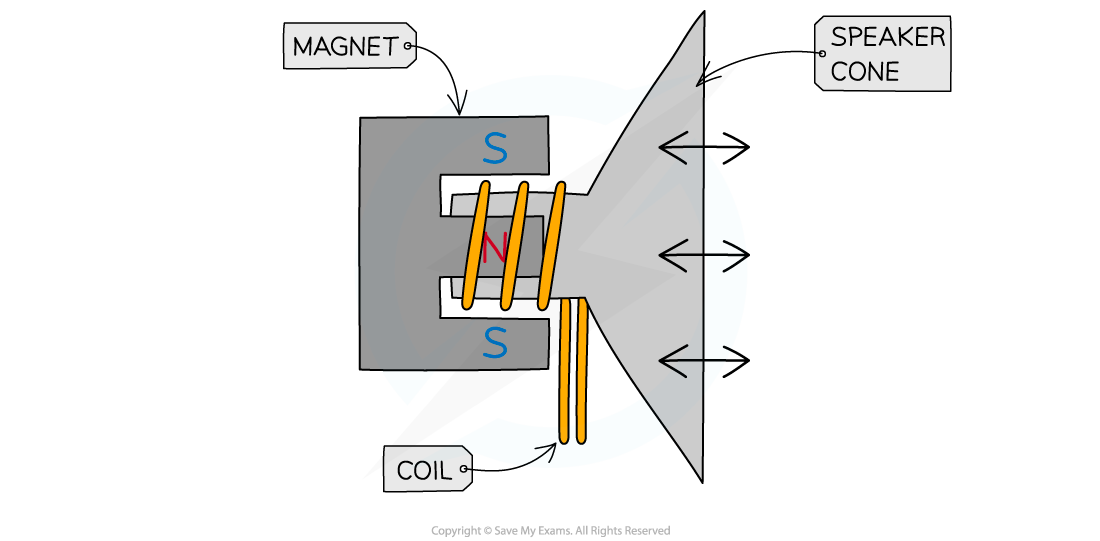
Diagram showing a cross-section of a loudspeaker
An alternating current passes through the coil of the loudspeaker
This creates a changing magnetic field around the coil
As the current is constantly changing direction, the direction of the magnetic field will be constantly changing
The magnetic field produced around the coil interacts with the field from the permanent magnet
The interacting magnetic fields will exert a force on the coil
The direction of the force at any instant can be determined using Fleming’s left-hand rule
As the magnetic field is constantly changing direction, the force exerted on the coil will constantly change direction
This makes the coil oscillate
The oscillating coil causes the speaker cone to oscillate
This makes the air oscillate, creating sound waves