Force on a Current-Carrying Conductor
Force on a Current-Carrying Conductor
Force on a Current-Carrying Conductor
A current-carrying conductor produces its own magnetic field
When interacting with an external magnetic field, it therefore will experience a force
A current-carrying conductor will only experience a force if the current through it is perpendicular to the direction of the magnetic field lines
A simple situation would be a copper rod placed within a uniform magnetic field
When current is passed through the copper rod, it experiences a force which makes it move
Force on a Current-Carrying Copper Rod in a Magnetic Field
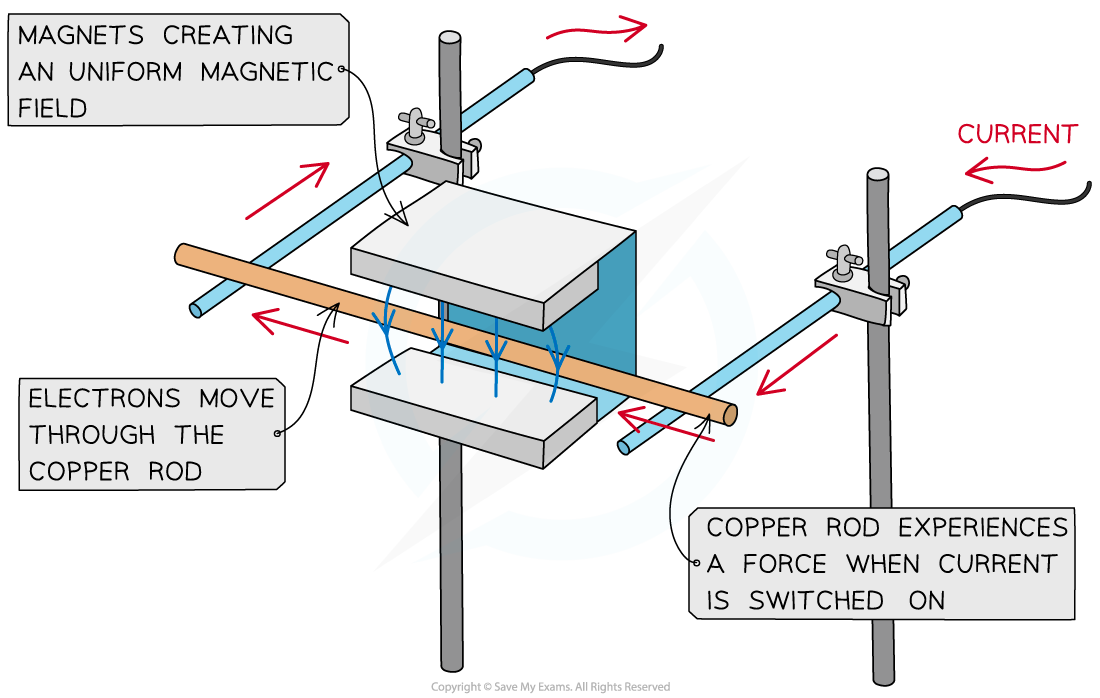
A copper rod moves within a magnetic field when current is passed through it
Two ways to reverse the direction of the force (and therefore, the copper rod) are by reversing:
The direction of the current
The direction of the magnetic field
Left Hand Rule
Left Hand Rule
The direction of the force (aka the thrust) on a current carrying wire depends on the direction of the current and the direction of the magnetic field
All three will be perpendicular to each other
This means that sometimes the force could appear to be acting either into or out of the page
The direction of the force (or thrust) can be worked out by using Fleming's left-hand rule:
Fleming's Left-Hand Rule
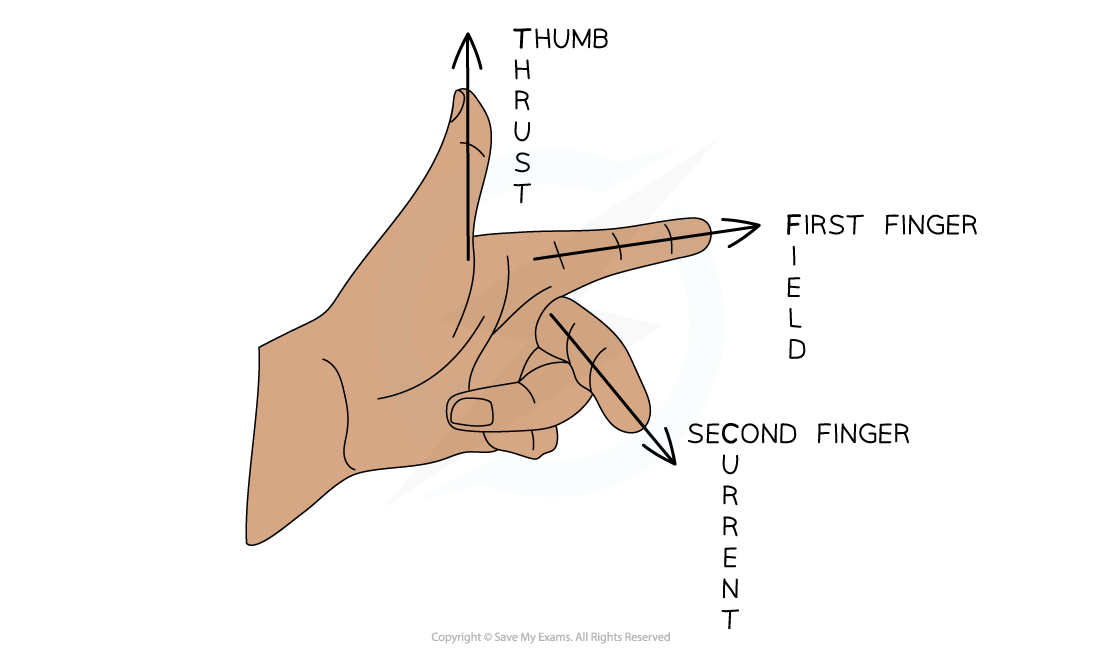
Fleming's left-hand rule can be used to determine directions of the force (thumb), magnetic field (first finger) and current (second finger)