Secondary Market Research
Secondary Market Research
Secondary market research
Secondary research involves the collection, compilation, and analysis of data that already exists
Businesses must weigh up the reliability of secondary market research and aspects such as cost, relevance and availability of data when making a decision on which secondary data to use
Sources of secondary market research
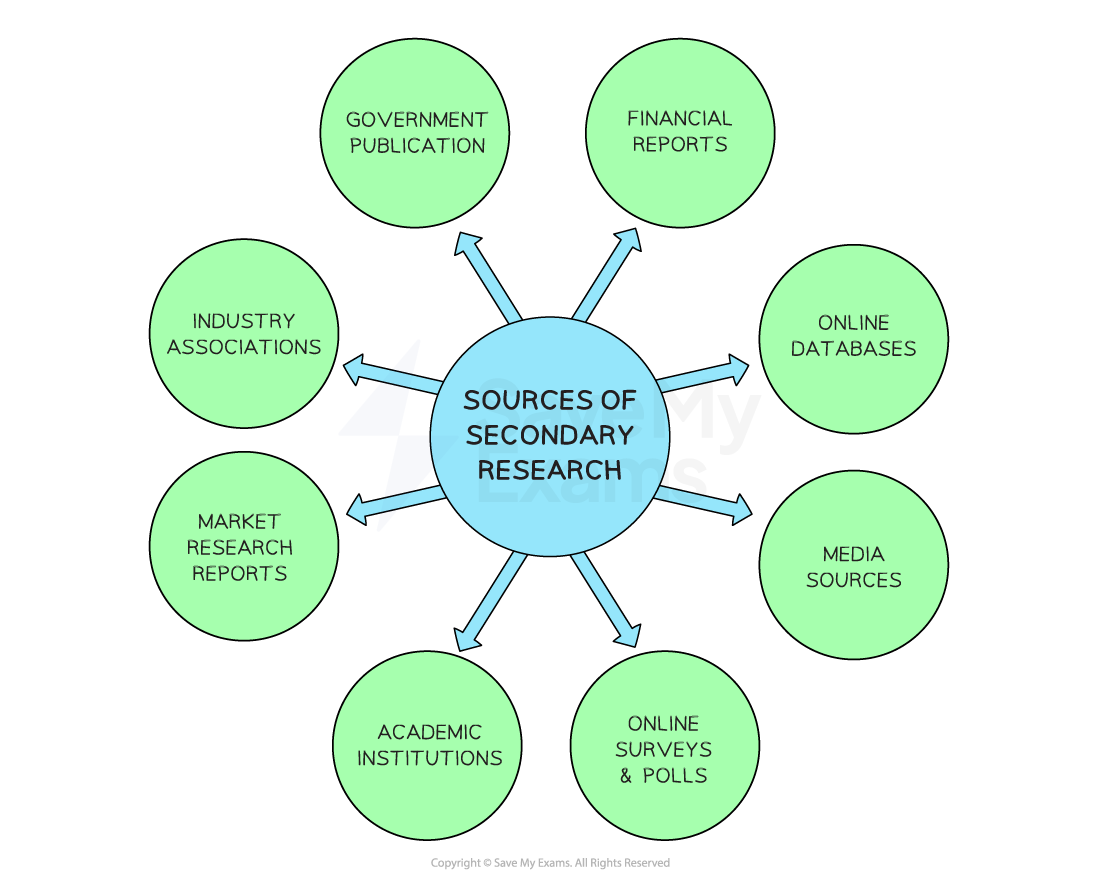
Government Publications: National governments and trading blocs such as the EU publish reports and statistics on topics such as the economy, demographics, industry trends and consumer behaviour
Academic Institutions: Universities and research institutions conduct studies and publish research papers which provide valuable insights and data on specific industries, consumer behaviour and market trends
E.g., Stanford University is a globally significant research centre for engineering and medicine
Industry Associations: Trade associations and industry-specific organisations provide detailed information about specific sectors, including market size, growth rates and industry benchmarks
E.g., The International Organisation of Motor Vehicle Manufacturers conducts and collates research on production and sales statistics
Specialist Market Research Reports: Companies specialising in market research produce and sell in-depth reports on various industries, markets and consumer trends
E.g., Mintel is one of the leading private companies supplying market research information
Financial Reports: Public limited companies are required to publish annual reports which can provide valuable information about a company's performance, market position and future plans
Online Databases: There are various online databases and research platforms that provide access to a wide range of secondary market research
E.g. Statista and Euromonitor International make a large volume of data on international commerce available
Media Sources: Newspapers, magazines and online publications often contain articles, opinion pieces and investigative reports that can offer insights into market trends, consumer behaviour and industry developments
E.g. The Financial Times and the Wall Street Journal
Evaluating the use of secondary market research
Advantages | Disadvantages |
|---|---|
|
|
The Accuracy of Market Research Data
The accuracy of market research data
The reliability and accuracy of market research depend upon a large number of factors, including
How questions are phrased in questionnaires or other tools used to conduct surveys
Questions should be written in such a way that they do not elicit a particular response
How carefully the sample is selected
Including its size, types of respondent chosen and how closely these reflect the intended target market
Who conducts the research including their experience, research skills and source (primary or secondary?)
Potential for Bias when conducting research or analysing results
The research and its analysis should be as objective as possible
When and where the research is conducted
Customer tastes, fashions, economic conditions and technology change, giving data a relatively short period of usefulness
Customers in different geographic areas can have very different opinions