Price: Types of Pricing Methods
Types of Pricing Strategies
Types of pricing strategies
Choosing the right pricing strategy is essential for a business to be profitable, competitive, and successful in the long run
By understanding their customers, competitors and costs, businesses can set prices that maximise sales revenue and profits
Pricing can play a significant role in the market positioning of the brand and help a firm to compete with rivals
The main pricing strategies
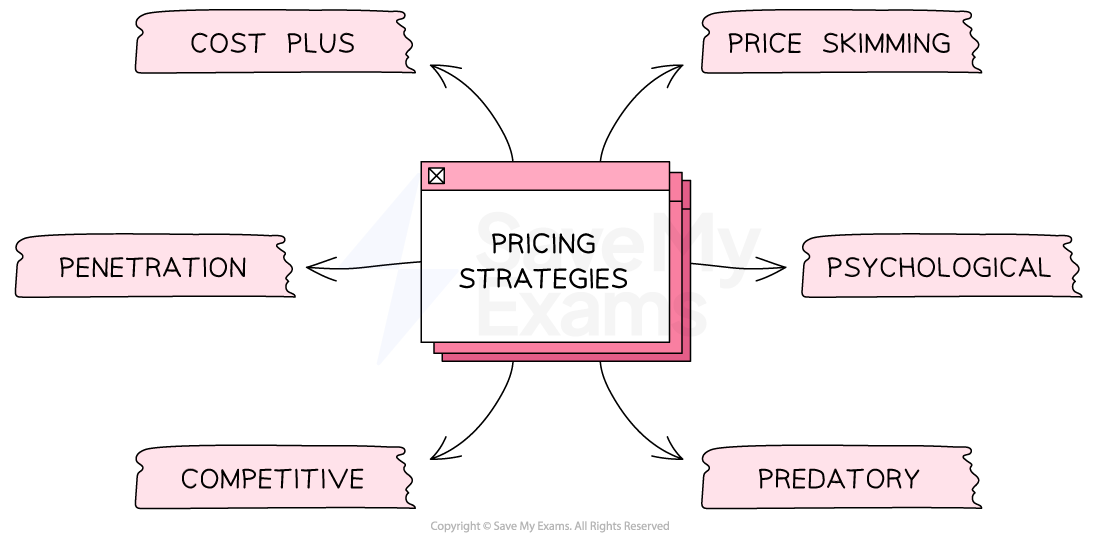
1. Cost plus pricing
The business calculates the cost of production and then adds a markup to determine the final price
The markup covers the cost of production plus the business's desired profit margin
This pricing strategy is simple and is commonly used by manufacturers that produce standardised goods, e.g., washing machines
Advantages | Disadvantages |
|---|---|
|
|
2. Price skimming
The business sets a high price for a new product or service when it is first introduced to the market
The business will then gradually lower the price to ensure sales continue
Advantages | Disadvantages |
|---|---|
|
|
3. Penetration pricing
The business sets a low price for a new product or service when it is first introduced
This is effective when a business wants to quickly capture market share and attract price-sensitive customers, e.g., many new perfumes launch using penetration pricing
Once they have enough customers, the business will start to raise the price
Advantages | Disadvantages |
|---|---|
|
|
4. Predatory pricing
The business sets prices so low that it drives its competitors out of the market
This strategy is illegal in many countries as it is considered anti-competitive and harms customers by reducing choice in the market
Advantages | Disadvantages |
|---|---|
|
|
5. Competitive pricing
The business sets its prices based on its competitors' prices
Advantages | Disadvantages |
|---|---|
|
|
6. Promotional pricing
This pricing strategy takes into account the customer's emotions, and compulsive behaviours in responding to price promotions
E.g., a business may have a Bogof offer - buy one, get one free
Generates higher volumes of sales for many products, but lowers the profit per item
7. Premium pricing
The business sets a high price for its product, which gives customers an impression of high quality and luxury
This is effective for designer brands such as Chanel and Ritz Carlton Hotels
Premium pricing should not be confused with price skimming, where a high price is set for a short period at a product's launch
Advantages | Disadvantages |
|---|---|
|
|
Recommending an Appropriate Pricing Strategy
Recommending an appropriate pricing strategy
A business needs to make informed decisions about its pricing and increase its chances of success
It should carefully consider a range of factors when deciding on an appropriate pricing strategy
Factors to consider
1. Number of USPs or the amount of differentiation
Products with many USPs and high differentiation can command higher prices
E.g Dyson vacuum cleaners have unique features which allow the company to charge a premium price
2. Technology
The use of online platforms and development of new markets has created new pricing strategies
E.g. Candy Crush Saga uses a freemium strategy where the initial game is free of charge after which users
have to pay for additional featuresCharging for these features generates a very high
profit margin
3. Level of competition
In highly competitive markets businesses may need to set their prices low to remain competitive
E.g. The budget airline industry is highly competitive and airlines keep their prices low so as to increase demand
In less competitive markets, businesses may be able to set higher prices
4. Strength of the brand
A strong brand with a loyal customer base can command higher prices
E.g. Nike's strong brand allows it to charge premium prices for its athletic shoes and apparel
5. Stage in the product life cycle
In the introduction stage, prices may be set lower to attract customers and build market share
In the growth stage, prices can increase as demand for the product increases
In the maturity stage, prices may need to be lowered again
6. Costs and the need to make a profit
Prices must cover the cost of production and provide a reasonable profit margin
E.g. A restaurant needs to consider the cost of ingredients, labour, rent, and other expenses when setting menu prices
The strategy requires monitoring
Retailers may need to adjust their pricing strategies to remain competitive in an online marketplace where customers can easily compare prices e.g www.comparethemarket.com
Pricing has changed to reflect the rise of price comparison through the use of price matching policies
Retailers now offer to match the prices of their competitors in order to prevent customers from switching to a competitor with a lower price